

Truity Career Test Review (2026):
What It Shows and What It Misses

Truity's Career Personality Profiler is a credible starting point for career exploration. The 94-question test combines Holland-style vocational interests with Big Five personality traits, takes about 10 to 15 minutes, and shows a useful basic result without requiring an email address.[1]
The free result is more substantial than many reviews suggest. In our hands-on test, it explained four work-style patterns, described all six interest areas, interpreted the highest interest area, and showed 11 career cards with earnings and growth figures before asking for payment. The optional full report cost $29 at the checkout we viewed on July 28, 2026. Prices can change, so check the live checkout before buying.
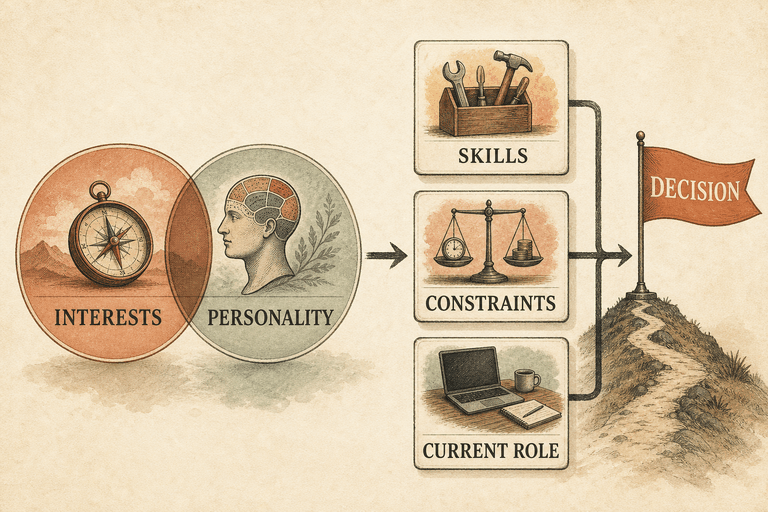
The main limitation is equally clear. Despite the "career aptitude test" label, the assessment we completed did not test ability. It asked what activities you like and how accurately personality statements describe you. That can generate useful career hypotheses, but it cannot tell you whether a transition is affordable, whether you have the required skills, or whether dissatisfaction comes from your occupation, employer, manager, workload, or burnout.
Quick verdict
Truity is worth using when you want broad, low-friction career ideas grounded in recognizable interest and personality models. The free result is useful enough to evaluate the approach before paying.
It is less suitable as a stand-alone decision tool for an experienced worker asking a constrained question such as, "Should I change careers, change employers, or repair my current role?"
| Question | Practical answer |
|---|---|
| Is the test free? | The 94-question assessment and basic result are free, with no email required.[1] |
| How long does it take? | Truity estimates 10 to 15 minutes. Our uninterrupted walkthrough fit that range.[1] |
| What does it measure? | Self-reported vocational interests and Big Five personality traits. |
| Is it an ability test? | No ability, knowledge, numerical, verbal, or work-sample task appeared in the assessment we completed. |
| What does the free result include? | A work-style summary, interest overview, a deeper explanation of the top interest, and a sample of career recommendations. |
| How much is the full report? | Our anonymous consumer checkout showed $29 on July 28, 2026. Truity separately advertises business purchases from $9 per test.[3] |
| Best for | Students, early explorers, and adults who want new career ideas. |
| Less useful for | Current-role diagnosis, transition feasibility, skills-gap analysis, or a high-stakes decision by itself. |
How we reviewed Truity
CareerMeasure publishes this review and competes in the career-assessment category. We have no affiliate relationship with Truity, and Truity did not review or pay for this article.
To make the review reproducible, we used four evidence layers:
- Anonymous walkthrough: We completed the public Career Personality Profiler on July 28, 2026 without signing in.
- Controlled response pattern: We answered with a consistent synthetic profile that favored creative, investigative, social, and enterprising work. This avoided presenting one reviewer's personal result as proof of accuracy.
- Free-to-paid boundary: We inspected the full free result and the consumer upgrade page, but did not purchase the report or enter an email address.
- Document review: We reviewed Truity's public 37-page sample report, product pages, and research claims, then compared those claims with independent vocational-interest and career-guidance research.[2]
This method supports a detailed review of the questions, result structure, product boundary, and decision usefulness. It does not independently validate Truity's scoring algorithm, confirm test-retest reliability, or evaluate whether a paid report accurately describes every user.
What the Career Personality Profiler actually measures
The assessment has five steps and 94 questions.[1] In our walkthrough, the structure was easy to understand:
- The first 54 items asked how much we would like specific activities, such as writing a script, analyzing samples, leading a team, repairing equipment, or organizing financial information.
- The final 40 items asked how accurately statements or adjectives described the respondent, including measures related to imagination, organization, sociability, agreeableness, and emotional sensitivity.
The interest items map onto six Holland-style areas. Truity gives them plain-language labels:
- Building
- Thinking
- Creating
- Helping
- Persuading
- Organizing
These correspond to the Realistic, Investigative, Artistic, Social, Enterprising, and Conventional structure commonly called RIASEC. Holland's model is not an obscure internet typology. The O*NET Interest Profiler uses the same six-domain foundation, and its technical manual summarizes more than 20 years of reliability, validity, scoring, and occupation-linkage research.[5]
The personality section uses the Big Five. Truity says it combines those traits with the interest profile to generate work-style descriptions and career matches.[1] Combining the two domains is sensible because vocational interests and personality overlap but still provide different information.[6]
Why "aptitude test" is an imprecise label
Truity markets the product as both a Career Personality Profiler and a career aptitude test. In everyday search language, that may help people find it. In measurement terms, it can create the wrong expectation.
An aptitude test normally samples what someone can do or learn, often through reasoning, knowledge, spatial, verbal, numerical, or task-based items. This assessment asked about preferences and self-descriptions. It did not ask us to solve a problem, demonstrate a skill, upload experience, or prove competence.
That does not make the assessment useless. Interests and traits matter. It means the result should be interpreted as career-interest and personality guidance, not evidence that you are capable of entering or succeeding in every recommended occupation.
What you get for free
The free experience has two genuine advantages: no registration gate before the result, and enough output to decide whether Truity's model feels useful.[1]
Our synthetic result contained three main sections.
1. A work-style overview
The result introduced four broad work styles:
- Humanitarian
- Caretaker
- Innovator
- Pragmatist
It showed how the profile leaned across those styles and gave short descriptions. More detailed sections about motivation, communication, teamwork, and other work patterns were reserved for the full report.
2. A career-interest profile
The free report explained all six interest areas and showed the result's relative pattern. It then expanded the highest interest area with:
- a narrative interpretation
- four example job tasks
- four core values
- four associated personality traits
For our deliberately creative synthetic profile, "Creating" ranked first. The description and supporting task list were consistent with the answers we supplied. That is evidence that the visible output followed the response pattern. It is not independent evidence that the underlying scores predict long-term satisfaction.
3. A sample of career recommendations
Our result displayed 11 career cards before the paid boundary. Each card included a short occupation description, an average-earnings figure, a projected-growth figure, and a link to a longer career profile.
The list was directionally coherent with the synthetic answers. It included roles such as art director, writer or author, editor, graphic designer, and special-effects artist. It also showed one weakness of broad interest matching: some recommendations may fit the theme while being unrealistic for a particular person's training, portfolio, location, finances, or desired transition time.
Truity handles this better than products that present a match as destiny. Its sample report explicitly tells readers that recommendations are starting points, that list order is not a definitive ranking, and that users still need real-world research such as reading, interviewing, or shadowing people in a field.[2]
What the $29 full report adds
The consumer upgrade page we reached after the free result showed a $29 one-time total and described a downloadable report of more than 10 pages. It also displayed a 60-day money-back guarantee. Those details were observed on July 28, 2026 and may change.
Truity's public sample report was 37 pages when we reviewed it. It showed the type of depth a buyer can expect, including:
- a fuller work-style and personality interpretation
- strengths and potential challenges
- a complete interest profile
- primary and secondary interest explanations
- more detailed career matches
- education, research, networking, job-search, and career-planning guidance[2]
That makes the paid report materially larger than the free result. It is not only a longer list of jobs.
Whether it is worth $29 depends on your next action. If the free result gives you several plausible directions and you want one organized document for reflection, the price is reasonable. If you already know your interests and need local salary data, transferable-skills analysis, credential requirements, or a realistic sequence from your current job, the extra narrative may not solve the actual problem.
Do not confuse consumer and organizational pricing. Truity's business-facing Career Personality Profiler page advertises purchases from $9 per test and a 10-plus-page report. That is a separate volume or workplace context, not the anonymous consumer checkout price we observed.[3]
What Truity does well
The test is easy to complete
Each screen uses the same five-point response pattern, progress is clear, and the instructions separate interest from skill. The site asks whether you would enjoy an activity, not whether you are trained to perform it. That is appropriate for an interest inventory.
There is one practical catch. Truity says anonymous progress is not saved, so users who do not create an account need to finish in one session.[1]
The free result has real utility
Many assessment funnels hide every useful insight behind an email or payment wall. Truity lets users see the basic report and career sample first. This lowers purchase risk and makes the product easier to evaluate honestly.
The underlying frameworks are defensible
RIASEC interests and Big Five traits are established research domains. A large meta-analysis found that interest fit had a positive but modest relationship with overall job satisfaction, with stronger relationships for some career-focused satisfaction measures.[7] Personality can also contribute to work-performance prediction, although its usefulness changes with the demands and strength of the situation.[8]
The important conclusion is measured: these signals deserve a place in career exploration, but neither one is a complete career decision.
The report includes appropriate cautions
The sample report repeatedly frames career matches as ideas to research rather than instructions to obey.[2] That is good practice. A career tool should expand and organize options without pretending to know the user's entire life.
Where Truity falls short
Product-level psychometric detail is limited on the page
Truity's product page says the Career Personality Profiler was validated with a large global sample and has excellent reliability.[3] The page we reviewed did not provide the sample size, coefficient tables, validity criteria, subgroup results, scoring method, or a linked technical manual specific to this instrument.
The Big Five and Holland frameworks have strong research histories. That does not automatically validate every commercial implementation, item set, scoring rule, or career-matching algorithm. A demanding buyer should distinguish evidence for the underlying models from evidence for this exact product.
It cannot diagnose a current-role problem
The assessment did not ask about our current occupation, manager, employer, workload, autonomy, compensation, schedule, health, or recent life events. It therefore cannot separate:
- a poor occupation fit from a poor employer fit
- chronic overload from a deeper interest mismatch
- a difficult manager from an unsuitable role family
- a trainable weakness from a structural mismatch
This matters most for mid-career adults. The OECD's review of adult career guidance emphasizes individualized needs, current labor-market information, and a personalized development roadmap. It also cautions that observed outcomes cannot be attributed to guidance without a credible counterfactual.[9]
It does not evaluate transition feasibility
A recommended career can fit your interest profile while remaining a bad next move. The test did not evaluate:
- existing skills and evidence of competence
- transferable skills from the current role
- licensing or education barriers
- time and money available for retraining
- local demand and compensation
- family, visa, health, or schedule constraints
- the risk of starting over
The career cards are useful discovery prompts. They are not transition plans.
Broad categories can produce plausible but noisy matches
Our synthetic profile intentionally favored writing, design, investigation, helping, and leadership. The recommendations followed that pattern, but they still ranged across occupations with very different preparation requirements and daily realities.
That is normal for an interest-led result. The risk appears when a user treats thematic coherence as precision. "Creative" can describe a writer, architect, art director, actor, or designer, yet the route into each occupation is completely different.
Career Personality Profiler or TypeFinder for Career Planning?
Truity offers more than one career test, so choosing the right instrument matters.
For most users seeking career guidance, start with the Career Personality Profiler. It combines Big Five traits with Holland-style interests, directly samples preferred work activities, and is more aligned with career exploration than a type-first product.
Choose TypeFinder for Career Planning if your main interest is the Myers and Briggs 16-type lens. Truity says that test has 110 questions, may add clarifying items, takes about 15 minutes, and combines type preferences with career interests. It is Truity's own TypeFinder assessment, not the official MBTI instrument.[4]
| If your main question is... | Better Truity starting point |
|---|---|
| What work activities and environments might suit me? | Career Personality Profiler |
| Which careers fit my interests and broad traits? | Career Personality Profiler |
| How might my 16-type preferences affect work? | TypeFinder for Career Planning |
| Is my current job problem burnout, employer fit, or occupation fit? | Neither test can answer this alone |
| What is my most realistic next move from my current role? | Use the result as one input, then add skills, constraints, and labor-market research |
If you are comparing Truity with other platforms rather than choosing between its tests, our separate CareerMeasure vs CareerExplorer vs Truity comparison covers that broader intent.
Who should use it, and what should you do next?
Truity is a good starting point for:
- students who need a wider map of possible careers
- early-career users who have not yet named their work interests
- adults who want fresh ideas without creating an account
- people who prefer familiar personality and interest language
- career-coaching conversations where the result will be interpreted, challenged, and combined with other evidence
Use it cautiously if you are making an expensive or irreversible decision, already understand your interests, or need to compare realistic moves from an established career.
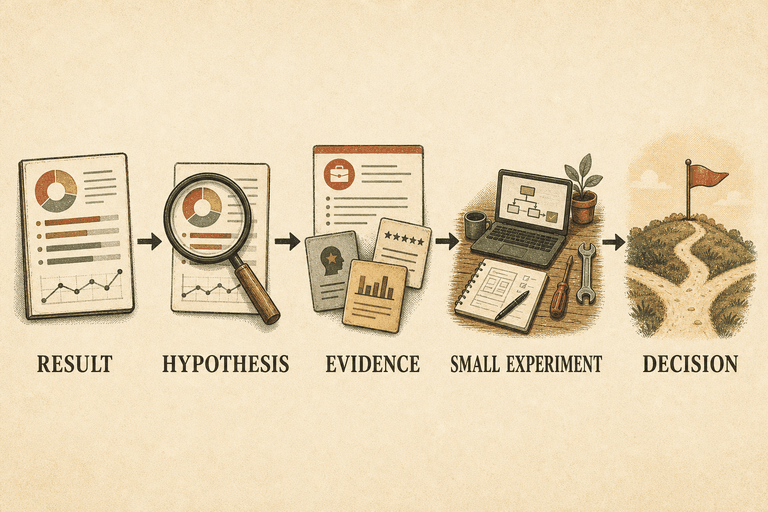
After taking the test, use this sequence:
- Keep three to five hypotheses. Do not treat the first recommendation as a verdict.
- Inspect the daily work. Read current job postings and authoritative occupation profiles, not only inspirational descriptions.
- Check entry barriers. Record required skills, credentials, portfolio evidence, location, pay, and transition time.
- Compare against your current role. Identify whether the real friction comes from tasks, environment, motivation, management, or workload.
- Run a small experiment. Interview someone in the field, complete a realistic work sample, volunteer, shadow, or take a short project before committing.
For a deeper evaluation framework, use our career-assessment credibility checklist. If you are already employed and considering a move, the career-changer test guide explains which additional evidence matters. CareerMeasure's public methodology documents how our own assessment approaches interests, motivations, strengths, and occupational matching.

Final verdict
Truity's Career Personality Profiler is one of the better low-friction entry points in the consumer career-test market. The assessment is clear, the free result is genuinely useful, and the combination of vocational interests with Big Five traits is more defensible than a type label alone.
The honest limitation is scope. It is an interest-and-personality assessment with career recommendations, not a demonstrated aptitude test, current-role diagnostic, or transition-feasibility model. Its matches can help you decide what to investigate. They cannot decide what you should do.
Take the free test if you want structured career ideas. Consider the paid report if you value a longer, organized interpretation and the free result already generated useful hypotheses. Before changing careers, add current-role evidence, skills, constraints, labor-market data, and a small real-world experiment.
Frequently asked questions
Is the Truity career test really free?
Yes. Truity says the 94-question Career Personality Profiler and its basic result are free, and no email address is required.[1] A more comprehensive report is optional and paid.
How much does the Truity Career Personality Profiler report cost?
The anonymous consumer checkout we viewed on July 28, 2026 showed a one-time price of $29. Truity can change pricing, so verify the amount at checkout. Its separate business product page advertises volume access from $9 per test.[3]
How long is the Truity career test?
It has 94 questions across five steps, and Truity estimates 10 to 15 minutes.[1] Anonymous progress is not saved, so finish it in one session unless you sign in.
Is the Truity career test accurate?
It uses established Big Five and Holland-style domains, and our synthetic walkthrough produced directionally coherent results. Truity also claims instrument validation and excellent reliability.[3] However, the public product page we reviewed did not show enough product-specific technical detail to independently verify those claims, and no career test can validate a life decision by itself.
Does Truity test career aptitude?
Not in the ability-testing sense. The assessment we completed measured self-reported interests and personality. It did not test reasoning, knowledge, skills, or task performance, so the result should not be treated as proof of occupational ability.
Is the Truity paid report worth it?
It can be worth $29 if the free result surfaced useful directions and you want a longer interpretation, fuller career list, and structured planning material in one report. Skip or delay the purchase if your unresolved question is mainly about current-role problems, transferable skills, retraining cost, or the feasibility of a specific move.
References
[1] Truity. Career Aptitude Test | Career Personality Profiler.
[2] Truity. Career Personality Profiler Sample Report.
[3] Truity. About the Career Personality Profiler.
[4] Truity. TypeFinder for Career Planning.
[5] Rounds, J., Hoff, K., & Lewis, P. (Eds.). (2021). O*NET Interest Profiler Manual*. National Center for ONET Development.
[6] Wille, B., Dupré, S., & De Fruyt, F. (2025). Personality and vocational interests: Connections between two fundamental individual-differences construct domains. Current Opinion in Psychology, 66, 102103.
[7] Hoff, K. A., Song, Q. C., Wee, C. J. M., Phan, W. M. J., & Rounds, J. (2020). Interest fit and job satisfaction: A systematic review and meta-analysis. Journal of Vocational Behavior, 123, 103503.
[8] Judge, T. A., & Zapata, C. P. (2015). The person-situation debate revisited: Effect of situation strength and trait activation on the validity of the Big Five personality traits in predicting job performance. Academy of Management Journal, 58(4), 1149-1179.
[9] OECD. (2021). Career Guidance for Adults in a Changing World of Work.
Try The Assessment Yourself
See how CareerMeasure handles your current role, your fit gaps, and your next-step options directly.

Builds CareerMeasure hands on and writes about career fit, role transitions, and the gap between generic personality advice and evidence-based career decisions.
Community Discussion
Share your thoughts about this article
Delete Comment?
Are you sure you want to delete this comment? This action cannot be undone.