

O*NET Interest Profiler Review:
What It Helps With and Where It Stops

The O*NET Interest Profiler is a free tool for exploring your work interests. The current web version has 30 questions; the paper Short Form has 60. It helps you find occupations to investigate, but an interest match does not establish that you have the qualifications or would enjoy a particular employer's version of the job.[1]
Start with the official O*NET Interest Profiler, then compare three possible roles against your experience and practical constraints. The worked example below shows how to do that without treating the result as a career verdict.
What You Get From The Free Tool
The questionnaire asks how much you would like different work activities. Its six interest areas are Realistic, Investigative, Artistic, Social, Enterprising, and Conventional, often shortened to RIASEC. The official manual explains the instrument's purpose and research background.[2]
You use that interest profile to explore occupations. This can give you a better starting point when you have been searching only for familiar titles, or when you know what you want to leave but cannot describe what you want more of. The useful output is a set of possibilities to investigate, not a qualification, job offer, or instruction to resign.
The tool is part of the public O*NET career exploration resources.[7] CareerMeasure is a separate product. Our use of occupational data does not make this review an official O*NET endorsement.
Why Some Pages Say 30 Questions And Others Say 60
Both numbers refer to real formats. The Resource Center lists the web-based Mini-IP and the 60-question paper Short Form separately.[1] O*NET's October 2025 announcement describes the refreshed web experience.[3]
The Mini-IP was developed as a shorter, mobile-friendly instrument; its technical report describes that development and its psychometric characteristics.[4] A shorter questionnaire can be useful for access and completion. Question count alone does not tell you whether an assessment answers your decision.
If you are checking an older review, first identify the version it describes. A review of the paper form can contain accurate information and still describe a different experience from the current website.
How To Read A Match Without Overreading It
The career-return documentation describes comparing the shape of a person's interest profile with occupational interest profiles.[5] That is a specific form of similarity. It does not mean the tool has observed you doing the job or evaluated a particular vacancy.
| What the result can prompt | What you still need to establish |
|---|---|
| I am interested in these activities | Whether I want to repeat them under real deadlines and constraints |
| This occupation deserves a closer look | Whether its tasks resemble the parts of work I want to keep |
| Several roles share an appealing interest pattern | Which role has requirements I can meet or realistically build toward |
| My result differs from my current work | Whether changing duties, team, employer, or profession would address the problem |
An occupation profile is the next research step. O*NET OnLine lets you browse occupations by interests,[6] and our guide to reading O*NET career profiles explains how to move from the label to tasks, requirements, and work context.

A Worked Example: A Teacher Comparing Three Directions
This is an illustration, not a customer story or an actual O*NET-generated ranking. Suppose a teacher enjoys explaining difficult material and improving lessons, but wants fewer live classroom hours. An interest result gives them a reason to investigate learning-related work; it does not establish which move is feasible.
The teacher chooses three directions and writes down a question that could change the decision. These are research prompts, not claims that every employer organizes these jobs the same way.
| Direction to investigate | Existing evidence to inspect | Gap or condition to verify | Small test before applying |
|---|---|---|---|
| Staff training | A lesson that helped adults learn a process | Amount of live facilitation, travel, and business knowledge expected | Deliver a short practice session and ask a participant to perform the task |
| Learning design | A sequence of materials revised after learner feedback | Portfolio, accessibility, and production tools in actual vacancies | Build a short self-guided lesson and observe where a reader gets stuck |
| Customer education | A guide that explains a difficult system clearly | Product knowledge, customer contact, and any commercial targets | Write an onboarding guide for a tool you can lawfully demonstrate |
The distinction between these paths comes from the work you inspect next. For example, U.S. BLS describes training and development specialists as needing related experience as well as education and communication skills.[9] Classroom experience may supply relevant evidence, but the vacancy still determines the specific requirement.
The teacher may discover that the training role has as much live delivery as the classroom they want to leave. That does not invalidate the interest result. It identifies a condition the interest score could not settle.
A Practical Sequence After Taking The Test
- Save your interest profile and note which activities behind it feel familiar. Include activities you dislike, rather than reading only the highest scores.
- Choose three occupations worth inspecting. Write one sentence about the daily work that attracts you in each.
- Open the occupation profiles and current vacancies. Separate typical occupational information from the requirements of an actual employer.
- Record evidence you already have, missing requirements, and constraints such as schedule, location, and training cost.
- Choose one small test that could confirm or weaken your interest. Revisit the shortlist after the test rather than collecting another long list immediately.
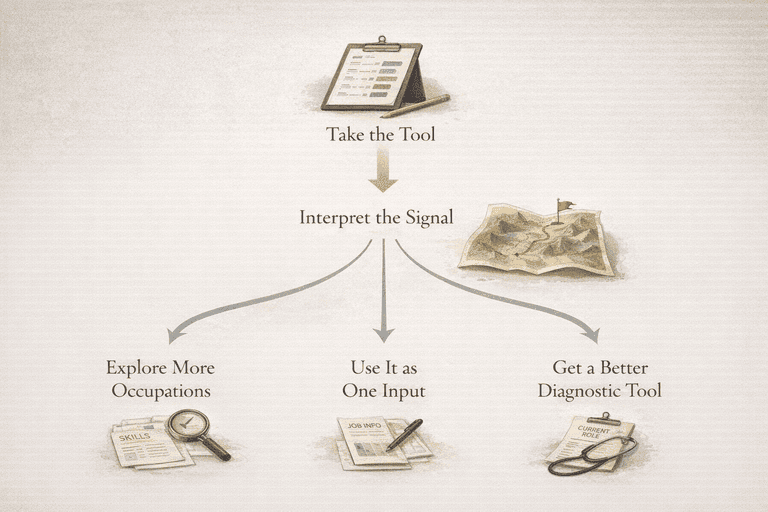
Do not force certainty if you have little exposure to an activity. You can investigate unfamiliar work before concluding that a low rating reflects a settled preference. Equally, an attractive title is a reason to read more, not evidence that you would enjoy its routine tasks.
When The Interest Profiler Is Enough
It may be enough when your immediate aim is to find work activities and occupations worth exploring. You can use the free result, public occupational information, and conversations with people doing the work to build a useful shortlist without buying another assessment.
A different question needs additional evidence. If your main concern is an exhausting manager, an unsuitable schedule, an income constraint, or a regulated entry requirement, another interest score will not resolve it. No career questionnaire diagnoses burnout or determines whether you should leave a job.
When evaluating another assessment, our career-assessment credibility checklist separates evidence about a framework from evidence about a particular product's recommendations. That distinction applies to CareerMeasure too.
Where CareerMeasure Fits In The Process
CareerMeasure is designed to show interests, motivations, and strengths together, including interpretation of current-role fit. You can inspect the product demo and methodology to decide whether those outputs address a question the interest profile left open. These features are decision aids; we have not established that they produce better career outcomes than the O*NET tool.
Our career-change test buyer guide helps you choose between exploring interests, examining current work, and validating a transition. Start with the route that answers your next question, then test what you learn against real work.

References
[1] O*NET Resource Center. Interest Profiler (IP) at O*NET Resource Center.
[2] O*NET Resource Center. O*NET Interest Profiler Manual.
[3] O*NET Resource Center. What's New? October 7, 2025 New O*NET Interest Profiler (Mini-IP Version 2.0).
[4] O*NET Resource Center. Development of an O*NET Mini Interest Profiler (Mini-IP) for Mobile Devices: Psychometric Characteristics.
[5] O*NET Resource Center. Career Returns within the O*NET Interest Profiler Tools.
[6] O*NET OnLine. Browse by Interests.
[7] O*NET Resource Center. O*NET Career Exploration Tools.
[8] O*NET Web Services. Interest Profiler at O*NET Web Services.
[9] U.S. Bureau of Labor Statistics. Training and Development Specialists. Occupational Outlook Handbook.
Try The Assessment Yourself
See how CareerMeasure handles your current role, your fit gaps, and your next-step options directly.

Builds CareerMeasure hands on and writes about career fit, role transitions, and the gap between generic personality advice and evidence-based career decisions.
Community Discussion
Share your thoughts about this article
Delete Comment?
Are you sure you want to delete this comment? This action cannot be undone.