

Best Career Test for Career Changers:
What To Look For Before You Switch Roles

The best career test for a career changer depends on the question you need answered next. If you want to discover appealing work activities, start with the free O*NET Interest Profiler. If you want to examine several aspects of current-role fit, inspect CareerMeasure's sample experience before taking its 90-question assessment. If you already have a shortlist, spend time checking the work and entry requirements before taking another test.
Disclosure: I am CareerMeasure's founder. This guide explains where our product may be useful, but it is not an independent study showing that it improves career outcomes more than other assessments.
Choose A Route Based On Your Immediate Question
| Your question | A useful starting route | What remains outside the result |
|---|---|---|
| Which work activities interest me? | Official free O*NET Interest Profiler, with 30 web questions[1] | Qualifications, employer conditions, and the practicality of a move |
| What would CareerMeasure tell me? | Inspect the product demo and methodology before deciding to take the assessment | Whether the interpretations fit your experience and constraints |
| Is the problem this job or the profession? | Compare specific duties and conditions using the job-versus-career decision guide | What can change at your employer and what actually improves the work |
| Which of two or three target roles is realistic? | Read vacancies, map your evidence, and test a task from each role | Employer selection, credentials, local demand, and your willingness to do the work |
The table is a sequence, not a ranking of scientific quality. A free tool can be sufficient for one question while a detailed report can still leave another unanswered. O*NET's career exploration documentation is useful because it states the purpose of its tools explicitly.[2]
If You Came Here Looking For A Career-Change Quiz
You can take CareerMeasure's actual assessment. It has 90 questions across interests, motivations, and strengths, with an estimated completion time of about 15 minutes. A free account unlocks the baseline result, including a Blueprint preview and current-career check; the product's deeper reports and exploration features have a paid boundary.
This is not a short yes/no quiz about quitting. The assessment organizes information to reflect on, and it does not certify your skills or measure your performance on a work task. You can inspect the methodology before sharing answers.[5]
If you only want an interest profile, the official free route above is a reasonable place to stop. Our O*NET Interest Profiler review includes a worked example of using the result without buying a second test.
Inspect The Output Before You Pay
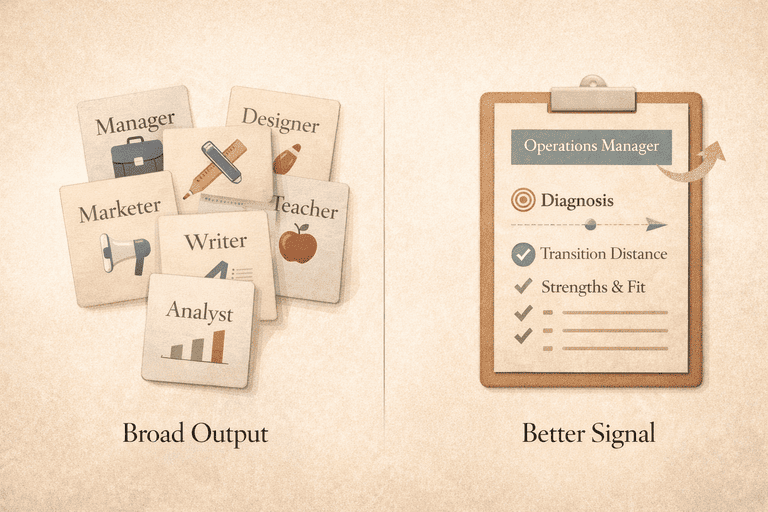
Open a sample report and find the section that would answer your question. Do not judge only whether the description sounds like you. A recognizable description and a useful transition plan are different outputs.
For a career changer, I would inspect four things:
- Current-work interpretation. Does the report help you identify a task or condition to investigate, or only attach a label to you?
- An explanation of matches. Can you see why a role appears and which information was used? A score without an explanation is hard to challenge.
- Evidence and gaps. Does the product distinguish self-reported preferences from demonstrated skills, credentials, and employer requirements?
- A usable next step. Can you turn one finding into a vacancy comparison, conversation, or small work sample?
Our comparison of CareerExplorer, Truity, and CareerMeasure documents the public features and access boundaries we could verify. Read it alongside each provider's current pages because features and access terms can change.
Keep Scientific Claims At The Right Level
A product can use a familiar psychological framework without having demonstrated the accuracy of every career recommendation it makes. Personality is relevant to work, but research such as Judge and Zapata's analysis also examines how situational demands affect its relationship with job performance.[4] That does not validate a particular website's ranking of your next career.
Likewise, a scale measuring career adaptability has a specific research purpose. Savickas and Porfeli's work examines the construction and measurement properties of the Career Adapt-Abilities Scale; it is not evidence that an adjacent move always beats a larger change.[7]
16Personalities also explains its own framework, which is worth reading if you are using one of its results.[3] Compare what the instrument says it measures with the claim you want to draw from it. A preference description cannot establish that a regulated occupation is open to you.
Turn A Result Into A Transition Hypothesis
Consider this illustration: an account manager enjoys explaining difficult products and coordinating handoffs, but dislikes renewal negotiations. An assessment highlights interests consistent with teaching and organizing. The next question is whether a target role preserves the explanation work while changing the commercial pressure.
| Possible direction | Evidence already available | Missing evidence | A question that could change the choice |
|---|---|---|---|
| Customer education | A guide used to explain a product | Whether people can learn independently from the materials | How much live delivery and customer escalation does this role own? |
| Implementation coordination | A documented handoff or project plan | Technical depth required by the target product | Who owns configuration problems and missed launch dates? |
| A different account-management role | Existing client relationship work | The actual targets and compensation structure | Are renewals still an individual target in this position? |
These are illustrative options, not test-generated recommendations. Use real vacancies to replace the questions with evidence. The transferable-skills worksheet helps you document the old task, target task, proof, and remaining gap.
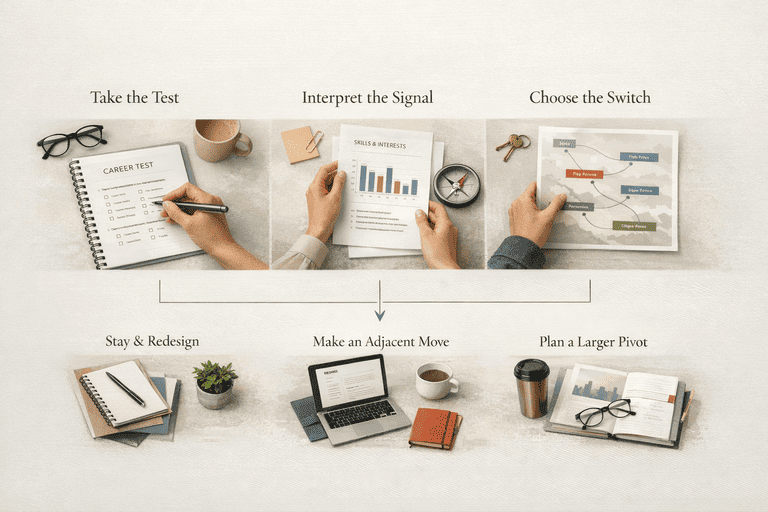
An adjacent move may reuse useful experience. A larger change may still be justified if the work you want requires different preparation. Neither is automatically better; compare the cost and the daily work you would be moving toward.
Validate The Shortlist Before Committing
Career exploration research treats gathering information about yourself and the environment as part of the process.[9] Broader career theory also covers paths that do not follow one organization's ladder.[6] Those ideas support investigating options; they do not supply a personal probability of transition success.
For each shortlisted role, save current vacancy examples and write down recurring requirements. Mark each requirement as demonstrated, partly demonstrated, missing, or unclear. Then separate a genuine entry barrier from an employer preference you can ask about.
Choose one practical test: build a short example of the work, observe someone doing it where access is permitted, or ask a practitioner about the part of the role you find uncertain. A test is useful when it can change your mind. Repeating only the appealing part of the job tells you less.
Decide Whether More Guidance Is Worth It
Adult career guidance can address training choices, progression, and changing jobs, not just self-description.[8] Sometimes the missing input is a conversation about constraints or qualifications rather than another report.
Use CareerMeasure if its visible outputs help you formulate a better question about current fit or possible roles. Use the free baseline to check that usefulness before paying for depth. If you already know the target and the uncertainty is an entry requirement or hiring practice, investigate that uncertainty directly.
A useful assessment leaves you with something you can check. The next move should follow from that check, together with your experience and constraints.

References
[1] O*NET Resource Center. Interest Profiler (IP) at O*NET Resource Center.
[2] O*NET Resource Center. O*NET Career Exploration Tools.
[3] 16Personalities. Our Framework.
[4] Judge, Timothy A., and Charles P. Zapata. The Person-Situation Debate Revisited: Effect of Situation Strength and Trait Activation on the Validity of the Big Five Personality Traits in Predicting Job Performance. Academy of Management Journal, 2015.
[5] CareerMeasure. Methodology.
[6] Sullivan, S. E., & Baruch, Y. (2009). Advances in career theory and research: A critical review and agenda for future exploration. Journal of Management, 35(6), 1542-1571.
[7] Savickas, M. L., & Porfeli, E. J. (2012). Career Adapt-Abilities Scale: Construction, reliability, and measurement equivalence across 13 countries. Journal of Vocational Behavior, 80(3), 661-673.
[8] OECD. Career Guidance for Adults in a Changing World of Work.
[9] Jiang, Z., Newman, A., Le, H., Presbitero, A., & Zheng, C. (2019). Career exploration: A review and future research agenda. Journal of Vocational Behavior, 110, 338-356.
See Your Stronger-Fit Next Moves
Get a clearer picture of which adjacent paths fit you better before making a bigger jump.

Builds CareerMeasure hands on and writes about career fit, role transitions, and the gap between generic personality advice and evidence-based career decisions.
Community Discussion
Share your thoughts about this article
Delete Comment?
Are you sure you want to delete this comment? This action cannot be undone.