

Personality Type Is Not Career Fit:
What To Look At Instead

A personality test can describe you accurately and still give you bad career advice. That is the core problem. You can read your type description, feel completely seen, and still end up in a role that drains you.
That does not mean personality tests are worthless. It means they are being asked to do a job they cannot do alone. If you are using Myers-Briggs-style typing, 16Personalities, or personality-led career advice to figure out what work fits you, the better question is not "What job matches my type?" The better question is: what combination of work actually fits my interests, my motivations, and the way I operate day to day?
That is a harder question, but it is also the one that matters.
The Short Version
Personality matters, but it is not enough. Research on personality and job performance consistently finds that personality traits have some predictive value, but they explain only part of what makes someone effective or satisfied at work.[1] A later longitudinal study on promotions points in the same direction: personality has some signal, but it is far from a full career-fit model.[2] Even 16Personalities says there is no single ideal career for a personality type and that personality information should work more like a guide than a rule book.[3]
That is the honest position. The problem is that most career content built around personality types gets much more deterministic than that. It turns broad tendencies into career prescriptions, and that is where people get misled.
Why Type Advice Feels More Useful Than It Really Is
Part of the problem is that personality descriptions often feel uncannily accurate.
They describe how you think, how you recover energy, what kinds of environments feel natural, and how you tend to respond under pressure. That can create a strong sense of recognition. Once someone feels accurately seen, it is easy for them to assume the tool is also good at prediction.
Those are different things.
A framework can be good at saying, "This sounds like you," and still weak at saying, "This is the work you should build your next ten years around." That is the jump many people do not notice.
This is why personality-led career content can feel persuasive even when the downstream advice is thin. Descriptive accuracy creates trust fast. But trust in the description often gets borrowed by the career recommendation, even when the recommendation itself rests on a much weaker chain of reasoning.
Where Personality Tests Help And Where They Stop
It is too easy to overcorrect and say personality tests tell you nothing useful. That is not true. A good personality framework can help you notice patterns like whether you recover energy alone or with people, whether you prefer open-ended work or clearer structure, whether conflict drains you or sharpens you, and whether you naturally seek novelty, stability, autonomy, or external input.
Those are useful signals because they help you understand why some environments feel natural and others feel costly. They can also give you language for things you already sensed but could not explain well. That is real value.
That value is strongest when personality is used for interpretation, not verdicts. It can help you notice why open-ended work feels better than rigid structure, or why constant interruption costs you more than it seems to cost other people. It can help you talk about environment preferences, team style, or social energy honestly. That is already useful.
The problem starts when that one useful layer gets treated like the whole model.
Where Personality Tests Start Failing
The failure starts when a broad personal tendency gets treated like a job recommendation engine. That leap is too big.
A personality test may tell you that you are more introverted, more structured, more people-oriented, or more abstract in your thinking. But a career decision usually depends on more than that. It also depends on questions like what kind of work energizes you, what outcomes matter enough to sustain effort, how much autonomy you need, how much interruption you can tolerate, whether you like advising people or solving technical problems, and whether your current frustrations are trainable gaps or deeper mismatch. A type code does not answer those questions on its own.
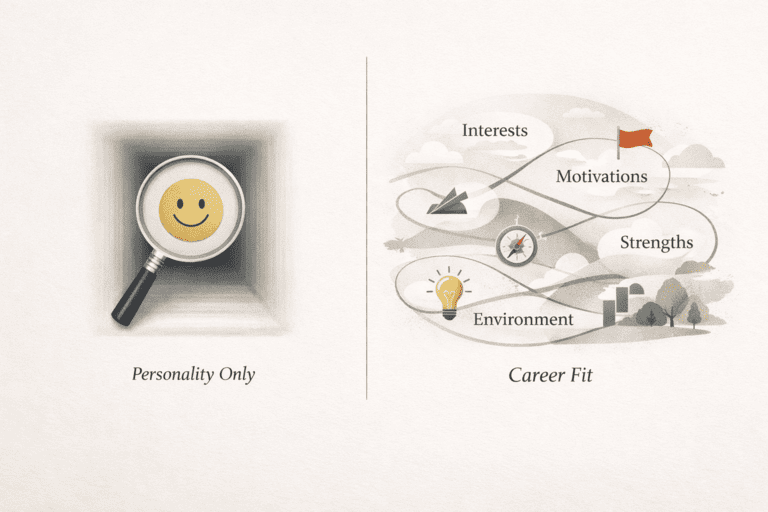
Another way to say it is this: personality helps describe how you tend to operate. Career fit depends on what the work asks from you, what kind of work content you want more of, what kind of motivation keeps you engaged, and what kind of environment lets you do good work without paying too much for it.
That is why type-only advice breaks down so quickly once a real adult decision is on the table.
Even The Personality Sites Are More Careful Than Their Fans
The strongest criticism of personality-led career matching is not only academic. It also shows up inside the personality platforms themselves. 16Personalities explicitly says there is no ideal career for a personality type and that personality information should be treated as a road map, not a rule book.[3]
Our 16Personalities career-matches review distinguishes the platform's framework and career content from the stronger claims readers sometimes draw from them.
That caution also fits the broader research direction. Recent review work on personality and vocational interests treats the two domains as connected but distinct, which is exactly why type alone is too thin for career-fit guidance.[7]
So the problem is not that every personality platform says something absurd. The problem is that users, affiliate articles, and simplified career content often turn nuanced tools into simplistic advice. That is how you end up with statements like "INFJs should become counselors," "INTJs should become engineers," or "ENFPs should work in creative careers." Those statements sound useful because they are clean, but they are much too coarse.
They are also too flattering to challenge. They give people a coherent identity story, and identity stories are sticky even when they are only partially helpful.
Why Type-Based Career Advice Breaks Down In Real Life
1. The Same Job Title Can Mean Very Different Work
"Counselor" is one job title, but the lived work can vary enormously by setting, client mix, pace, emotional load, autonomy, and supervision. The same is true of "marketer," "teacher," "designer," "analyst," or "software engineer." If a career recommendation is based mainly on personality type, it often treats the job title as if the work reality is stable. It is not.
A person may fit one version of a role and hate another version of the exact same title. That is one reason type-based career advice feels persuasive in theory and disappointing in practice.
2. Personality Does Not Capture Interest Depth
You can be highly empathetic and still not want a people-heavy job. You can be analytical and still not want analysis as your daily work. You can be creative and still dislike creative production under client pressure. That is because personality and interest are related, but not identical.
This is one reason Holland-style interest systems remain useful in career work: they target the content of work more directly than broad personality typing does.[4]
3. Personality Does Not Tell You What Sustains You
Two people can share similar personality tendencies and still need very different things from work. One might need recognition and upward movement. Another might need calm, predictability, and minimal politics. Another might need autonomy above everything.
That is not a small detail. It is often the difference between staying and burning out, and it is one of the biggest reasons a role can look right on paper and still feel wrong in real life.
4. Personality Does Not Explain The Gap Between Fit And Friction
People do not only need to know whether a role looks compatible in theory. They need to know where the friction is, whether that friction is fixable, and whether they are in the wrong team, the wrong environment, or the wrong role family entirely. A type label does not diagnose that well.
The Real Distinction: Descriptive Accuracy Versus Decision Usefulness
This is the line most people need.
A personality tool can be descriptively accurate and still be weak at decision support.
It can be right that you prefer autonomy, dislike constant interruption, or think in more abstract patterns. It can still be wrong to translate those truths into a narrow set of career titles. That is because career decisions are not made only from traits. They are made from the combination of:
- what kind of work content you actually want to do
- what kind of outcomes matter enough to sustain effort
- what kind of environment helps or hurts you
- what strengths you are actually using day to day
- what kind of friction is fixable versus structural
That distinction matters a lot in practice. Plenty of people feel accurately described by a personality result and still feel completely lost about what to do next. The missing piece is not always more identity language. It is better decision logic.
What The Research Actually Supports
The academic position is much less magical than the internet version. Personality traits do have meaningful relationships with work outcomes, but they operate inside situations, role demands, incentives, and context.[1] That means two things can be true at once: personality is relevant, and personality alone is not enough for career fit.
A 2015 paper by Judge and Zapata looked at how personality traits interact with situation strength and trait activation in predicting job performance. The point was not that personality is useless. The point was that context matters, and the same trait does not operate identically across all roles and situations.[1] A 2024 study in one multinational company examined how relationships between personality and promotions differed across job levels. It does not establish a universal trait-to-career rule.[2]
Again, that does not make personality irrelevant. It does show that a clean trait-to-career equation is much weaker than popular career content suggests. And if you go further back, critiques of MBTI's utility for applied decision-making have been around for a long time, including concerns about reliability, forced categories, and overconfident downstream use.[5]
That is why the practical lesson should be moderation, not personality worship.
What You Should Look At Instead
If personality type is only one layer, what should sit beside it? At minimum, a better career-fit model needs interests, motivations, and work-behavior strengths. Recent review work on personality and vocational interests points in the same direction: the two domains are connected, but they are not interchangeable, which is exactly why type alone is too thin for career-fit guidance.[7]
Interests tell you what kind of work content actually gives you energy. Not what sounds admirable and not what suits your type in theory, but whether you like building, advising, investigating, teaching, organizing, persuading, creating, or improving systems.
Motivations tell you what you need from work to stay engaged. That can include autonomy, impact, recognition, stability, growth, or connection. A job can match your personality and still fail badly on motivation, which is often what people mean when they say, "On paper this role suits me, but I still feel dead inside."
Work-behavior strengths make the guidance more operational. This is where you stop asking only who you are and start asking how you actually operate. Do you thrive with deep focus or frequent context switching? Independent problem solving or collaborative iteration? Structured execution or fluid ambiguity? Sustained empathy or bounded social interaction? That is closer to the lived reality of work.
A Better Career-Fit Model
If I were replacing type-based career advice with something stronger, I would want at least four layers in the model.
1. Work Content
What do you actually want to spend time doing?
Not what sounds impressive. Not what matches the identity story. The actual work. Investigating, building, explaining, improving, organizing, persuading, teaching, designing, coordinating, advising, troubleshooting, selling, or analyzing.
This is where interest systems still matter. They get closer to the content of work than most type systems do.[4]
2. Motivation
What keeps effort worth it for you?
Autonomy, impact, recognition, stability, growth, mastery, connection, or influence do not matter equally to everyone. A role can sound compatible on personality language and still feel dead because it fails on the motivational layer.
3. Operating Style
How do you do your best work?
This is the layer where personality-type language can still help. Do you do better in fast-moving social environments or in quieter deep-work environments? Do you want more ambiguity or less? Do you like open exploration or clearer structure? This layer matters. It is just not enough on its own.
4. Current-Role Reality
What is happening in the role you already have?
This is where most personality-based career advice simply stops too early. It does not tell you whether your current dissatisfaction comes from the role, the environment, the manager, the incentives, or a deeper mismatch between what the work asks from you and what you can sustainably give back.
The Better Career Question
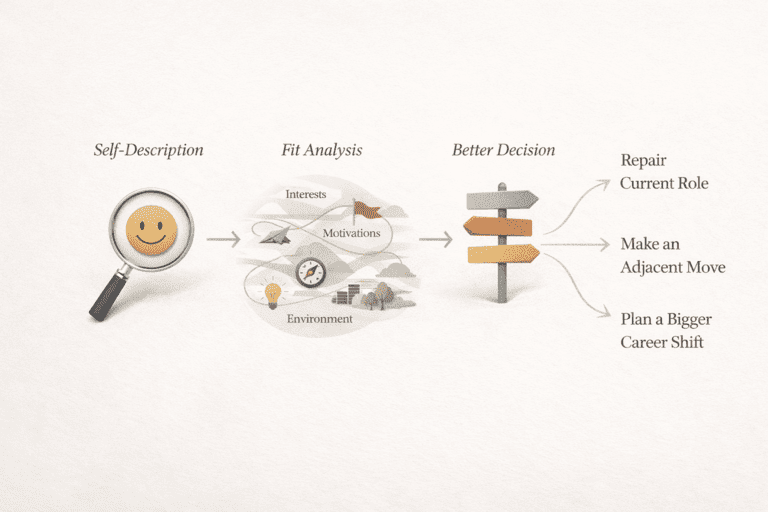
Instead of asking "What jobs fit my type?" ask what kind of work content energizes you, what kind of environment helps you do good work, what kind of motivation you need to stay engaged, where your current role is misaligned, and which nearby roles reduce that mismatch without forcing a blind leap.
If you need a separate interest-based starting point, the O*NET Interest Profiler review provides the official free tool and a practical example of interpreting its results.
That is a much stronger career question. It is also the reason CareerMeasure is built around interests, motivations, and strengths, then anchored back to current-role interpretation, fixable gaps, and adjacent movement rather than personality type alone.[6]
A Better Way To Use Personality Tests
If you already like personality tests, the answer is not to throw them away. Use them differently. Use them as a language tool, a reflection prompt, and one signal among several.
Do not use them as a final career answer, a substitute for interest and motivation analysis, or a reason to over-identify with one work story. The problem is not personality itself. The problem is career advice that asks personality to do too much.
A stronger way to use them looks more like this:
- use personality to understand environment preferences and working style
- use interests to understand what kinds of work content you want more of
- use motivations to understand what keeps the work worth doing
- use current-role diagnosis to understand where the mismatch really sits
That is a much cleaner decision chain than jumping from a type label straight to a job title list.
Final Answer
A personality test can help you understand yourself. It cannot, by itself, tell you what career fits. If a tool gives you a type and then jumps straight to job recommendations, treat the result as a starting point, not a verdict.
The stronger approach is to combine personality-adjacent insight with work interests, motivations, work-behavior strengths, current-role reality, and adjacent-role logic. That is how you get closer to real career fit.

References
[1] Judge, T. A., & Zapata, C. P. (2015). The person-situation debate revisited: Effect of situation strength and trait activation on the validity of the Big Five personality traits in predicting job performance. Academy of Management Journal, 58(4), 1149-1179.
[2] Kordsmeyer, T. L., Speer, A. B., Wilms, R., & Kurz, R. (2024). Longitudinal effects of employees' Big Five personality traits on internal promotions differentiated by job level in a multinational company. Journal of Business and Psychology, 39, 1049-1065.
[3] 16Personalities. Is There an Ideal Career for My Personality Type?
[4] O*NET Resource Center. Interest Profiler: Measuring six types of occupational interests.
[5] Pittenger, D. J. (1993). The utility of the Myers-Briggs Type Indicator. Review of Educational Research, 63(4), 467-488.
[6] CareerMeasure. Methodology.
[7] Wille, B., Dupré, S., & De Fruyt, F. (2025). Personality and vocational interests: Connections between two fundamental individual-differences construct domains. Current Opinion in Psychology, 66, 102103.
Get A Clearer Career Signal
Take the assessment to see what fits, what feels off, and which roles are more likely to suit you.

Builds CareerMeasure hands on and writes about career fit, role transitions, and the gap between generic personality advice and evidence-based career decisions.
Community Discussion
Share your thoughts about this article
Delete Comment?
Are you sure you want to delete this comment? This action cannot be undone.