

Why You Feel Stuck in Your Career Even With a Strong Resume

One of the more frustrating career problems is having enough evidence that the market should want you and still having no clean answer about what to do next.
Your resume may be solid. You may have good companies on it, strong titles, strong outcomes, or a clear track record of competence. Recruiters may respond. Other people may tell you that you have options. And still you may feel just as stuck as someone with far less external proof.
That can feel irrational until you notice what the resume is actually proving and what it is not.
A strong resume can prove that you have been employable. It cannot, by itself, tell you what kind of work you should keep building your life around.
The Short Answer
People often feel stuck even with a strong resume because a resume is primarily evidence of past market value, not a diagnosis of future fit.
It can show that you have:
- performed
- delivered
- advanced
- stayed employable
- built useful signal
What it usually cannot show is:
- what kind of work still fits you now
- what should be preserved in the next move
- what part of your dissatisfaction is environmental versus structural
- how far the next transition should actually be
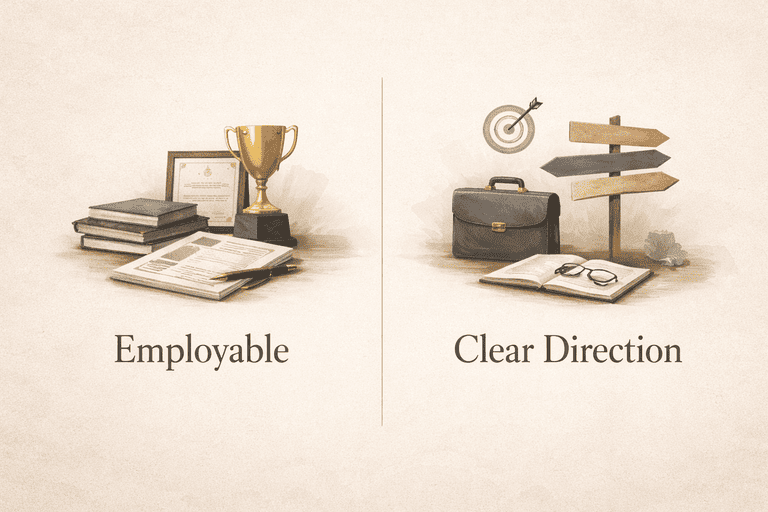
That is why strong resumes often solve the visibility problem without solving the direction problem. They create options. They do not automatically create clarity.
Why A Strong Resume Can Actually Make Stuckness Worse
This is the part many people miss.
When your resume is weak, the problem is often obvious: you need more evidence, more skill, more opportunity, or more traction.
When your resume is strong, the problem gets psychologically harder because the external world keeps telling you that you are fine. That makes it harder to admit that the real bottleneck is not employability. It is interpretation.
In practice, a strong resume can make people more stuck for three reasons:
- it creates more possible directions instead of fewer
- it gives just enough external validation to keep postponing the deeper question
- it makes the cost of changing direction feel higher because more career capital is now on the table
That is why career stuckness at this stage is rarely about raw capability. It is more often about how to use existing capability without wasting it.
What A Strong Resume Actually Tells You
A strong resume usually tells you some combination of the following:
- you can operate inside a valued system
- you have built skills the market recognizes
- you know how to convert effort into signal
- you can survive complexity, responsibility, or pressure
- you have enough evidence that other people can imagine paying for your work
That is all useful. It is not trivial.
But it still leaves open the harder questions:
- did the work actually fit you or did you simply perform well inside it?
- are the strengths being rewarded the ones you still want to build your future around?
- is the next logical step attractive, or only legible?
- does the resume represent a path you want more of or only proof that you could succeed there?
This is one reason person-environment fit research matters. Satisfaction, commitment, and the desire to stay are not explained by competence or market success alone.[1] Fit at the job, organization, and broader work level still matters in meaningful ways.[2]
What It Does Not Tell You
A strong resume does not tell you:
- whether your current dissatisfaction is temporary or structural
- whether the next role in the same path would actually be better
- which parts of your past experience still belong in your future
- whether the reason you are attractive to employers is the same reason you should stay on the path
This is where many people get misled. They treat resume strength like decision clarity. It is not. It is external proof, not internal direction.
That gap matters most in mid-career because the more evidence you have, the more tempting it becomes to let the market keep deciding the next move for you.
Five Reasons Strong-Resume People Still Feel Stuck
This pattern is usually not random.
1. The Resume Proves Capability, Not Preference
You may have a strong resume because you are disciplined, conscientious, resilient, persuasive, analytical, or fast to learn.
Those traits help you perform in many environments, including some that are not especially good for you.
That is why a strong resume can coexist with low clarity. The document proves you could do the work. It says much less about whether you should keep doing it.
2. External Signal Can Replace Self-Knowledge If You Let It
Once the market starts rewarding you, it becomes easy to outsource judgment.
You stop asking:
- what kind of work still feels worth doing?
and start asking:
- what role would be the easiest next win from this profile?
That is a dangerous shift because the easiest next win and the best next fit are not always the same thing.
3. A Strong Resume Creates Too Many Plausible Options
This is one of the hidden costs of credibility.
If you have built enough signal, many adjacent moves can look plausible. That sounds like freedom, but it can also create a wider field of ambiguity:
- stay in the same path and level up
- switch employers
- make an adjacent move
- shift functions
- use the resume strength to enter a new context entirely
The problem becomes less "can I move?" and more "which move actually solves the right problem?"
4. You Are Protecting Capital You Do Not Want To Waste
This is rational and emotionally heavy at the same time.
The stronger the resume gets, the more people worry about wasting it. They do not want to throw away the years, the signal, the title progression, or the credibility they built.
That concern is not fake. OECD guidance on adult career support keeps returning to the reality that adults are usually making decisions under real constraints, not abstract identity conditions.[3] At this stage, career decisions are partly about preserving useful capital while changing enough to improve fit.
5. The Resume Can Hide A Fit Problem For Longer Than It Should
This is another reason strong performers get stuck.
If the market keeps validating you, it becomes easier to treat discomfort like a temporary mood instead of a repeating signal. The resume keeps saying "this path works," even when your lived experience is starting to say "this path may no longer fit."
That mismatch can last a long time if nobody interrupts it.
Why Employability And Fit Are Not The Same Thing
This is the central distinction in the whole article.
Employability asks:
- can the market use you?
Fit asks:
- should your life keep being organized around this kind of work?
Those are not the same question.
Research on career adaptability and adult guidance is useful here because it treats careers as ongoing navigation problems rather than one-time identity choices.[4] The point is not just to stay employable. The point is to keep adapting in ways that produce stronger fit and stronger long-term coherence.[5]
That is why a strong resume should be treated as leverage, not as verdict.
Why The Market Keeps Offering You More Of The Same
This is another reason strong-resume people can feel unusually stuck.
Markets are not trying to solve your fit problem. They are trying to sort you into legible demand.
That means the stronger your resume gets, the more likely other people are to see you through the logic of what you have already proven:
- the same industry
- the same function
- the same seniority band
- the same visible strengths
- the same kind of value story
That creates a quiet feedback loop.
You get approached for work that resembles the work you have already done well. Recruiters infer continuity. Hiring managers reduce risk by imagining you in familiar lanes. Even your own thinking can start narrowing around whatever looks easiest to explain from the existing document.
This is not malicious. It is how labor-market sorting works.
The problem is that repeated market interest can feel like proof that you should continue on the same path. Often it is only proof that the path remains legible.
Those are very different things.
Legibility means:
- other people can price your experience
- your strengths are easy to classify
- your next move is easy to narrate
Fit means:
- the work still uses you in a way you want
- the future path still feels livable
- the daily task mix still makes sense for your motivation and energy
The more impressive the resume gets, the easier it is to confuse these two.
The Resume Story Can Outrun The Lived Story
One of the more subtle problems in mid-career is that the official version of your career can become cleaner than the lived version.
The exercise for work you do well but dislike separates evidence of competence from evidence that you want to repeat the same work.
The resume story says:
- this person keeps progressing
- this person keeps getting chosen
- this person is clearly valuable
The lived story may be different:
- the work became narrower than you want
- the strengths being rewarded are the ones that drain you
- the next logical step looks more expensive, not more desirable
- you can still win here, but you no longer want your life organized this way
That gap matters because the cleaner the resume story becomes, the easier it is to keep trusting it as the primary truth.
But resumes are compressed public documents. They summarize motion, not meaning. They record achievement, not whether the path still feels right from the inside.
This is why stuckness can increase after a run of objectively good years. Each additional credential, title, or brand-name signal can make the path look more coherent while your internal evidence becomes harder to defend socially and psychologically.
You start feeling pressure not only to choose well, but to remain consistent with the person the resume appears to describe.
The Resume Trap: When “I Have Options” Still Feels Like “I Have No Idea”
This is one of the most demoralizing versions of career confusion.
People around you may assume that if you have options, you cannot be stuck. But options without diagnosis often create a different kind of paralysis.
If you do not know:
- what you are trying to get away from
- what you are trying to preserve
- whether the problem is the role, the field, or the environment
- how much transition distance is actually wise
then more options can just mean more ways to move the wrong problem around.
This is why some very employable people stay in unsatisfying paths longer than outsiders expect. The bottleneck is not access. It is interpretation.
What People With Strong Resumes Often Misdiagnose
This pattern gets misread in a few predictable ways.
Lack Of Confidence
Sometimes people assume that if you feel stuck, you must secretly doubt your ability.
That can happen, but it is not the core issue here. Many stuck people with strong resumes know perfectly well that they can continue succeeding. That is exactly what makes the problem harder. They do not lack proof of competence. They lack conviction about where that competence should go next.
Laziness Or Indecision
This is another bad reading.
Some people are not frozen because they refuse to act. They are frozen because multiple plausible actions remain available and the cost of choosing the wrong one feels high. Strong resumes increase that pressure because a visible track record makes people feel they should be able to optimize the next move cleanly.
Fear Of Change Alone
Fear is often part of the picture, but it is rarely the whole picture.
The stronger diagnosis is usually this: the resume gives you enough leverage to move, but not enough guidance to know which move is actually worth making. That is different from simple avoidance.
How To Use A Strong Resume Better
Three Better Questions Than “What Could I Get?”
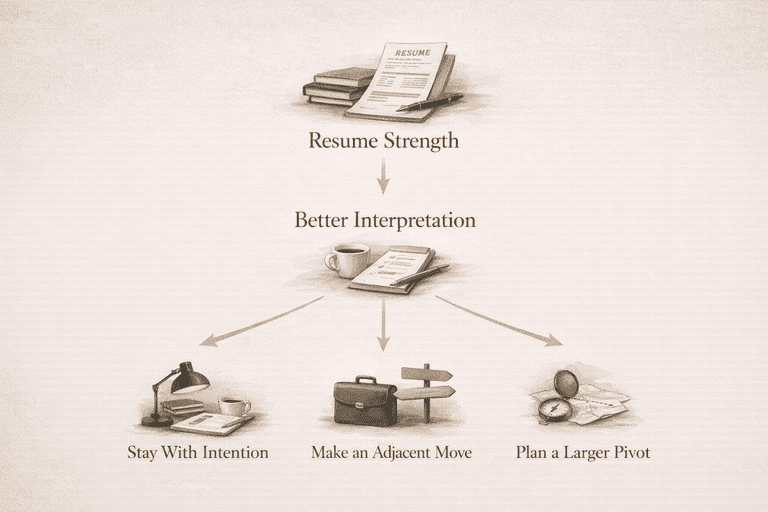
Put your experience into the three-option transition worksheet to compare what could improve in place, what could transfer, and what would require larger preparation.
If you want to use a strong resume intelligently, ask these before you start applying everywhere.
What Part Of My Resume Reflects Work I Want More Of?
Do not just look at what looks impressive. Look at what feels worth preserving.
For example:
- do you still want the strategy part, but not the stakeholder politics?
- do you still want the teaching part, but not the classroom intensity?
- do you still want the client insight, but not the quota pressure?
- do you still want the coordination part, but not the low-control accountability structure?
This is often where the adjacent move reveals itself.
What Part Of My Resume Only Proves Tolerance?
Some achievements are not proof of fit. They are proof that you could endure, adapt, or perform under pressure for a sustained period.
That matters. But it should not automatically decide the future.
A line on a resume can mean:
- I was good at this
- I could survive this
- I was rewarded for this
Those are not identical statements.
What Should This Resume Buy Me Now?
This is the highest-leverage question in the article.
Maybe the resume should buy you:
- a safer adjacent move
- more selectivity
- better access to healthier employers
- a smaller pay cut during transition
- more credibility while you pivot the story
That is a much smarter use of career capital than treating the resume like a command to continue the exact same pattern.
What To Do With A Strong Resume Instead
A strong resume is still useful. The trick is to use it in the right order.
1. Stop Asking Only What You Can Get
Start asking:
- what kind of work still feels worth building around?
- what parts of my experience do I want to carry?
- what parts of the current path are only externally impressive?
2. Separate External Signal From Internal Evidence
Your resume is external evidence. Your energy, dread, motivation, and future pull are internal evidence.
You need both.
3. Identify What The Resume Should Buy You
The resume may buy you:
- a safer adjacent move
- stronger negotiation power
- access to better versions of the same field
- a more believable transition story
That is much better than using it only to win a slightly shinier version of the same misfit.
4. Use It To Reduce Risk, Not To Avoid Diagnosis
This is where the strong resume becomes genuinely valuable.
It can help you make a cleaner move with less downside. It can preserve income better. It can make adjacent transitions more believable. It can create room for experimentation without a total reset.
But that only helps after you know what problem you are solving.
The Best Question To Ask Next
If you have a strong resume and still feel stuck, the best next question is usually not:
- what job could I get?
It is:
- what should this resume help me move toward, and what should it stop helping me stay stuck inside?
That question turns the resume from a trap into a tool.
Final Answer
You can feel stuck in your career even with a strong resume because a strong resume proves market value, not future fit.
It shows that you have built useful signal. It does not tell you what problem you are solving now, what should still transfer, or what kind of next move actually makes sense.
The stronger move is to treat the resume as leverage, not as direction. Once you diagnose the real mismatch, a strong resume becomes a powerful asset. Until then, it can just become a more sophisticated way to stay stuck.

References
[1] Verquer, M. L., Beehr, T. A., & Wagner, S. H. (2003). A meta-analysis of relations between person-organization fit and work attitudes. Journal of Vocational Behavior, 63(3), 473-489.
[2] Kristof-Brown, A. L., Zimmerman, R. D., & Johnson, E. C. (2005). Consequences of individuals' fit at work: A meta-analysis of person-job, person-organization, person-group, and person-supervisor fit. Personnel Psychology, 58(2), 281-342.
[3] OECD. Career Guidance for Adults in a Changing World of Work.
[4] Savickas, M. L., & Porfeli, E. J. (2012). Career Adapt-Abilities Scale: Construction, reliability, and measurement equivalence across 13 countries. Journal of Vocational Behavior, 80(3), 661-673.
[5] Sullivan, S. E., & Baruch, Y. (2009). Advances in career theory and research: A critical review and agenda for future exploration. Journal of Management, 35(6), 1542-1571.
[6] Jiang, Z., Newman, A., Le, H., Presbitero, A., & Zheng, C. (2019). Career exploration: A review and future research agenda. Journal of Vocational Behavior, 110, 338-356.
[7] Yang, W.-N., Niven, K., & Johnson, S. (2019). Career plateau: A review of 40 years of research. Journal of Vocational Behavior, 110, 286-302.
[8] CareerMeasure. Methodology.
Get A Clearer Career Signal
Take the assessment to see what fits, what feels off, and which roles are more likely to suit you.

Builds CareerMeasure hands on and writes about career fit, role transitions, and the gap between generic personality advice and evidence-based career decisions.
Community Discussion
Share your thoughts about this article
Delete Comment?
Are you sure you want to delete this comment? This action cannot be undone.