

Why You Feel Empty at Work Even When You Are Successful

One of the strangest work problems is looking successful from the outside while feeling increasingly absent from your own life on the inside.
You are performing well enough. The compensation may be fine. Other people may respect the path. You may even be objectively winning. And still some part of you keeps asking: why does this feel so dead?
That question can be hard to admit because success is supposed to settle the argument. If the work is paying off, if other people think you are doing well, if the path still looks desirable, then emptiness can feel ungrateful or irrational.
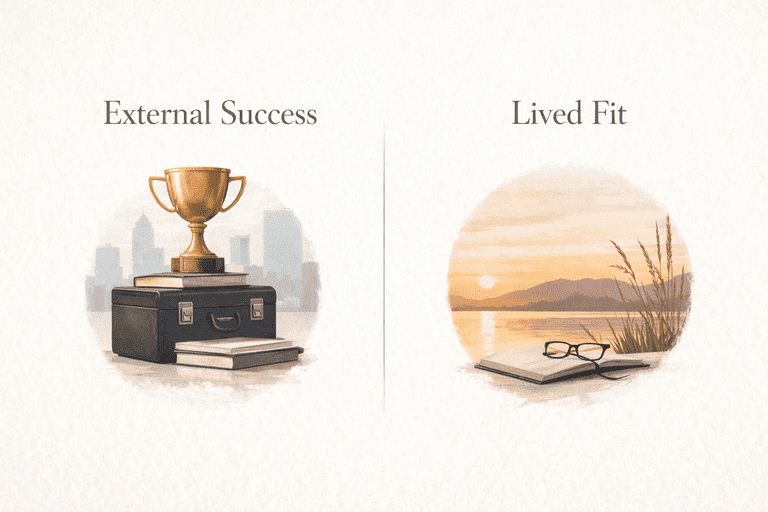
But success and fit are not the same thing. A career can reward you without feeding you. It can use your strengths without giving you work you want to keep organizing your life around.
The Short Answer
You often feel empty at work even when you are successful because external success can continue after internal fit has already started breaking down.
The work may still match your competence, but not your motivation. It may still reward you, but not in a way that feels meaningful anymore. It may still give you status, but not a future you want. And sometimes it may be drawing too heavily on strengths you have while underusing the parts of you that actually make work feel alive.
Burnout can create some of the same symptoms, so do not flatten the distinction too quickly.[1] CDC guidance is useful here because it keeps burnout tied to chronic work stress rather than every form of career flatness.[2] But when the emptiness survives rest, repeats across good months and bad months, and deepens as you imagine more success in the same path, it often points toward a deeper fit problem rather than a passing mood.
Why Success Does Not Protect You From Emptiness
Success answers a narrower question than people think.
It can tell you:
- whether you can perform
- whether the market values what you do
- whether you can survive the demands
- whether you know how to win inside the current system
What it cannot tell you by itself is:
- whether the work is still meaningful to you
- whether the strengths being rewarded are the ones you want to keep living through
- whether the future version of success in the path still feels worth it
- whether your motivation is being sustained in a healthy way
This is why the problem can hide for so long. Good performance creates social proof. It tells other people you belong there. It can even convince you for a while. But person-environment fit research has shown for a long time that work outcomes like satisfaction, commitment, and intention to stay are not reducible to performance alone.[3] Fit at the person-job and person-organization levels still matters independently of visible competence.[4]
In plain language: you can be good at a role that is becoming emptier for you.
Why The Feeling Often Shows Up Later, Not Earlier
Early in a path, success usually gives you enough to keep going.
It may give you:
- proof that you are capable
- financial safety
- identity
- momentum
- admiration
- relief from earlier uncertainty
Those are real rewards. They can carry a career for a while even when the deeper fit is only partial.
The problem usually shows up later, once the novelty is gone and the question changes from "can I do this?" to "do I want this to keep being my life?"
This is one reason career plateau research matters here. Plateau is not only about promotions slowing down. It can also show up as job-content plateau, where the work stops feeling developmental, alive, or worth the tradeoffs even if the career still looks respectable from the outside. Reviews of the plateau literature consistently connect this state with weaker satisfaction, lower well-being, stronger turnover intentions, and flatter motivation over time.[5]
That does not mean every empty feeling is plateau. It does mean there is a real, studied pattern where externally acceptable careers become internally deadening long before they visibly fail.
Five Common Reasons Success Still Feels Empty
This feeling usually has a structure. It is not random.
1. The Work Uses Your Ability Better Than It Uses Your Motivation
You may be good at the work because you are disciplined, conscientious, calm under pressure, socially skilled, analytically sharp, or fast to learn.
None of that guarantees the work is internally rewarding.
This is where self-determination theory is useful. Motivation at work is not only about whether you can perform. It is also shaped by whether the role supports autonomy, competence, and relatedness in ways that feel healthy and sustainable.[6] A role can satisfy competence while frustrating the rest of the system badly enough that the person keeps functioning but slowly disconnects.
That is one version of emptiness: success built on capacity without enough desire.
2. The Rewards Still Work Socially, But Not Personally
Some careers keep paying you in forms that other people can see:
- income
- status
- credibility
- title growth
- evidence of discipline
Those rewards can still matter while the personal meaning of the work is collapsing.
This is why emptiness often brings guilt with it. The person can see the external value clearly enough that they feel like they have no right to feel wrong inside it. But social legitimacy is not a substitute for fit.
3. You Are Overusing A Strength That Became Your Identity
This is common among high performers.
Maybe you are very good at:
- handling urgency
- persuading people
- cleaning up complexity
- carrying responsibility
- managing stakeholders
- staying calm in chaos
Those are real strengths. But once a career gets built mainly around one of them, the work can become narrower than you are.
The path keeps rewarding the same useful trait while the rest of your motivation, curiosity, and identity get less room to exist. The result is not failure. It is depletion through overuse.
4. The Future Version Of Success No Longer Pulls You
This is one of the clearest diagnostics in the whole problem.
Look at the next respected version of your path. Does it feel like a life you want?
If the answer is no, that matters more than many people realize. It means the success engine is still operating, but the future meaning engine is failing. The path may still be legible. It may still be rewarded. But if the next decade looks like a more expensive version of a life you already do not want, emptiness is not a mysterious defect. It is useful signal.
5. You Kept Optimizing For Winning, Not For Fit
This is the quiet trap behind many successful careers.
At each step, the choice may have made sense:
- better pay
- stronger signal
- more advancement
- more stability
- more credibility
The problem is not that those decisions were irrational. The problem is that if you optimize only for winning, you can slowly build a career that makes sense on paper and feels wrong in the body.
That is one reason meaningful-work research matters. Work does not become sustainable only by rewarding performance.[7] It also has to connect to significance, coherence, and some form of livable purpose or usefulness to the person doing it.[8]
The Version Of Success That Often Creates The Emptiness
There is a particular kind of success pattern that produces this feeling more often than people expect.
It usually looks like this:
- you are reliable enough that people keep giving you more
- you know how to meet the visible standard
- you became identified with one useful strength
- the path keeps rewarding what is marketable, not what is meaningful to you
From the outside, this looks like career progress.
From the inside, it can feel like compression. More of the same useful trait gets extracted, while less of the rest of you gets used. The career becomes efficient, legible, and increasingly narrow at the same time.
That is one reason success can make the emptiness worse rather than better. It can trap you inside a version of yourself that performs well but no longer feels complete enough to live through every day.
What Emptiness Often Gets Confused With
This is where the diagnosis usually goes off track.
The reflection guide on burnout and boredom can help you describe the work pattern, but it cannot determine whether persistent emptiness or exhaustion has a clinical cause.
Burnout
Burnout can absolutely produce emptiness-like symptoms: exhaustion, cynicism, emotional distance, and reduced professional efficacy.[1] CDC guidance reinforces that narrower burnout frame rather than treating it as a synonym for every form of misfit.[2]
The difference is that burnout is fundamentally a chronic workplace-stress problem. If the work still feels meaningful when the pressure lifts, the issue may be burnout more than wrong-path emptiness.
Ingratitude
People often moralize this feeling too quickly.
They tell themselves:
- I should be grateful
- other people would want this job
- nothing is objectively wrong
Those sentences do not diagnose anything. They only delay it.
Boredom Alone
Sometimes the work is simply underchallenging. That matters, but it is narrower than the full emptiness pattern.
The emptiness in question here is usually broader. It is not only "I need more stimulation." It is more like: I am still achieving, but I am becoming less present in the life this path is building.
A Temporary Dip In Meaning
Not every season of flatness means the path is wrong.
Sometimes a role goes through a stale stretch. A project ends. The team changes. The pressure gets weird. You lose connection to the work for a while. That can happen inside careers that still fit.
The stronger emptiness signal is not one dull season. It is a repeated sense that the path keeps taking more from you than it gives back, even when the visible success keeps rising.
Signs The Feeling Is Pointing To Something Deeper
The emptiness is more likely to be a real fit signal when:
- it survives good weeks as well as bad ones
- it remains even when the visible rewards increase
- the future path looks less attractive, not more
- small fixes make the work easier but not more alive
- you feel more relief imagining a different kind of work than a better version of the same one
Those signs matter because they suggest the problem is not only current stress. It is the relationship between you and the work itself.
What To Ask Before You Make The Wrong Move
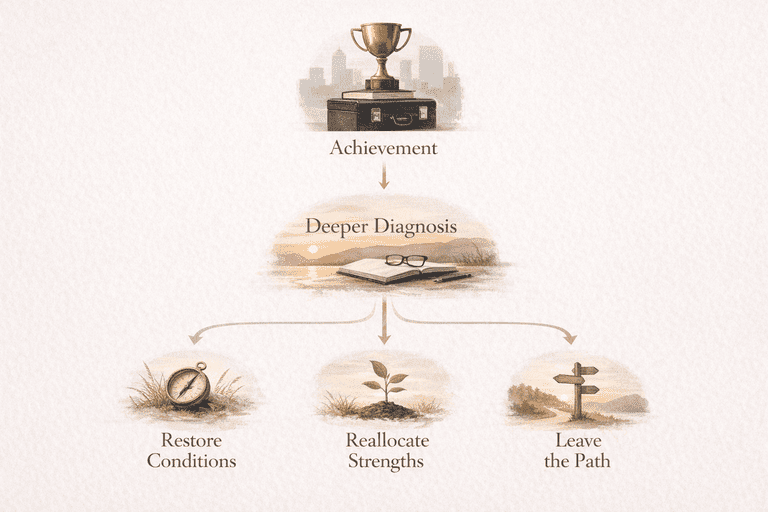
Do not jump from emptiness straight to total reinvention. Run the diagnosis in order.
Use the keep-and-change exercise to move from an overall feeling to specific tasks, conditions, and a small change you can observe.
Ask What Part Of The Work Still Feels Alive
Be precise.
Is there anything in the work you still genuinely want more of?
- the problem-solving
- the teaching
- the building
- the relationships
- the strategic thinking
- the design
- the research
If yes, the smarter move may be adjacent rather than total. If almost nothing feels worth carrying, the signal is stronger.
Ask Whether Better Conditions Would Restore Meaning Or Only Reduce Pain
This is the burnout versus fit question in practical form.
Would better boundaries, better management, better workload, or a healthier team make the work feel meaningful again? Or would those changes only make it easier to tolerate?
Tolerance and meaning are not the same thing.
Ask Whether You Want The Future, Not Just Relief From The Present
Sometimes people misread emptiness because they are mostly trying to escape today's stress. That matters, but it is not the whole question.
Ask instead:
If this path went well from here, would I want the life it creates?
That question often clarifies more than any mood check does.
Ask What You Have Been Protecting
Often the path continues because it protects something real:
- income
- identity
- status
- certainty
- family stability
That does not make the path right. It just explains why the diagnosis took so long.
Ask Whether Success Has Become A Delay Mechanism
This is the harder question.
Sometimes success does not solve the problem. It delays the moment you have to admit the problem. Each promotion, raise, or signal of external validation makes it easier to say, "I should stay a little longer."
That can be rational for a while. It is not the same thing as fit.
What A Better Outcome Usually Looks Like
The solution is not always quitting. Often it is reallocation.
That means:
- preserving the strengths you still want to use
- dropping the parts of the role that are draining the life out of you
- moving toward work that uses ability and motivation together more cleanly
For some people, that means a better version of the same field. For others, it means an adjacent shift. For others, it means finally admitting the path was good for a season but no longer right.
The key is that success should stop being treated as the final argument. It is only one input.
What Success Was Supposed To Feel Like
Part of the shock here is expectation failure. Many people assumed success would feel more conclusive than it does. When it does not, they often blame themselves before they question the path. That reaction is understandable and often exactly what keeps the emptiness hidden longer.

Final Answer
You can feel empty at work even when you are successful because success can continue after meaning, motivation, and future pull have already started breaking down.
The strongest version of this pattern is not simple tiredness or simple boredom. It is repeated achievement without deeper connection to the work or the future it is creating. When that feeling survives better conditions, rising rewards, and short-term fixes, it usually points toward a fit problem that external success has been masking.
That is not ingratitude. It is information.
References
[1] World Health Organization. Burn-out an occupational phenomenon.
[2] CDC NIOSH. What burnout is and is not.
[3] Verquer, M. L., Beehr, T. A., & Wagner, S. H. (2003). A meta-analysis of relations between person-organization fit and work attitudes. Journal of Vocational Behavior, 63(3), 473-489.
[4] Kristof-Brown, A. L., Zimmerman, R. D., & Johnson, E. C. (2005). Consequences of individuals' fit at work: A meta-analysis of person-job, person-organization, person-group, and person-supervisor fit. Personnel Psychology, 58(2), 281-342.
[5] Yang, W.-N., Niven, K., & Johnson, S. (2019). Career plateau: A review of 40 years of research. Journal of Vocational Behavior, 110, 286-302.
[6] Deci, E. L., Olafsen, A. H., & Ryan, R. M. (2017). Self-determination theory in work organizations: The state of a science. Annual Review of Organizational Psychology and Organizational Behavior, 4, 19-43.
[7] Rosso, B. D., Dekas, K. H., & Wrzesniewski, A. (2010). On the meaning of work: A theoretical integration and review. Research in Organizational Behavior, 30, 91-127.
[8] Allan, B. A., et al. (2018). Meaningful work and mental health: Job satisfaction as a moderator. Journal of Mental Health.
Get A Clearer Career Signal
Take the assessment to see what fits, what feels off, and which roles are more likely to suit you.

Builds CareerMeasure hands on and writes about career fit, role transitions, and the gap between generic personality advice and evidence-based career decisions.
Community Discussion
Share your thoughts about this article
Delete Comment?
Are you sure you want to delete this comment? This action cannot be undone.