

Why "Follow Your Passion" Is Bad Career Advice

"Follow your passion" sounds like brave career advice. For most adults, it is not. It is vague, incomplete, and often expensive in the wrong way.
The problem is not that passion is fake. The problem is that adult career decisions are bigger than one feeling. People are balancing motivation, strengths, money, timing, obligations, identity, and the practical question of what kind of move is realistic from where they already are. That is why "follow your passion" often produces confusion instead of clarity. It turns a complicated decision into a slogan.
The Short Answer
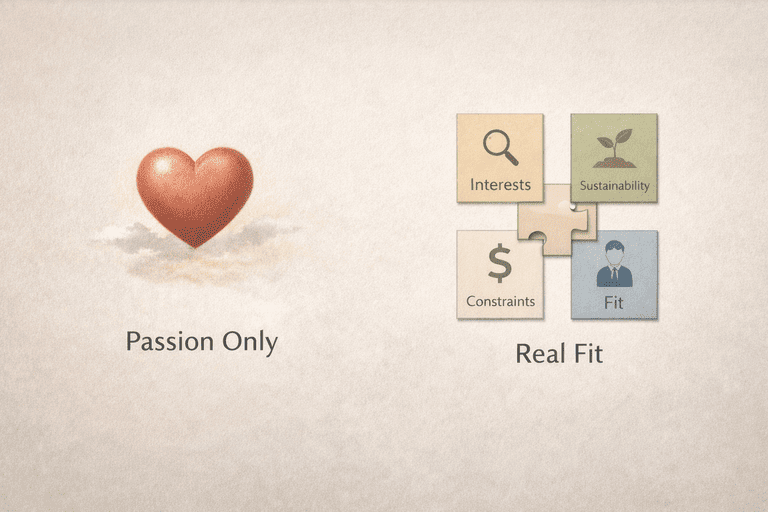
Passion matters, but it is a bad standalone decision rule. Interests can point you toward better work. Meaning matters. Enjoyment matters. But for most adults, a strong career decision also has to account for whether the work is sustainable, whether the environment fits, whether the move is realistic, and whether the life around the work still works.
Research points in the same direction. Interests can develop instead of arriving fully formed.[1] Motivation at work depends on more than excitement alone.[2] Constraints matter in whether meaningful work is even accessible.[3] And not all passion is healthy: harmonious passion and obsessive passion lead to very different outcomes.[4]
So the better question is not "What am I passionate about?" It is: what kind of work content energizes me, what conditions sustain me, what constraints are real, and what next move improves fit without forcing fantasy?
Why This Advice Refuses To Die
The advice survives because it flatters a deep hope.
People want to believe there is one right thing they are supposed to do. They want to believe that if they can identify it clearly enough, the rest of the career problem will collapse into place. A phrase like "follow your passion" promises that kind of simplicity.
It also feels morally attractive. It sounds brave, authentic, and anti-corporate. It feels better than advice about tradeoffs, experimentation, constraints, and gradual repositioning. "Follow your passion" gives people a story in which the only real enemy is fear.
That is emotionally powerful. It is also why the advice gets repeated so often by people who are not paying the cost of the decision.
The phrase is not wrong in every possible sense. It points toward one real insight: what interests you and what gives you energy matter. Work is usually easier to sustain when the content is not fundamentally dead to you. People who completely ignore their interests often end up in roles they can perform but cannot live inside very well.
That part is important. O*NET's Interest Profiler still exists for a reason: work interests are real, measurable, and useful for exploration.[9] A good career process should absolutely care about what kinds of work activities feel alive to you. The problem starts when that one truth becomes the whole model.
Five Problems With The Advice
1. Passion Is Often Developed, Not Found
The current-career fit guide separates appealing subject matter from the tasks and conditions that make up the working day.
This is one of the most important corrections.
Many people hear "follow your passion" and imagine that passion should already be present in a clear, stable, discoverable form. If they cannot identify it instantly, they assume they are blocked, confused, or behind.
That is a bad frame.
Research by O'Keefe, Dweck, and Walton on implicit theories of interest makes a useful distinction here. People with a more fixed view of interests tend to believe passions are found whole. People with a growth view are more likely to see interests as developed over time through exposure, effort, and deeper engagement.[1] That matters because careers rarely become meaningful in one flash of recognition. More often, people get interested, build competence, find deeper challenge, and then develop stronger commitment as the work becomes more legible and more rewarding.
In plain English, many adults do not have a hidden perfect passion waiting to be uncovered. They have a set of interests that can deepen, combine, or become more compelling when the context improves and the work gets more specific.
That alone makes "follow your passion" weaker advice than it sounds. It treats career direction like treasure hunting when it is often closer to cultivation.
2. Passion Alone Does Not Tell You Whether Work Will Hold Up
A role can feel exciting and still be a bad long-term fit.
This is where people confuse attraction with sustainability. You can be passionate about an outcome, a mission, or an identity story and still dislike the daily work required to support it. You can be drawn to writing, helping people, entrepreneurship, design, teaching, or advocacy and still hate the pace, politics, precarity, or social demands of the real work.
That is one reason self-determination theory is more useful than passion slogans. In work settings, motivation is shaped by whether the role supports autonomy, competence, and relatedness in the right ways.[2] A career can look fascinating from the outside and still frustrate those needs badly enough that the person becomes depleted, brittle, or disengaged.
"Passion" is too imprecise to capture that. It does not tell you:
- whether you like the daily task mix
- whether the environment supports how you work best
- whether the social exposure is energizing or draining
- whether the rewards justify the cost
- whether the path becomes more attractive as you advance
That is how people end up in work they once idealized but no longer want. The mission still matters to them, but the day-to-day work does not. The identity still sounds admirable, but the actual life is too unstable, too exposed, too political, or too draining to keep carrying. Passion can get you interested. It cannot tell you by itself whether the work will remain livable.
That is why adults so often end up saying some version of: "I cared about this, but I do not actually want this life."
3. Not All Passion Is Healthy
Even when passion is real, it is not always good.
Vallerand's dualistic model of passion is useful here because it separates harmonious passion from obsessive passion.[4] Harmonious passion is integrated into life in a healthier way. Obsessive passion is more controlling, more rigid, and more likely to create conflict with other needs and roles.
That distinction matters a lot for work.
Some people hear "follow your passion" and move toward work they cannot detach from. They end up measuring their worth entirely through the activity. They rationalize bad boundaries because the work feels meaningful. They accept poor conditions because they are "doing what they love." They become easier to exploit precisely because they care so much.
This is one reason passion rhetoric can be dangerous. It can make overidentification sound noble.
The healthier version is not "never care deeply." It is caring deeply without handing one activity total control over your identity, your relationships, your financial stability, and your boundaries.
4. Adults Have Constraints, Not Just Dreams
This is where the slogan becomes especially weak for adults.
A teenager choosing electives and a 37-year-old with bills, dependents, accumulated skills, and a fragile tolerance for instability are not facing the same decision. Telling both of them to "follow your passion" as if the choice architecture were identical is unserious.
OECD guidance on adult career support keeps returning to the same reality: adults usually need guidance because they are changing jobs, responding to labor-market change, or trying to make a better decision from where they already are.[5] That is not the same as choosing from zero.
The psychology of working literature reinforces the same point. Access to meaningful work is shaped partly by social class, work volition, and socioeconomic constraints, not only by inner desire.[3] So when people say "just follow your passion," they often smuggle in the assumption that everyone has the same room to experiment, the same margin for risk, and the same ability to absorb a bad transition. They do not.
Good career advice has to respect reality, not pretend reality is a lack of courage.
5. The Advice Ignores Existing Career Capital
For adults, the more useful question is often not "What do I love most?" but "What should I keep, what should I stop doing, and what kind of move improves fit without wasting too much useful experience?"
This is where "follow your passion" clashes with how real transitions often work.
Mid-career changers usually do not benefit from treating themselves like blank slates. Research on career adaptabilities for mid-career changers points instead toward resources like concern, control, curiosity, confidence, and commitment as part of making successful transitions over time.[8] That is a much more grounded frame than waiting for passion to solve direction.
Adults often need:
- a clearer diagnosis of what is wrong in the current role
- a better understanding of which strengths still transfer
- a realistic sense of transition distance
- enough adaptability to test smaller, smarter moves
That is why adjacent transitions are so often stronger than dramatic reinventions. They use existing capital instead of pretending existing capital does not matter.
What To Use Instead
If "follow your passion" is too thin, what should replace it?
To explore interests concretely, the O*NET Interest Profiler review links the official free tool and shows how to investigate three possible directions afterward.
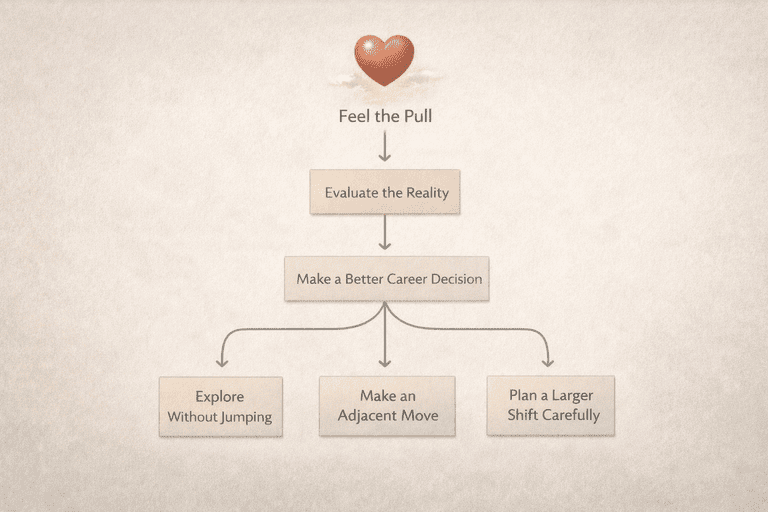
I would use a five-part test instead. The goal is not to suppress desire or become purely risk-avoidant. It is to treat desire as one useful signal inside a better decision system.
1. Start With Work Interests, Not Fantasy Identities
Ask what kinds of work content repeatedly pull your attention in a durable way.
Not what sounds impressive. Not what matches a romantic self-image. The actual work content:
- explaining
- building
- investigating
- organizing
- teaching
- persuading
- improving systems
- caring for people
- designing
- troubleshooting
This is where interest tools can help. Their job is not to issue a destiny statement. Their job is to clarify where energy tends to rise.
2. Check Whether The Motivation Is Sustainable
A career should not only attract you. It should hold up.
That means asking:
- do I want the daily work or only the identity around it?
- does this role support autonomy, competence, and relatedness in ways I can sustain?
- would I still want this if the novelty wore off?
This is where many people discover they are not actually chasing passion. They are chasing escape, status, symbolism, or relief from a current bad role.
3. Respect Constraints Without Letting Them Rule Everything
Constraints are not proof you should stay stuck. They are also not irrelevant.
Money, debt, caregiving, geography, health, visa realities, and timing all matter. Pretending otherwise creates fake courage stories. Better career decisions are usually made by working with constraints honestly, then identifying the highest-leverage move available inside them.
That may mean a slower transition. It may mean skill-building before jumping. It may mean an adjacent move instead of a total reset. None of that is failure.
4. Look For Job Crafting Before Total Escape
Sometimes the smartest move is not to abandon the field. It is to change the design of the work you already have.
Job crafting research is useful here because it recognizes that people can reshape tasks, relationships, and meaning in work, and that this can improve person-job fit and meaningfulness over time.[6] Later longitudinal work reinforces that same link between crafting, fit, and meaningfulness rather than treating the idea as only conceptual.[7]
That does not mean every bad role can be saved. It means some people think they need a new passion when what they actually need is:
- less client exposure
- more deep work
- a different task mix
- stronger boundaries
- a better team
- a role that uses the same strengths differently
That is not glamorous advice, but it is often better.
5. Judge The Future Life, Not Only The Current Excitement
One of the best questions in career decision-making is this:
If this path goes well, do I want the life it leads to?
That question is stronger than "Am I passionate about it right now?" because it forces you to think about the actual shape of success. The senior version of the path, the tradeoffs, the pace, the expectations, the relationships, the boundaries, the identity cost.
Passion can pull you toward a direction. It cannot answer that whole question.
A Better Rule Than "Follow Your Passion"
If I had to replace the slogan with one line, it would be this:
Follow stronger-fit work, not just stronger-feeling work.
Stronger-fit work is work where:
- the content genuinely interests you
- the motivation is sustainable
- the strengths you rely on feel usable, not overused
- the environment is livable
- the move is realistic from where you are now
That is a much better rule for adults because it respects both energy and reality.
Final Answer
"Follow your passion" is bad career advice because it turns a multi-variable decision into a slogan. It assumes passion is already fully formed, assumes excitement is enough to guide a major choice, ignores unhealthy forms of passion, and downplays the real constraints adults carry.
Better career decisions usually come from something more grounded: interests, sustainable motivation, realistic constraints, existing strengths, and a next move that improves fit without requiring fantasy.
Passion still matters. It just does not deserve to run the whole decision alone.

References
[1] O'Keefe, P. A., Dweck, C. S., & Walton, G. M. (2018). Implicit Theories of Interest: Finding Your Passion or Developing It? Psychological Science, 29(10), 1653-1664.
[2] Deci, E. L., Olafsen, A. H., & Ryan, R. M. (2017). Self-Determination Theory in Work Organizations: The State of a Science. Annual Review of Organizational Psychology and Organizational Behavior, 4, 19-43.
[3] Allan, B. A., Autin, K. L., & Duffy, R. D. (2016). Self-Determination and Meaningful Work: Exploring Socioeconomic Constraints. Frontiers in Psychology, 7, 71.
[4] Vallerand, R. J. (2012). From Motivation to Passion: In Search of the Motivational Processes Involved in a Meaningful Life. Psychology of Well-Being, 2(1).
[5] OECD. Career Guidance for Adults in a Changing World of Work.
[6] Wrzesniewski, A., & Dutton, J. E. (2001). Crafting a job: Revisioning employees as active crafters of their work. Academy of Management Review, 26(2), 179-201.
[7] Tims, M., Derks, D., & Bakker, A. B. (2016). Job crafting and its relationships with person-job fit and meaningfulness: A three-wave study. Journal of Vocational Behavior, 92, 44-53.
[8] Brown, A., Bimrose, J., Barnes, S. A., & Hughes, D. (2012). The role of career adaptabilities for mid-career changers. Journal of Vocational Behavior, 80(3), 754-761.
[9] O*NET Resource Center. Interest Profiler (IP) at O*NET Resource Center.
Get A Clearer Career Signal
Take the assessment to see what fits, what feels off, and which roles are more likely to suit you.

Builds CareerMeasure hands on and writes about career fit, role transitions, and the gap between generic personality advice and evidence-based career decisions.
Community Discussion
Share your thoughts about this article
Delete Comment?
Are you sure you want to delete this comment? This action cannot be undone.