

What To Do After Teaching:
Adjacent Roles in Learning, Training, and Design

Many teachers who want to leave the classroom do not actually want to leave learning work.
They want to leave the institutional conditions around teaching. They want less emotional overload, less behavior management, less unpaid prep, less bureaucracy, less constant public-facing intensity. But they may still like explaining, structuring information, helping people improve, building clarity from confusion, and designing something that makes learning more likely.
That is why "What do I do after teaching?" often gets answered too broadly. The issue is not only how to leave education. The issue is how to separate the parts of teaching you want to stop doing from the parts you still want your next role to be built around.
The Short Answer
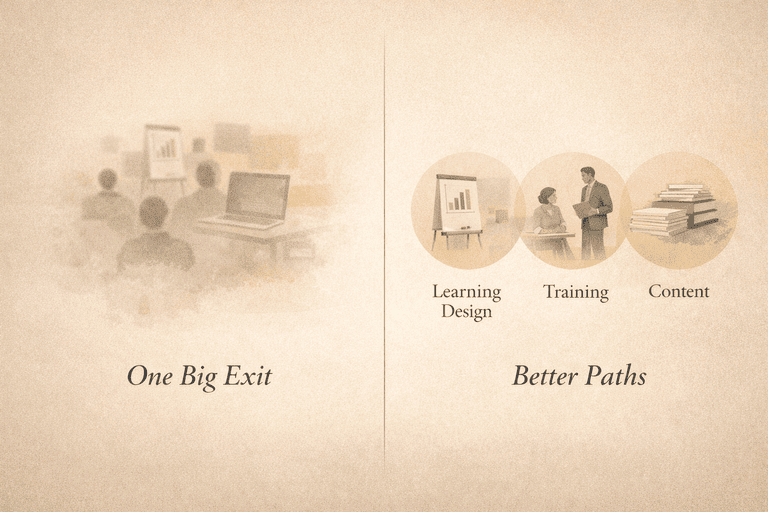
If you still care about learning work but want out of classroom teaching, the strongest adjacent paths usually fall into three families:
- learning design: building learning experiences, materials, assessments, and content structure
- training: facilitating learning for adults, onboarding, enablement, or workforce development
- education content or curriculum work: writing, revising, aligning, or improving instructional material
Those are related, but they are not the same path. The better question is not "What can I do after teaching?" It is: do I want to design learning, deliver learning, or shape learning content behind the scenes? Once that distinction is clear, the transition gets much more practical.[1] O*NET is useful here because it exposes adjacent overlap through real work content, not just title proximity.[2] The search structure then makes that overlap more usable in real role exploration.[3]
Why This Narrower Question Works Better
Generic teacher-exit advice often creates noise.
You get long lists with dozens of options:
- instructional designer
- academic advisor
- customer success manager
- executive assistant
- project coordinator
- curriculum specialist
- corporate trainer
- operations associate
That kind of list can be useful for brainstorming, but it does not solve the real decision problem. It treats "leaving teaching" as one giant category when most teachers are actually trying to answer a smaller question:
- Do I still want to work around learning?
- Do I still want to facilitate live?
- Do I want more deep work and less public-facing intensity?
- Do I want to stay in mission-aligned work, or move into business settings?
That is why this narrower cluster matters. Learning, training, and design sit close enough to classroom teaching that real transfer is possible, but different enough that the daily life can improve meaningfully. O*NET's related-occupations logic reflects the same principle: occupations are often adjacent because of shared activities, knowledge, and work demands, not because they share the same title.[2] The search structure makes that overlap visible in a practical way instead of leaving it as an abstract idea.[3]
In practice, this means many teachers should not start by asking, "What totally different career could I do?" They should start by asking, "Which version of learning work still feels like mine?"
First Decide What You Are Trying To Stop Doing
Before you choose a path, name the source of the friction.
Many teachers are trying to leave one or more of these:
- classroom management
- family escalation
- institutional rigidity
- emotionally saturated days
- constant multitasking and interruption
- invisible labor
- low control over pace and standards
That matters because different adjacent roles remove different kinds of pain.
If your biggest issue is live social intensity, then training may not actually solve the problem. If your biggest issue is school bureaucracy rather than facilitation, training or student-facing support may still fit. If your biggest issue is emotional exhaustion, then content design or back-end instructional work may be stronger than any role that keeps you in constant human demand.
This is why burnout should not be confused with total career mismatch. Teacher attrition research keeps pointing to the weight of burnout, workload, and job conditions in why people leave.[4] NCES data reflects the same broader pressure pattern at the system level.[5] The presence of that pressure does not automatically mean you are done with all learning-related work. It may mean you are done with this version of it.
Three Better-Fit Paths To Explore
1. Learning Design
If none of these learning-focused paths removes the conditions you want to leave, the broader former-teacher comparison includes advising, customer education, and coordination options.
This path is strongest for teachers who liked the architecture of learning, not only the performance of teaching.
If you were energized by:
- structuring lessons
- sequencing learning
- anticipating confusion
- writing clear explanations
- designing practice and assessment
- revising materials when they did not land
then instructional design, learning experience design, and adjacent design roles are often a natural direction.
The appeal of this path is that it preserves a lot of what good teachers already do, but changes the mode. Instead of carrying a room all day, you spend more time building the conditions for learning to happen well. That often means more deep work, more revision, more documentation, and more asynchronous thinking.
What transfers well:
- learning objectives
- sequence and scaffolding
- clarity of explanation
- assessment logic
- audience empathy
- revision based on learner friction
What changes:
- more tool and platform fluency
- more documented design rationale
- less live delivery
- more artifact-based proof of your thinking
This path fits best when you still care about learning outcomes but want more design and less constant interpersonal load.
2. Training and Facilitation
Some teachers do not actually want less live teaching energy. They want different learners, different conditions, or different stakes.
If you still like:
- reading a room
- facilitating discussion
- making difficult material understandable
- adjusting pace in real time
- helping confused people gain confidence
then training, learning and development, onboarding, customer education, and enablement roles may fit better than pure design work.
This path often appeals to teachers who still want human-facing work, but want to leave schools, children, or classroom systems. Adult learning also changes the dynamic. It requires different assumptions about motivation, prior experience, and autonomy, which is why adult-learning theory matters here.[8] The work is still about helping people learn, but not in the same social structure as K-12 teaching.
What transfers well:
- live facilitation
- explanation for mixed-experience audiences
- confidence-building
- session pacing
- attention management
- reading and responding to confusion
What changes:
- adult learners instead of children
- stronger business or performance context
- more stakeholder influence
- sometimes less emotional saturation, but not always less social demand
This path fits best when the teacher still likes live learning energy but wants a better environment for it.
3. Education Content, Curriculum, and Assessment Work
This path is strongest for teachers who liked the intellectual shaping of learning more than the constant delivery of it.
If you cared most about:
- building stronger materials
- writing and editing content
- aligning standards
- improving assessments
- strengthening instructional quality
then curriculum, education publishing, assessment design, content development, and adjacent writing-heavy roles may fit better than either classroom teaching or training.
This path often attracts teachers who want more focus and less performance. They still want meaningful learning work, but in a way that feels more editorial, analytical, or design-oriented.
What transfers well:
- standards interpretation
- instructional writing
- assessment judgment
- audience-aware communication
- quality revision
What changes:
- less immediate learner feedback
- more document-centered work
- more production rhythm
- often more need for portfolio proof
This path fits best when you want to stay close to learning, but with more depth and less constant social exposure.
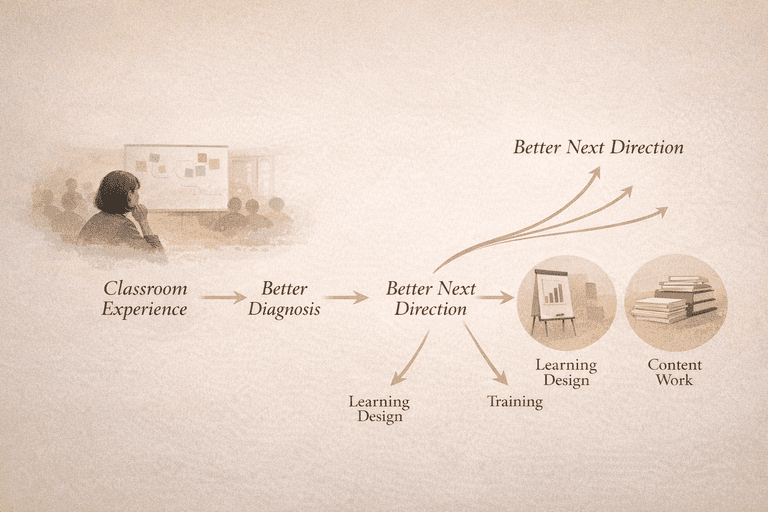
How To Choose And Validate The Right Path
At this point, the most useful question is not which path sounds prestigious. It is which path matches the part of teaching that still feels alive.
Use these filters.
If You Still Like The Live Moment, Look Harder At Training
Some teachers are exhausted by school conditions but still love the actual moment of facilitation. They like energy in the room. They like helping people "get it." They like guiding a group through uncertainty toward clarity.
If that is still true, a fully back-end role may feel flatter than expected. Training, L&D, or customer education may preserve more of what you actually liked.
If You Like Structure More Than Performance, Look Harder At Learning Design
Some teachers were always strongest before and after the lesson rather than during it. They loved mapping progression, tightening material, and seeing where learners would get lost before the problem happened.
Those teachers often feel more relief moving into design than into another live-facilitation role.
If You Want More Focus and Less Human Load, Look Harder At Content
Some teachers do not want another room, another cohort, another session, or another high-contact day. They want more concentration and more time to think. That usually points more toward content, curriculum, or assessment work than toward training.
The Risk Of Choosing Only By Relief
This is where people make avoidable mistakes.
If you are depleted enough, any non-classroom role can sound good. Relief becomes the whole decision rule. But relief is not the same as fit.
A teacher may leave the classroom for training and discover that the same live-energy demand still drains them. Another may move into content and discover they miss human interaction more than expected. Another may move into customer education and underestimate how much commercial context changes the feel of the work.
That is why adult career-change decisions usually improve when people combine two filters:
- what pain am I trying to reduce?
- what kind of work do I still want to organize my life around?
Career adaptability research reinforces the same logic. Strong mid-career transitions are not only emotional exits.[6] They are structured moves that combine curiosity, control, confidence, and realistic planning over time.[7]
The Daily Life Is Not The Same
This is the part many teachers need to slow down for.
All three paths can sound similar in a search bar because they sit near learning. But the lived rhythm can be very different.
Learning design usually rewards:
- patient thinking
- structure
- revision
- documentation
- comfort working through tools and systems
Training usually rewards:
- facilitation energy
- verbal clarity
- responsiveness in the moment
- confidence in front of adults
- comfort with repeated human interaction
Content and curriculum work usually rewards:
- writing quality
- editorial judgment
- consistency
- quiet concentration
- tolerance for less immediate feedback
That is why people get into trouble when they choose only by surface similarity. A teacher who says, "I like learning," may still dislike two of the three paths. Someone who loved teaching because of real-time interaction may feel flat in back-end design work. Someone who is desperate for less social intensity may accidentally recreate the same kind of depletion in a training role.
So the more useful question is not only, "Does this role connect to teaching?" It is:
- how much live interaction does it require?
- how much deep work does it require?
- how much ambiguity or tool-learning does it require?
- how much of the work is visible performance versus back-end craft?
That is where the paths separate in a meaningful way.
Mission-Adjacent or Business-Adjacent
Teachers also differ in how much they want to stay near education as a mission.
Some want to remain close to learner growth, developmental support, or education-facing organizations. Others are ready to move into business settings as long as the work still uses the same strengths.
That distinction often matters more than people expect.
For example:
- instructional design can exist in schools, higher education, nonprofits, healthcare, software companies, and internal corporate learning teams
- training can exist in mission-driven organizations, workforce programs, or commercially driven enablement and onboarding environments
- content work can sit inside education publishing, edtech, assessment companies, or broader business content systems
The title may look similar while the surrounding culture feels very different.
Some former teachers feel immediate relief in business-adjacent settings because expectations are clearer, boundaries are stronger, and emotional labor is lower. Others feel unexpected friction because the work is less mission-heavy, more commercial, or less relational than they hoped.
Neither reaction is wrong. It just means the transition choice is not only about function. It is also about context.
That is another reason to test for fit before overcommitting to one direction. The same teacher strengths can be expressed in multiple environments, but the environment still changes whether the work feels meaningful, sustainable, and worth building a life around.[1]
What To Build Before You Apply
Teachers usually become more credible faster when they stop trying to "sound corporate" and start proving continuity.
Use the transferable-skills worksheet to choose a portfolio artifact that demonstrates a target task and makes the remaining learning gap visible.
That often means:
- rewriting experience at the task and outcome level
- building a small portfolio or work sample
- learning the target role's language without becoming jargon-heavy
- narrowing the target instead of applying everywhere
- showing why the move is adjacent, not random
Examples:
- for learning design: show sequence, objectives, learning materials, assessment logic
- for training: show facilitation, onboarding, workshop structure, learner support
- for content or curriculum: show writing, revision, standards alignment, quality judgment
The point is not to deny that there is a gap. The point is to make the gap legible, limited, and bridgeable.
Final Answer
If you are asking what to do after teaching, a strong next move is often not a total exit from learning work. It is a narrower shift into the part of the work you still want to keep.
Learning design fits teachers who like structure, sequence, and building learning experiences. Training fits teachers who still like live facilitation and helping adults learn in real time. Content and curriculum roles fit teachers who want more focused, less socially saturated work while staying close to learning quality.
The smartest move is usually not to ask what job sounds most different from teaching. It is to ask which part of teaching you still want to preserve, which part you most need to stop doing, and which adjacent role makes that tradeoff most believable.

References
[1] OECD. Career Guidance for Adults in a Changing World of Work.
[2] O*NET Resource Center. O*NET Content Model.
[3] O*NET OnLine. Help: Advanced Searches.
[4] Madigan, D. J., & Kim, L. E. (2021). Towards an understanding of teacher attrition: A meta-analysis of burnout, job satisfaction, and teachers' intentions to quit. Teaching and Teacher Education, 105, 103425.
[5] National Center for Education Statistics. Teacher Turnover: Stayers, Movers, and Leavers.
[6] Brown, A., Bimrose, J., Barnes, S. A., & Hughes, D. (2012). The role of career adaptabilities for mid-career changers. Journal of Vocational Behavior, 80(3), 754-761.
[7] Savickas, M. L., & Porfeli, E. J. (2012). Career Adapt-Abilities Scale: Construction, reliability, and measurement equivalence across 13 countries. Journal of Vocational Behavior, 80(3), 661-673.
[8] Knowles, M. S., Holton, E. F., & Swanson, R. A. (2015). The Adult Learner: The definitive classic in adult education and human resource development (8th ed.). Routledge.
See Your Stronger-Fit Next Moves
Get a clearer picture of which adjacent paths fit you better before making a bigger jump.

Builds CareerMeasure hands on and writes about career fit, role transitions, and the gap between generic personality advice and evidence-based career decisions.
Community Discussion
Share your thoughts about this article
Delete Comment?
Are you sure you want to delete this comment? This action cannot be undone.