

What Can Nurses Do Besides Bedside Care? Adjacent Career Paths That Still Fit

Nurses can work beyond bedside care in coordination, triage, education, quality, informatics, and operations. First separate a nursing role outside the ward from a role that does not involve nursing practice. That distinction affects the clinical responsibility, license requirements, and evidence an employer may expect.
A remote or office-based position can still involve patient assessment, high caseloads, targets, or escalation. Use the role descriptions below to investigate the work and its requirements rather than assuming that "non-bedside" means nonclinical or less demanding.
Separate Nursing Practice From A Nonclinical Move
The regulatory examples here are U.S.-specific. NCSBN explains that nursing practice occurs where the patient is located, including care delivered through telehealth and telephone.[12] Check the relevant board and the employer's requirements for the actual duties and locations. A remote job title does not remove a nursing practice requirement.
| Kind of move | Examples to investigate | License and experience check | Evidence to build without patient data |
|---|---|---|---|
| Nursing practice outside the bedside | RN care coordination, telephone triage, clinical utilization review | Treat these as clinical roles; establish practice authority, clinical experience, supervision, and escalation scope | A fictional handoff or workflow example, clearly marked as an illustration |
| Roles combining nursing and systems work | Nursing informatics, nursing professional development, nursing quality leadership | Check whether the employer requires an active RN license, specialty experience, a degree, or certification | A de-identified process description or a fully invented training example |
| Roles outside nursing practice | General project coordination, software implementation, administrative operations, nonclinical learning-content production | Establish that the duties do not include nursing practice; employer-specific technical or business requirements may still apply | A fictional project plan, a public-tool walkthrough, or a general training artifact |
Certification is a separate question from whether a role is available to you. For example, ANCC's informatics nursing certification has RN licensure, education, experience, and specialty eligibility requirements.[13] A short course does not automatically satisfy them, and certification eligibility is not a universal job description for every health-technology role.
Ask the employer: "Which decisions in this job require clinical judgment, and what must I escalate?" Then ask about caseloads, on-call coverage, productivity measures, and where patients are located. These details help distinguish an appealing setting from a workable change.
Use the transferable-skills worksheet to translate your coordination and documentation evidence. If the uncertainty is mainly about your current setting, the job-versus-career guide helps you compare a setting change with a larger move. An assessment can support reflection, but the career-test buyer guide explains why it cannot settle credentials or scope of practice.
Why "Besides Bedside" Is A Better Question Than "Should I Leave Nursing?"
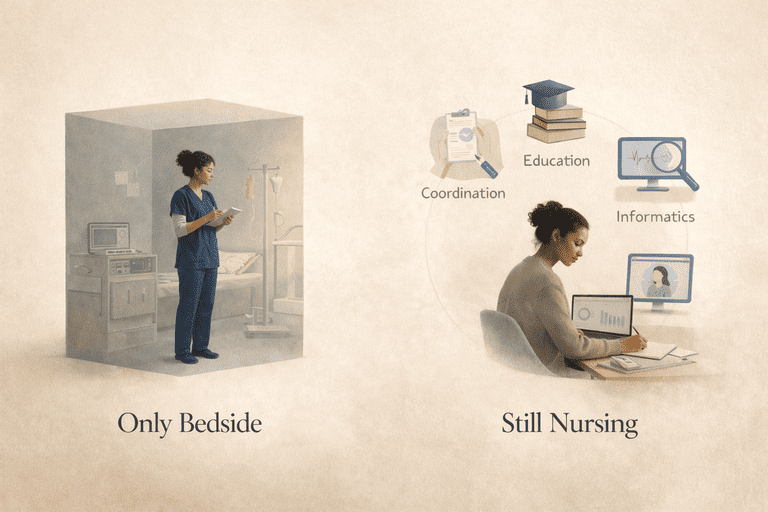
Bedside care compresses so much of nursing into one role that people start to confuse the setting with the profession.
But nursing is much broader than one environment. The National Academies' Future of Nursing 2020-2030 describes nurses as working across care delivery, education, technology, coordination, leadership, community settings, and systems improvement, not only inside acute bedside roles.[4] The BLS outlook for registered nurses also reflects that broader reality, describing pathways into management, education, ambulatory settings, and advanced or specialized practice, not just inpatient care.[1]
That matters because the question "Should I leave nursing?" can become too total too fast. It turns a role problem into an identity problem.
A more disciplined read usually starts with what is actually breaking:
- the physical wear
- the schedule
- the patient load
- the emotional exposure
- the pace and staffing
- the lack of control
- the mismatch between your strengths and the current environment
Nursing burnout research keeps pointing to that cluster of pressures. A meta-analysis found an association between burnout and nurses' intentions to leave.[5] A separate nursing review describes multiple work-related factors; most included studies were cross-sectional, so those associations should not be read as a single proven cause.[6] That does not automatically tell you to stay in nursing. It does tell you not to assume bedside is the whole profession.
First Decide What You Need Less Of
Before looking at adjacent paths, name the pressure you are actually trying to reduce.
Common patterns:
- less physical intensity: lifting, long shifts, constant motion, bodily wear
- less acute emotional saturation: repeated exposure to crisis, grief, and moral distress
- less schedule chaos: nights, weekends, rotation, short staffing, unstable recovery time
- less constant multitasking: high interruption, fragmented attention, documentation under speed
- less direct bedside load: fewer moment-to-moment patient care demands
This matters because different adjacent roles solve different problems.
A nurse who wants less physical intensity but still likes patient decision-making may fit telehealth or triage well. A nurse who wants less real-time patient intensity may fit quality or informatics better. A nurse who still likes teaching may fit education. A nurse who likes systems and coordination may fit case management or operational roles.
If you skip this step, the search gets sloppy. Everything outside the bedside can start to look equally attractive even though the day-to-day life is very different.
Six Better-Fit Paths To Explore
1. Care Coordination and Case Management
This is one of the strongest adjacent paths for nurses who still like the logic of care, but want less direct bedside intensity.
Care coordination is fundamentally about organizing care across people, settings, and transitions so the patient gets safer and more effective support.[7] CMS and AHRQ both treat that cross-setting continuity as a core quality and safety function rather than administrative filler.[8] That makes it a natural fit for nurses who are strong at seeing the whole picture, anticipating next steps, catching gaps, and communicating across fragmented systems.
What transfers well:
- prioritization
- escalation judgment
- discharge and transition thinking
- family communication
- interdisciplinary coordination
- patient education
What changes:
- less hands-on care
- more systems navigation
- more documentation and communication work
- more longitudinal coordination rather than shift-based intervention
This path is strongest for nurses who still care deeply about continuity and outcomes, but want less physical bedside strain.
2. Ambulatory Triage and Telehealth
Some nurses do not want to leave patient-facing work. They want a different format for it.
Ambulatory triage and telehealth roles can make sense for nurses who still like assessment, patient guidance, and deciding what should happen next, but want less bedside intensity. NCSBN's telehealth guidance reflects how nursing practice can extend into remote and telephonic settings while still requiring real clinical judgment, communication, and licensure discipline.[9]
What transfers well:
- symptom assessment
- risk recognition
- patient education
- escalation decisions
- calm communication under uncertainty
What changes:
- less physical care
- more remote interpretation
- more dependence on communication precision
- less visible feedback from the patient environment
This path is strongest for nurses who still want direct clinical relevance, but in a more controlled or less physically punishing setting.
3. Nurse Education and Professional Development
Some nurses are most energized when they are helping others become more capable.
If you like onboarding, teaching patients, precepting, explaining procedures, building confidence in less experienced staff, or structuring learning, then nurse education or professional development can be a strong path. The profession's future-facing literature continues to emphasize education, leadership, and systems improvement as major areas where nurses contribute beyond direct bedside care.[4]
What transfers well:
- explanation under pressure
- teaching and coaching
- standards-based judgment
- practical demonstration
- learner empathy
What changes:
- less continuous bedside assignment
- more planning and facilitation
- more curriculum, orientation, or competency work
- more indirect impact through others
This path is strongest for nurses who still want people-centered work, but want the emphasis to shift from acute care delivery to capability-building.
4. Quality, Safety, and Utilization-Focused Roles
Some nurses eventually realize that what they are best at is seeing patterns in how care succeeds or breaks.
Quality, safety, and utilization-focused work can fit nurses who are attentive to process, standards, documentation, outcomes, and the systems conditions around care. These roles often rely on the same clinical reasoning nurses use at the bedside, but apply it to trend recognition, compliance, utilization logic, or process improvement rather than live bedside intervention.
What transfers well:
- documentation judgment
- risk recognition
- standards awareness
- pattern recognition
- escalation logic
What changes:
- less direct patient interaction
- more policy, audit, or systems framing
- more cross-functional communication
- more abstract distance from immediate care
This path is strongest for nurses who still want their clinical judgment to matter, but do not need the work to stay tied to continuous bedside contact.
5. Informatics
This path is often a strong fit for nurses who care about workflow, technology friction, data quality, and how systems shape care.
HIMSS defines nursing informatics as the specialty that integrates nursing science with information and analytical sciences to manage and communicate data, information, knowledge, and wisdom in nursing practice.[10] In practice, that means the role often sits at the intersection of care, systems, technology, implementation, and change.
What transfers well:
- understanding how clinical work actually happens
- recognizing workflow friction
- documentation logic
- safety awareness
- translating between bedside reality and systems design
What changes:
- much less direct patient care
- more systems thinking
- more project, build, or optimization work
- more stakeholder coordination across clinical and technical teams
This path is strongest for nurses who are repeatedly frustrated by bad systems and want to work on the infrastructure around care rather than only inside the shift.
6. Leadership, Operations, and Program Roles
Some nurses are strongest not only clinically, but organizationally.
If you are the person who naturally sees staffing problems, workflow bottlenecks, handoff failures, escalation gaps, or unit-level inefficiencies, leadership and operations-adjacent roles may fit better than another purely clinical track. AONL's nurse leader competencies reflect how nursing leadership work expands into systems influence, people leadership, communication, and organizational judgment.[11]
What transfers well:
- triage and prioritization
- team coordination
- escalation under pressure
- operational awareness
- communication across disciplines
What changes:
- less bedside contact
- more management or systems responsibility
- more accountability for process and people
- greater distance from direct patient impact
This path is strongest for nurses who still want high responsibility, but want the responsibility to operate at a team, unit, or systems level rather than inside bedside care itself.
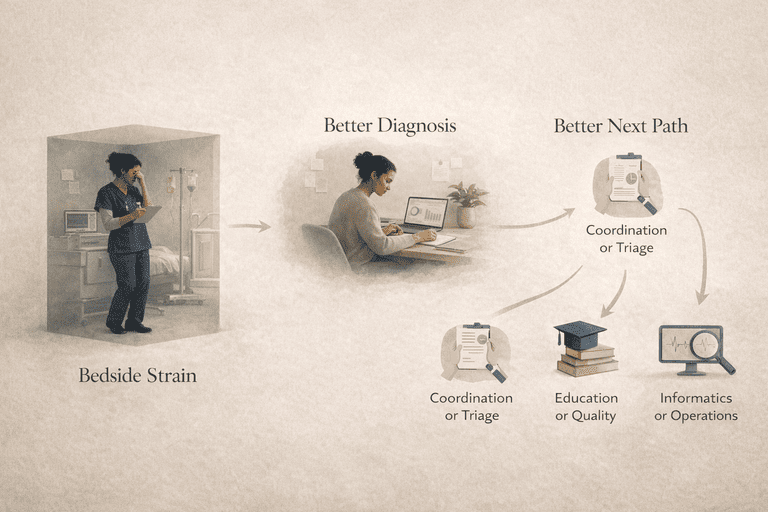
How To Choose And Validate The Right Path
The biggest mistake here is choosing only by what you want to escape.
A better filter is:
What Part Of Nursing Still Feels Like Yours?
Examples:
- clinical judgment
- patient education
- systems thinking
- coordination
- teaching
- workflow improvement
If you cannot answer that, every adjacent role starts sounding equally plausible.
What Kind Of Contact Do You Still Want?
Do you still want:
- live patient interaction?
- family communication?
- staff development?
- no direct care at all?
- clinical relevance without bedside intensity?
That answer separates telehealth from informatics, education from quality, and coordination from operations.
What Kind Of Day Would Actually Feel Better?
Do you want:
- fewer physical demands?
- less schedule disruption?
- more deep work?
- more system-level work?
- fewer crises and fewer interruptions?
Different roles solve different versions of that problem.
The Risk Of Choosing Only By Exhaustion
This is where nurses can make avoidable mistakes.
If you are exhausted enough, almost any non-bedside job can feel like salvation. But relief is not the same thing as fit.
A nurse may leave bedside care for case management and discover that the documentation and coordination load is fine, but the lack of direct care feels empty. Another may move into education and realize they still do not want a role with heavy human exposure all day. Another may move into informatics and find the loss of clinical immediacy more jarring than expected.
That does not mean the move was wrong to explore. It means the decision needs two filters:
- what kind of strain am I reducing?
- what kind of nursing work do I still want to organize my life around?
That is the difference between a clean exit from bedside and a stronger long-term fit.
The Feel Of The Work Changes A Lot
This is the part many nurses need to slow down for.
All of these roles sit near nursing, but the day still feels very different depending on the path.
Care coordination and case management often feel:
- broader and more longitudinal
- communication-heavy
- system-facing rather than procedure-facing
- less physically intense but still emotionally engaged
Telehealth and triage often feel:
- clinically relevant
- faster and more judgment-heavy than they look from the outside
- lighter physically
- more dependent on communication precision because you are missing visual and environmental information
Education roles often feel:
- more developmental
- more people-focused
- less acute
- more centered on helping others become capable rather than carrying direct patient load yourself
Quality, utilization, and informatics roles often feel:
- more systems-oriented
- more document and workflow heavy
- less physically and emotionally intense in the bedside sense
- more abstract, which some nurses find relieving and others find distancing
That difference matters because not every non-bedside role solves the same problem. A nurse who still wants strong clinical relevance may feel flat in a highly abstract informatics role. A nurse who desperately needs less human exposure may find education too socially demanding. A nurse who wants less physical strain but still likes direct guidance may feel better in telehealth or coordination than in pure quality work.
So the real decision is not only, "Is this role outside the bedside?" It is:
- how close do I still want to stay to live patient care?
- how much human intensity do I still want in the day?
- how much of my satisfaction comes from direct impact versus systems impact?
- how much abstraction, documentation, and process work am I actually willing to live inside?
That is where adjacent-path decisions become much sharper.
What To Build Before You Apply
Nurses usually become more credible faster when they translate their bedside experience into the actual logic of the target role.
That often means:
- rewriting bedside experience at the task and judgment level
- showing continuity instead of only escape
- identifying any real gap in tools, documentation style, or role-specific language
- narrowing the target instead of applying to every non-bedside role at once
- building proof where needed through projects, committee work, cross-training, or certifications only when they materially help
The point is not to pretend every adjacent move is effortless. The point is to make the move coherent. A stronger story is not "bedside nurse trying to get out." It is "nurse with strong clinical judgment, patient education, coordination, and systems awareness moving into a role where those strengths still matter under better conditions."
Final Answer
The best non-bedside paths for nurses are usually adjacent roles that keep real nursing judgment while changing the mode of work.
Care coordination, telehealth, education, quality, informatics, and operations-adjacent roles often make sense because they preserve core nursing strengths while reducing bedside-specific strain. The smartest move is usually not to ask what nurses are "allowed" to do besides bedside care. It is to identify which part of bedside care you need less of, which part of nursing you still want to keep, and which adjacent role makes that tradeoff realistic.

References
[1] U.S. Bureau of Labor Statistics. Registered Nurses. Occupational Outlook Handbook.
[2] O*NET Resource Center. O*NET Content Model.
[3] O*NET OnLine. Help: Advanced Searches.
[4] National Academies of Sciences, Engineering, and Medicine. The Future of Nursing 2020-2030: Charting a Path to Achieve Health Equity.
[5] Özkan, A. H. (2022). The effect of burnout and its dimensions on turnover intention among nurses: A meta-analytic review. Journal of Nursing Management, 30(3), 660-669.
[6] Dall'Ora, C., Ball, J., Reinius, M., & Griffiths, P. (2020). Burnout in nursing: A theoretical review. Human Resources for Health, 18, 41.
[7] Centers for Medicare & Medicaid Services. Care Coordination.
[8] Agency for Healthcare Research and Quality. Care Coordination.
[9] National Council of State Boards of Nursing. International Guiding Principles for Telehealth Nursing.
[10] HIMSS. What is Nursing Informatics?
[11] American Organization for Nursing Leadership. AONL Nurse Leader Core Competencies.
[12] National Council of State Boards of Nursing. Nurse Licensure Guidance.
[13] American Nurses Credentialing Center. Informatics Nursing Certification eligibility.
See Your Stronger-Fit Next Moves
Get a clearer picture of which adjacent paths fit you better before making a bigger jump.

Builds CareerMeasure hands on and writes about career fit, role transitions, and the gap between generic personality advice and evidence-based career decisions.
Community Discussion
Share your thoughts about this article
Delete Comment?
Are you sure you want to delete this comment? This action cannot be undone.