

How To Change Careers Without Starting Over

Changing careers without starting over means checking what you can carry forward before committing to retraining. Compare three options: improve the current role, move to an adjacent role, or prepare for a larger change. The right choice depends on the work you want and the requirements and constraints of each option.
For someone considering a career change at 40 or later, existing experience, responsibilities, and study time can make that comparison especially useful. Age alone does not choose the path. Use the worksheet below to replace a vague reset with three options you can investigate.
Compare Three Options Before Retraining
Write a real option in each column. Include the current-role option even if you expect to reject it; it helps you identify which problem a larger move must solve. This worksheet is a planning aid, not a formula predicting success.
| Decision item | Improve the current role or change employer | Move to an adjacent role | Prepare for a larger career change |
|---|---|---|---|
| Work I want more of | Name the task and a realistic way to get more of it | Name a target role and the appealing tasks | Name the occupation and work that justifies the change |
| Work or conditions I want less of | What could change, and who controls it? | Does the vacancy actually remove it? | Could it return in the new profession? |
| Evidence I already have | Relevant achievements and responsibilities | Target tasks I can demonstrate | Evidence that still counts and what starts from scratch |
| Entry requirements | Requirements for a different employer or responsibility | Missing tools, domain knowledge, or credentials | Required education, supervised practice, or licensing to verify |
| Practical constraints | Schedule, location, and acceptable compensation | Time available to build evidence and apply | Training cost, time, and responsibilities during preparation |
| The main unknown | What would make this option unworkable? | What would make this option unworkable? | What would make this option unworkable? |
| Next evidence-gathering step | A specific conversation or change to test | A vacancy comparison or small work sample | Confirm the entry route with the relevant institution or authority |
Leave unknowns visible. A blank requirement should not quietly become "no barrier," and an attractive course should not become the plan before you establish what it qualifies you to do. The transferable-skills worksheet provides the task-level detail for the evidence row.
Illustration: An Experienced Teacher With Limited Study Time
This is an invented example, not a customer story or a typical outcome. A teacher enjoys developing explanations but wants fewer live classroom hours. They need to keep earning and have limited time for preparation, so they compare what would change in each option.
| Option | Reason to investigate | Unknown that matters | Next step |
|---|---|---|---|
| Seek curriculum responsibilities in the current setting | Reuse subject knowledge and test more design work | Whether the timetable would actually reduce classroom delivery | Discuss a bounded trial with a decision-maker and clarify what work it replaces |
| Investigate corporate learning design | Test whether asynchronous materials are more appealing | Actual portfolio, tool, and business-context requirements | Compare current vacancies and build a short lesson using public or invented content |
| Retrain for another profession | Explore a different kind of daily work | Entry route, cost, and whether the routine work is as appealing as the title | Verify requirements and speak with someone doing the work before enrolling |
There is no score declaring a winner. If the first option adds curriculum work without removing teaching hours, it may fail the teacher's main constraint. If a learning-design vacancy is mostly live training, the adjacent title may also fail it. Those discoveries are useful even if neither results in an application.
For U.S. context, school instructional coordinator roles typically require a master's degree and related experience, and public-school roles may require a state-issued license.[10] Do not assume that every role containing "curriculum" or "design" shares that entry route. Check the occupation and employer rather than the familiar word in the title.
If you are uncertain which scale of change fits the problem, use the job-versus-career decision guide. If you still need a structured reflection on interests and fit, the career-change test buyer guide explains what an assessment adds and what remains outside it.
Why "Starting Over" Is Usually The Wrong Frame
People say they want to start over when they are really describing one of four problems:
- the work itself is wrong
- the environment is wrong
- the incentives are wrong
- the role uses the wrong mix of their strengths
Those are not the same problem, and they do not lead to the same next move.
If you are exhausted in enterprise sales, that does not automatically mean you need a new identity. It may mean you are tired of quota pressure, constant prospecting, and short-cycle performance stress, but still strong at relationship-building, discovery, stakeholder management, and translating needs into action. That profile does not point only to "leave everything." It may point to customer success, partnerships, sales enablement, account management, recruiting, or people leadership.
If you are a burned-out teacher, the answer may not be "leave education entirely." It may be curriculum design, learning and development, instructional design, academic advising, student success, or training. If you are in marketing and tired of campaign churn, the answer may not be "become a totally new person." It may be UX research, product marketing, content strategy, lifecycle marketing, or customer insights.
That is why "start over" is often the wrong mental model. It hides the fact that many strong moves are not random leaps. They are adjacent transitions.
And that matters because adjacent transitions are often much more realistic than people assume. A longitudinal study covering the first 10 to 15 years of participants' careers found positive associations between upward and horizontal transitions and career-success measures. This is not a guarantee for a particular move at mid-career.[2] Not every valuable move is a straight promotion, and not every sideways move is a step backward.
What Career Changers Actually Need
Most career changers do not need a giant list of unrelated job titles. They need a way to answer five harder questions:
- What exactly is wrong with my current role?
- What part of my current experience is still an asset?
- How big does this change actually need to be?
- Which adjacent roles reduce the mismatch without forcing a blind leap?
- How do I explain this move in a way that sounds coherent to other people?
That is a much more practical decision problem than "What job matches my personality?" It is also closer to how employability research frames the issue: career transitions and employability shape each other over time, and the ability to make a strong move depends partly on how clearly you can identify and develop the capabilities that still travel with you.[4]
The career-transition literature also supports a wider, more process-oriented view than the internet usually does. A recent review of transition research argues that the field needs to pay more attention to less predictable, more idiosyncratic transitions rather than treating careers as a simple ladder.[3] That matters because most real career changes are messy. They are not neat category swaps. They involve identity, timing, risk, resources, and fit.
A Better Framework For Changing Careers
Here is the framework I would use instead of "start over."
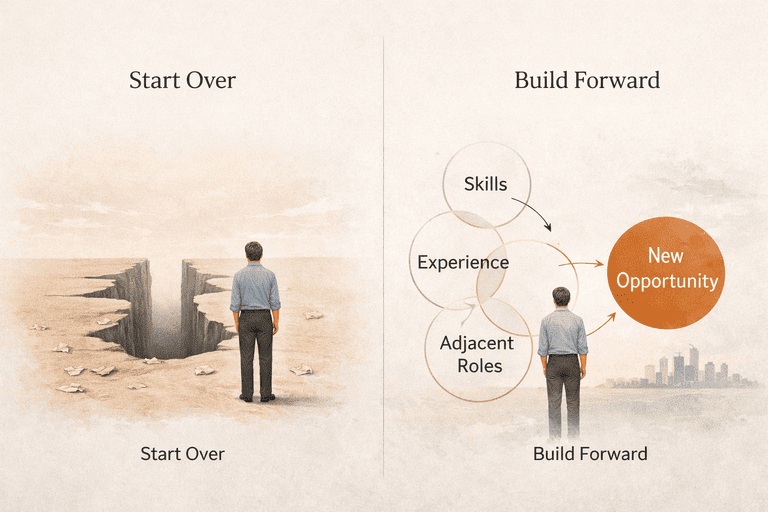
1. Diagnose The Real Source Of Friction
Before you choose a destination, you need to know what is actually broken.
Many people say "I hate my job" when the real problem is narrower:
- they hate the pace
- they hate the politics
- they hate the incentive model
- they hate the amount of social interaction
- they hate the lack of autonomy
- they hate the kind of problems they solve all day
Those differences matter. If you misdiagnose the friction, you will carry the same problem into the next role.
Take a marketing manager who says they are done with marketing. That could mean at least three different things. They might hate campaign churn and shallow metrics, but still love understanding customer behavior. They might hate stakeholder chaos, but still love strategy. Or they might hate persuasion work itself and want more analytical depth. Those three diagnoses point to very different next moves.
The first step is not "pick a new field." The first step is: name the mismatch precisely enough that you can stop solving the wrong problem.
2. Separate Transferable Strengths From Domain-Specific Tools
This is where many career changers underestimate themselves.
You may not have the target title yet. You may not know the exact tool stack. You may not have the preferred jargon. But that does not mean your experience resets to zero.
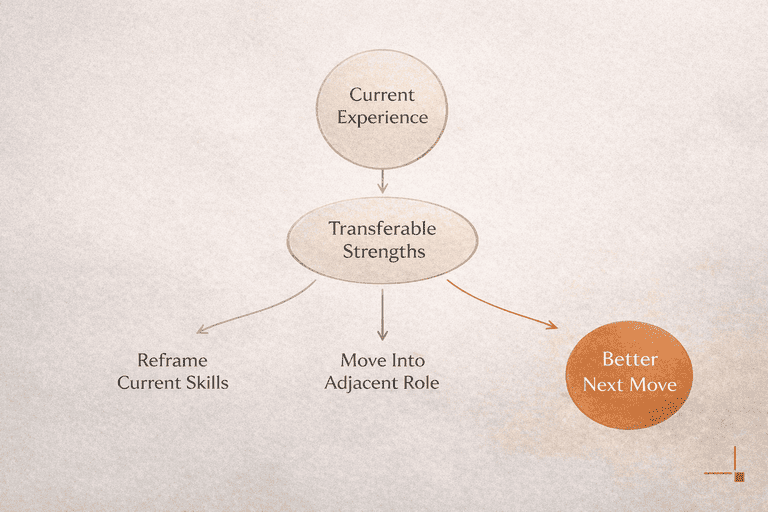
What usually transfers best is not the surface label of the old role. It is the way you operate inside work:
- how you solve problems
- how you communicate
- how you handle ambiguity
- how you manage detail
- how you build trust
- how you make decisions
- how you learn under pressure
Those patterns often travel much better than people think. A teacher moving into learning design still brings explanation, facilitation, audience awareness, and structured communication. A salesperson moving into customer success still brings discovery, relationship management, objection-handling, and account judgment. A marketer moving into UX research still brings user empathy, experimentation, framing, and insight translation.
That is also why good mid-career guidance puts so much emphasis on making skills visible. OECD guidance for mid-career adults explicitly argues that effective guidance should surface skills acquired through informal learning over years of work, identify transferable skills, map skill gaps, and build clear career and training pathways.[6]
The right question is not "Do I already have every target-role skill?" The right question is: which parts of my experience are core strengths, and which parts are just domain packaging?
3. Choose The Right Transition Distance
Not every move needs the same amount of reinvention.
A cleaner way to think about career change is by transition distance:
Low-distance move
Same core strengths, similar work pattern, different context.
Examples:
- sales to customer success
- teacher to trainer
- recruiter to people operations
- marketer to product marketing
These are often the fastest moves because the work logic is still familiar.
Medium-distance move
Core strengths still transfer, but the work environment or operating model changes more.
Examples:
- marketer to UX research
- finance to operations
- project manager to product manager
- teacher to instructional design
These usually require some upskilling, stronger proof of fit, and clearer positioning, but they are still far from a zero-based reset.
High-distance move
Both the domain and the work pattern change heavily.
Examples:
- accountant to therapist
- salesperson to software engineer
- teacher to clinical psychologist
These moves can still be right, but they carry a different cost profile. More time, more retraining, more credential risk, and less immediate leverage from prior experience. That distinction matters more now because employers themselves expect the skill mix inside jobs to keep changing. The World Economic Forum's 2025 Future of Jobs work says nearly 40% of core skills are expected to change by 2030, which means transition decisions increasingly depend on how fast you can recombine existing strengths with new skill-building, not only on whether your old title matches the new one.[7]
This is one reason horizontal and adjacent transitions matter. They can create momentum, signal, and fit without forcing the highest-risk leap first.[2]
4. Validate With Real Evidence Before You Leap
A lot of career-change failure happens because people fall in love with an image of a job, not the work itself.
That is why validation has to happen before the full move.
At minimum, validate four things:
- the day-to-day work
- the actual hiring bar
- the transferability of your experience
- the parts of the role that may drain you even if the title sounds attractive
Good validation methods are simple:
- read a large sample of real job postings
- talk to people already doing the work
- look for repeated tools, outputs, and expectations
- run a small test project, volunteer scope, certification, or portfolio experiment if the role requires proof
This is also where many career changers discover that the role they thought they wanted is only one version of the broader direction. Maybe you do not need to become a full UX designer. Maybe the better move is UX research, product marketing, service design, or content design. Maybe you do not need "nonprofit work" as a category. Maybe what you really want is mission-aligned operations, community programs, learning, or partnerships.
Validation narrows the fantasy into something usable.
It also reduces one of the oldest risks in career change: confusing a title with a fit. A practical review of job and role transitions argues that transition decisions should consider role fit with lifestyle expectations, readiness for upward or lateral movement, and whether extra formal education is actually required.[8]
5. Build A Transition Story That Makes Sense
Most career changers explain themselves badly because they describe the move as a rejection instead of a progression.
They say:
- "I want something more meaningful."
- "I just need a change."
- "I am burned out and want to try something different."
Those statements may be emotionally true, but they are weak professionally.
A stronger transition story sounds like this:
- what you have done
- what strengths that work proved
- what kind of work you now want more of
- why the target role is a credible extension of your track record
For example:
I have spent ten years in sales, but the part of the work where I consistently add the most value is diagnosing client needs, building trust over time, and helping accounts adopt a solution successfully. That is why customer success is a better next fit for me than another quota-heavy closing role.
Or:
I have spent twelve years in teaching, and the strongest through-line in my work is designing learning experiences, translating complexity into something usable, and adapting to different audiences. That is why instructional design is not a reset for me. It is a more focused application of the work I already do well.
That is how you stop sounding like someone abandoning a past life and start sounding like someone making a defensible transition.
Where Most Career Tests Fall Short
Most career tests are better at broad description than transition logic.
They may tell you:
- your type
- your interests
- a list of suggested careers
That can be useful at the edges, but it often misses the real decision problem for career changers:
- what in your current role is still worth keeping
- where the friction is actually concentrated
- which adjacent roles make sense before a bigger leap
- whether the mismatch is structural or partly fixable
That is one reason career-change content can feel strangely unhelpful. It often assumes the reader needs a new identity, not better interpretation. OECD guidance for adults makes a similar point from a policy angle: adults seek guidance not only to find a job, but also to progress in their current role, choose training, handle uncertainty, and respond to changing labor-market conditions.[5]
Where CareerMeasure Fits
CareerMeasure is more useful for this problem when it is used as a transition-diagnosis tool, not just a matching tool.
Its structure is built around three things: interests, motivations, and strengths, then anchored back to current-role fit, gap interpretation, and adjacent-career reasoning.[9] That matters because a career changer usually needs more than "top career matches." They need help understanding what should stay, what is fixable, and what kind of next move is actually realistic.
Used well, that gives you a stronger transition conversation:
- what work content energizes you
- what conditions keep you engaged
- how you naturally operate
- where your current role is breaking down
- which nearby roles use more of what already works
That is a much stronger basis for change than starting from a blank sheet.
Final Answer
If you want to change careers without starting over, stop asking which completely different identity you should adopt. Start by diagnosing the mismatch in your current role, separating your transferable strengths from your domain-specific tools, choosing the right transition distance, validating adjacent options, and building a transition story that makes sense.
That is how most good career changes actually happen. Not as fantasy resets, but as better-fit moves built on real continuity.

References
[1] Mussagulova, A., Chng, S., Goh, Z. A. G., Tang, C. J., & Jayasekara, D. N. (2023). When is a career transition successful? A systematic literature review and outlook (1980-2022). Frontiers in Psychology, 14, 1141202.
[2] Steindórsdóttir, B. D., Sanders, K., Arnulf, J. K., & Dysvik, A. (2023). Career transitions and career success from a lifespan developmental perspective: A 15-year longitudinal study. Journal of Vocational Behavior, 140, 103809.
[3] Akkermans, J., da Motta Veiga, S. P., Hirschi, A., & Marciniak, J. (2024). Career transitions across the lifespan: A review and research agenda. Journal of Vocational Behavior, 148, 103957.
[4] De Vos, A., et al. (2021). Career transitions and employability. Journal of Vocational Behavior.
[5] OECD (2021). Career Guidance for Adults in a Changing World of Work.
[6] OECD (2022). Strengthening Career Guidance for Mid-Career Adults in Australia.
[7] World Economic Forum (2025). The Future of Jobs Report 2025.
[8] Bleich, M. R. (2017). Job and Role Transitions: The Pathway to Career Evolution. Nursing Administration Quarterly, 41(3), 252-257.
[9] CareerMeasure. Methodology.
[10] U.S. Bureau of Labor Statistics. Instructional Coordinators. Occupational Outlook Handbook.
Get A Clearer Career Signal
Take the assessment to see what fits, what feels off, and which roles are more likely to suit you.

Builds CareerMeasure hands on and writes about career fit, role transitions, and the gap between generic personality advice and evidence-based career decisions.
Community Discussion
Share your thoughts about this article
Delete Comment?
Are you sure you want to delete this comment? This action cannot be undone.