

Signs You Are in the Wrong Career

Most people do not wake up one day with a clean, dramatic realization that they are in the wrong career.
Usually it shows up more quietly. You keep performing well enough, but the work never really starts fitting better. You change teams, managers, or employers, and the same friction returns. You imagine the future version of success in the path and feel less ambition than dread. You tell yourself the issue is temporary, but the pattern keeps surviving each new explanation.
That is why the useful question is not "am I having a hard week?" It is: what kind of pattern keeps repeating, and what does that pattern say about fit?
The Short Answer
You may be in the wrong career if the actual work keeps draining you across roles, the same mismatch survives better conditions, small fixes never solve the real problem, and the future version of success in the path feels wrong rather than motivating.
But do not rush to the conclusion too fast. Burnout, bad management, weak role design, and poor environment fit can all mimic career mismatch.[1] CDC guidance is useful here because it keeps burnout narrower than vague career despair.[2] That is why the signs matter most when they repeat across time and across contexts, not just during one hard period.
Why This Question Is So Easy To Misread
The problem is that several different failures at work feel similar from the inside.
You may feel exhausted because:
- the career is wrong
- the manager is wrong
- the pace is wrong
- the environment is corrosive
- the role drifted into something you never wanted
- burnout has narrowed your world until everything feels bad
From the inside, all of those can feel like "I need to leave." That is why diagnosis matters more than raw feeling.
Adult career guidance increasingly reflects the same reality. Adults usually seek help because they want to progress, change jobs, interpret uncertainty, or respond to labor-market shifts, not because they are choosing a path from zero for the first time.[3] In other words, the question is almost never purely abstract identity. It is interpretation under pressure.
Why Good Performers Miss The Signs Longer
People who are visibly failing in a role often get forced into clarity faster. People who are competent can stay confused for years.
The better you perform, the easier it is for other people to assume you belong there. You get more trust, more responsibility, and more proof that the path is "working." That outside signal can delay the inside diagnosis.
This is one reason successful people often ask the wrong question. They ask:
- why am I unhappy when everything looks fine?
instead of:
- what if success and fit are not the same thing?
That distinction matters because a career can reward you for strengths that are real while still organizing your life around work you do not want to keep doing.
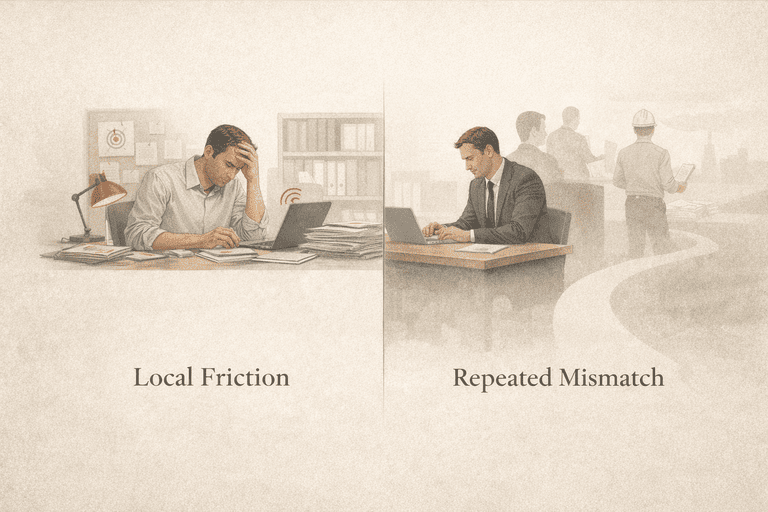
Seven Signs The Career May Actually Be Wrong
These signs matter most when several of them show up together.
1. You Dislike The Core Work, Not Just The Conditions
This is the strongest signal.
If the role became calmer, better paid, and better managed tomorrow, would you still dislike the work itself?
Not the stress around it. The actual work.
Would you still dislike spending your days selling, coordinating, presenting, troubleshooting, persuading, documenting, teaching, managing, serving, or analyzing in the way the role requires?
If the answer is yes, that is much stronger evidence of a career-fit problem than a bad quarter.
2. The Same Friction Keeps Following You
If you have changed managers, companies, or role versions and the same dissatisfaction keeps returning, pay attention.
Repeated friction matters because it survives the easiest explanation. Once the same kind of pain follows you across contexts, it becomes less likely that the problem is just one employer and more likely that something about the work itself does not fit you well.
This does not automatically mean total reinvention. But it does mean the pattern sits deeper than one bad setup.
3. The Future Version Of Success Feels Dead
Look at the respected senior version of your path.
Do you want that life?
If the answer is no, that matters. If the next logical promotion looks like a more expensive version of the same life you already dislike, the path may be wrong even if the present role is tolerable enough to survive.
This is one of the clearest signs because it asks whether success in the path still pulls you forward at all.
4. Small Fixes Help, But Never Solve The Real Problem
Some role pain is fixable. Better boundaries help. Better support helps. More autonomy helps. Better role design helps.
Research on job crafting and fit matters here because people really can improve work experience by reshaping tasks, demands, and resources in the right direction.[4] The job-crafting literature is especially useful because it shows how far better design can sometimes move the lived experience before a full path change is necessary.[5] But there is a big difference between "this became meaningfully better" and "this became slightly less bad."
If every fix only reduces pain without restoring real fit, the evidence starts pointing toward a larger problem.
5. You Respect The Path More Than You Want It
This is common among competent adults.
You may respect the salary, status, credibility, or external logic of the path while privately not wanting the life it creates.
That matters because external success can hide internal deadness for a long time. Person-environment fit research is useful here because satisfaction, commitment, and turnover-related outcomes are not explained by performance alone.[6] Fit at the job, organization, and group level still matters in meaningful ways.[7]
In plain language: being able to win in a path is not proof that you should keep building your life around it.
6. You Keep Trying To Negotiate The Work Into Something It Is Not
Some people spend years trying to redesign a fundamentally misfitting role into a different kind of career.
They keep asking for:
- less client contact
- less social intensity
- less urgency
- less politics
- less ambiguity
- less selling
- less management
That can be smart if the core role still fits. But if you keep removing the defining features of the career and only then can imagine tolerating it, that is a clue. You may not need a better version of the same path. You may need a different path.
7. Relief Comes More From Leaving The Work Than From Improving It
This is another useful distinction.
Some people feel better when the environment improves. Others mainly feel better when they imagine no longer organizing life around that kind of work at all.
If the strongest emotional relief comes from not having to keep doing that kind of work, not just from doing it under better conditions, that is a meaningful sign.
Signs That Feel Serious But Are Not Enough On Their Own
This is where people often overdiagnose.
These signals can matter, but they are too weak to use alone:
You Are Tired Right Now
Fatigue matters, but it does not diagnose the level of the problem. You may be burned out inside a career that still fits, or depleted inside a role design that is fixable.
You Envy Someone Else’s Job
Envy is not useless, but it is noisy. Sometimes it points to a real desire. Sometimes it only points to wanting relief from your current pain.
One Test Result Told You Something Big
A tool can give useful signal. It should not settle the question by itself.
One Bad Employer Made Everything Feel Wrong
Some employers are genuinely distorting enough to make an otherwise workable career feel broken. That is why repeated evidence matters more than one extreme environment.
The point is not to ignore these signals. The point is to stop treating them like proof.
Signs It May Still Be The Right Career, Just the Wrong Setup
These are the counter-signals worth taking seriously.
You Still Like The Core Work When Conditions Improve
If the work itself becomes meaningfully better when the pace, management, boundaries, or team improve, that points away from a full career mismatch.
Better Versions Of The Same Field Still Sound Good
If healthier versions of the same work still feel attractive, the problem may be role version rather than path.
Adjacent Roles Feel More Right Than Total Reinvention
If you dislike your current role but still feel pulled toward nearby roles that use similar strengths with different demands, that often points toward adjacency rather than full departure.
The Problem Is Easy To Name As Local
Examples:
- quota pressure is the issue, not helping customers
- bureaucracy is the issue, not teaching or training
- politics are the issue, not strategic work
- nonstop interruption is the issue, not problem-solving itself
Specific local diagnosis usually points toward a smaller move.
The Pattern That Usually Matters Most
If I had to compress the whole problem into one practical rule, it would be this:
the strongest wrong-career sign is repeated mismatch that survives better explanations.
That means:
- it survives a different boss
- it survives a different employer
- it survives temporary rest
- it survives small improvements
- it survives your attempts to explain it away as a rough season
That is what makes the signal serious. Not intensity alone. Persistence.
Burnout Can Mimic The Wrong-Career Signal
This is where many people go wrong.
The reflection guide on burnout and boredom at work helps describe different work patterns while keeping them separate from a clinical assessment.
Burnout can make a basically workable career feel intolerable. WHO keeps the concept narrow on purpose: chronic workplace stress, exhaustion, mental distance or cynicism, and reduced professional efficacy.[1] CDC guidance reinforces the same point and warns against treating burnout as a catch-all label for every form of work distress.[2]
That is useful because it forces a harder question:
- do I still respect the work when rested?
- does the work feel better when the pressure lifts?
- is the problem the stress load, or the work itself?
If the answer changes a lot with rest and conditions, the career may still be fine. If the work still feels wrong when the stress recedes, the evidence shifts.
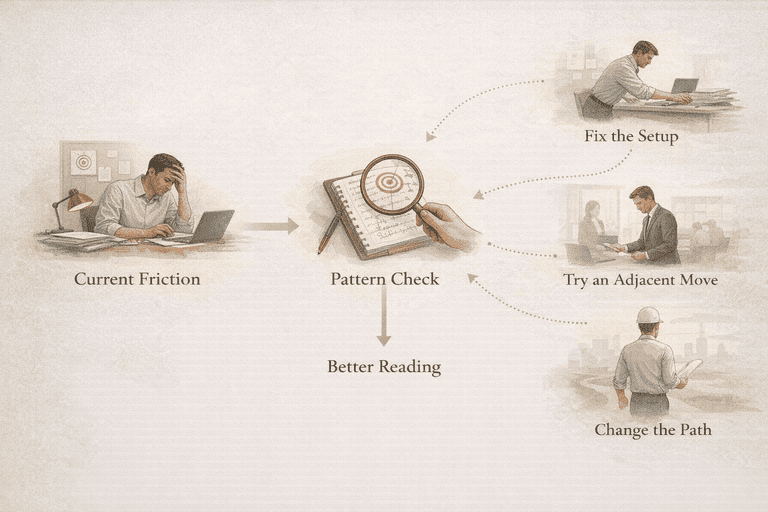
What To Do Before You Call It The Wrong Career
Do not jump from discomfort straight to a giant conclusion. Run the evidence in order.
Use the job-versus-career comparison to define what would need to change and whether a smaller move could test that hypothesis.
Step 1: Separate Work Content From Work Conditions
Ask what is wrong with:
- the work itself
- the environment
- the incentives
- the pace
- the social demands
- the future path
Until you separate those layers, every conclusion stays blurrier than it needs to be.
Step 2: Look For Repeating Evidence
Do not decide from one bad season. Look at the pattern across time:
- what work consistently energizes you
- what work consistently depletes you
- what conditions help a lot
- what conditions barely help
That pattern matters more than one emotional spike.
Step 3: Test The Smallest Plausible Fix First
Before making a full career jump, test smaller changes where possible:
- different team
- different employer
- different scope
- adjacent role
- more autonomy
- less client or stakeholder load
If those changes solve much more than you expected, you just learned something important. If they barely move the experience, you learned something important too.
Step 4: Ask What You Still Want To Preserve
Wrong-career decisions get clearer when you ask not just what you hate, but what still belongs in your next move.
That may include:
- the kind of problems you like solving
- the pace you can sustain
- the strengths you want your work to use
- the amount of human contact you actually want
If there is a lot you want to preserve, the smartest move may be adjacent. If very little feels worth carrying, the evidence starts pointing toward a larger change.
If Four Or More Signs Are Showing Up, Do This Next
If several of the stronger signs are present at once, do not jump straight to resignation energy.
Do three things first:
- write down exactly which signs are repeating and in what contexts
- identify one adjacent path that preserves the strengths you still want to keep
- test whether the current pain drops when you imagine leaving the work itself, not only the employer
That sequence turns vague dread into usable evidence. It also helps prevent two common mistakes:
- making a huge move based on one emotional spike
- staying too long because the path still looks respectable from the outside
Wrong Career Versus Career Fatigue
One last distinction helps here.
Career fatigue usually says: "I am tired of this version."
Wrong-career signal usually says: "I do not want my life organized around this kind of work anymore."
Those are close enough to confuse and different enough to matter.
Why People Delay Calling It
People delay this diagnosis because it is expensive to be right. Leaving a career path may threaten identity, reputation, income, or the story other people know about you. That pressure makes it easy to keep treating a repeated signal like a temporary mood.
That is why patterns matter more than moments. It also explains why many people stay just long enough to become even more invested in a path they already know is wearing them down. Delay makes the signal more expensive, not usually less true.

Final Answer
The strongest signs you are in the wrong career are repeated mismatch across contexts, dislike of the core work itself, failure of small fixes, lack of future pull, and relief that comes more from leaving the path than from improving the current version of it.
But do not confuse burnout, bad management, or one broken environment with a broken career. The smartest move is to separate the work from the conditions, look for repeated evidence, and test smaller explanations before paying for a larger change.
References
[1] World Health Organization. Burn-out an occupational phenomenon.
[2] CDC NIOSH. What burnout is and is not.
[3] OECD. Career Guidance for Adults in a Changing World of Work.
[4] Jiang, Z., Newman, A., Le, H., Presbitero, A., & Zheng, C. (2019). Career exploration: A review and future research agenda. Journal of Vocational Behavior, 110, 338-356.
[5] Ok, C., & Lim, S. (2022). Job crafting to innovative and extra-role behaviors: A serial mediation through fit perceptions and work engagement. International Journal of Hospitality Management, 106, 103288.
[6] Verquer, M. L., Beehr, T. A., & Wagner, S. H. (2003). A meta-analysis of relations between person-organization fit and work attitudes. Journal of Vocational Behavior, 63(3), 473-489.
[7] Kristof-Brown, A. L., Zimmerman, R. D., & Johnson, E. C. (2005). Consequences of individuals' fit at work: A meta-analysis of person-job, person-organization, person-group, and person-supervisor fit. Personnel Psychology, 58(2), 281-342.
[8] CareerMeasure. Methodology.
Check What Is Actually Misfitting
Use the assessment to separate current-role friction, deeper mismatch, and stronger-fit next moves.

Builds CareerMeasure hands on and writes about career fit, role transitions, and the gap between generic personality advice and evidence-based career decisions.
Community Discussion
Share your thoughts about this article
Delete Comment?
Are you sure you want to delete this comment? This action cannot be undone.