

Should I Change Careers or Change Jobs? How To Tell the Difference

One of the easiest ways to make a bad career decision is to ask the right question too late.
People often say they need a career change when what they really mean is: this team is bad, this boss is draining, this quota structure is miserable, or this role has drifted into something I never actually wanted. Other people do the opposite. They keep changing jobs hoping the feeling will finally go away, when the deeper problem is that the work itself keeps misfitting them.
That is why "Should I change careers or just change jobs?" is a much better question than most internet career advice starts with. It forces a more disciplined diagnosis. It asks whether the issue is local or structural, temporary or repeating, environment-level or work-content-level.
Most adults do not need a dramatic identity answer. They need a better explanation of what exactly is breaking. OECD guidance on adult career support reflects the same reality: adults usually seek guidance because they want to progress, change jobs, or respond to labor-market shifts, not because they are choosing from zero for the first time.[1]
The Short Answer
You probably need a new job if you still like the core work when the conditions improve, the problem is specific to the environment or role design, and better versions of the same field still sound attractive.
You probably need a new career direction if the actual work keeps draining you across contexts, small fixes never solve the real problem, and the future version of success in the path does not appeal to you.
Burnout can make a basically decent role feel intolerable, so do not rush the distinction.[2] Adult career-transition research reinforces the same caution against overreading one painful moment as a total path verdict.[3] The real question is: what changes when the conditions improve, what keeps repeating across roles, and which move would actually solve the problem instead of only moving it?
Why These Two Decisions Get Blurred Together
The feelings overlap.
A bad manager, a corrosive culture, a broken incentive model, and a true career mismatch can all create similar surface symptoms:
- dread on Sunday night
- lower patience
- cynicism
- emotional exhaustion
- fantasies about leaving everything
- loss of interest in the future version of the role
From the inside, those experiences can feel almost identical. That is why people misread them.
Another reason is that job and career advice often collapses everything into one story. If you are unhappy, the internet tells you to follow your passion, reinvent yourself, or take a new test. But career-transition research treats transitions much more broadly than that. A transition can mean changing employer, changing role, changing field, or changing how you relate to the work you already do.[4] That is a much more realistic frame.
If you start with the assumption that every meaningful change must be a career change, you will overdiagnose structural mismatch. If you start with the assumption that every problem can be solved by finding a better employer, you will underdiagnose it.
So the first job is not deciding. The first job is diagnosing.
Evidence That The Career May Still Fit
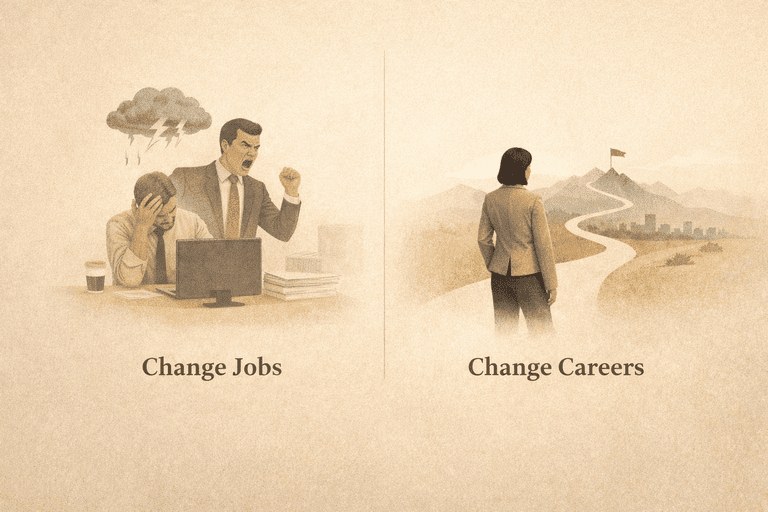
Here are the strongest signs that the field may still fit, but your current setup does not.
You Still Like The Core Work When Conditions Improve
This is the clearest sign.
If the work becomes meaningfully better when you get space, support, autonomy, better colleagues, or a healthier workload, that points away from a full career mismatch.
Maybe you still like helping customers, but hate the sales pressure. Maybe you still like designing learning experiences, but hate the institution. Maybe you still like strategy, but hate the politics around execution. Those are not trivial distinctions. They often decide whether the smartest move is a job change inside the same field or a more serious career shift.
Person-environment fit research matters here because fit is not only about the broad career label.[5] It also lives at the job, group, and organization level.[6] A bad fit with one employer does not automatically mean a bad fit with the work itself.
You Can Name Specific Local Problems
Examples:
- the manager is the issue, not the work
- the incentive system is the issue, not the craft
- the pace is the issue, not the role family
- the politics are the issue, not the actual skill set
- the role drift is the issue, not the broader path
The more specifically you can name the environmental or organizational problem, the more likely it is that the right answer is a different job rather than a different career.
That does not guarantee a simple fix. It does mean the problem is more local than structural.
Better Versions Of The Same Field Still Sound Good
This is another underused signal.
If you can imagine a healthier employer, a narrower role, a different customer type, a better scope, or a different business model within the same general field and feel relief rather than resistance, that is important.
It means your problem may not be "I need to leave this career." It may be "I need a better version of this work."
This is why adjacent and intra-field moves matter. A person can dislike one version of sales and still fit partnerships, account management, customer success, or enablement. A teacher can dislike classroom conditions and still fit instructional design, training, curriculum work, or student success. A project manager can dislike agency chaos and still fit operations, implementation, or internal program leadership.
Small Fixes Change More Than You Expected
This is where people often get surprised.
Sometimes one or two changes improve the role much more than your emotional story predicted:
- more autonomy
- fewer interruptions
- less client exposure
- a different team
- better boundaries
- clearer ownership
That is one reason job crafting matters. Research suggests that when people reshape tasks, resources, or work demands in the right direction, person-job fit and meaningfulness can improve.[7] That does not mean every role can be rescued. It does mean that if modest changes make the work meaningfully better, you may not need a career change at all.
Evidence That The Career Itself May Be Wrong
Now the harder side of the decision.
You Dislike The Actual Work, Not Just The Conditions
If the role became calmer, better managed, and better compensated tomorrow, would you still dislike the work itself?
Not the pressure around it. The actual work.
Would you still resist spending your days persuading, managing, coordinating, documenting, selling, serving, troubleshooting, analyzing, or presenting in the way the role requires?
If the answer is yes, that is much stronger evidence of a career-level mismatch than a rough quarter or a bad employer.
The Same Friction Keeps Repeating Across Jobs
This is the pattern that matters most.
If you have changed companies, teams, or managers and the same dissatisfaction keeps coming back, the explanation becomes less "bad luck" and more "this kind of work may not fit me well."
Maybe every version of the role eventually feels too externally driven. Or too socially exhausting. Or too repetitive. Or too fragmented. Or too politically dependent. When the pattern survives multiple environments, that is strong evidence that the mismatch sits deeper than one employer.
The Future Version Of Success Does Not Appeal To You
This is one of the cleanest diagnostics in the whole problem.
Look at the respected senior version of your current path. Do you want that life?
If the honest answer is no, pay attention.
If the future arc feels like a more expensive version of a life you already dislike, then changing jobs inside the same track may only buy you temporary relief. It may not solve the real issue.
This is where people often confuse tolerable present pain with meaningful direction. They assume that because the path is prestigious or legible, it must still be right. That is not good enough.
Small Fixes Never Solve The Real Problem
If better boundaries, better teams, better communication, and better role design only make the work slightly less bad, that matters.
It suggests the problem is not only the conditions. It suggests the work itself, or the role family beneath it, may be wrong for you.
That does not necessarily mean a dramatic reinvention. It may mean a larger adjacent move, a different occupational family, or a slower repositioning. But it does mean "find the same role somewhere nicer" is probably too shallow.
The Signal Gets Noisier When Burnout Is In The Mix
This is where many people go wrong.
Burnout can make a basically good role feel unbearable. At the same time, a true mismatch can create a burnout-like experience because you are constantly forcing yourself through work that does not fit. The overlap is real.
WHO's burnout framing keeps the concept narrow on purpose: chronic workplace stress, exhaustion, mental distance or cynicism, and reduced professional efficacy.[2] That narrowness is useful because it keeps you from treating every painful work experience as proof that the whole career is wrong.
If you suspect burnout, ask:
- do I still respect the work when I am rested?
- does the work still feel meaningful when the pressure lifts?
- if the environment improved, would I want more of this kind of work or only relief from this employer?
Those questions are not perfect, but they help separate temporary overload from deeper mismatch.
Use This Order Before You Make The Move
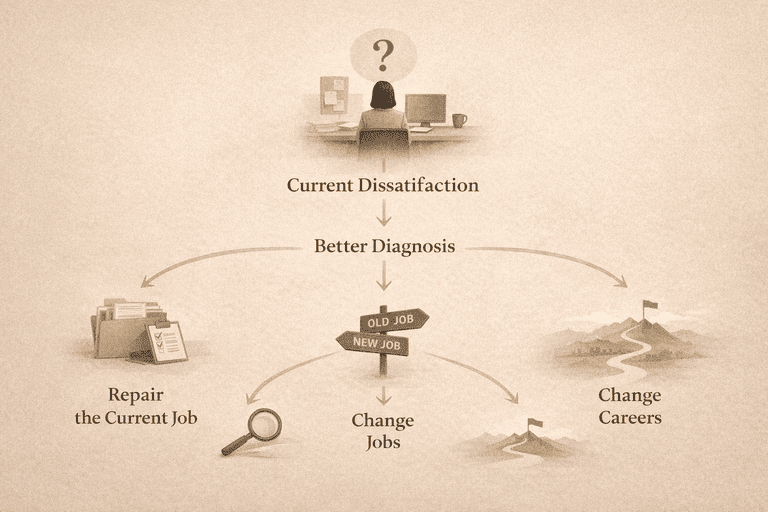
The new-job-or-new-career reflection guide offers prompts for checking how the pattern changes across work conditions before you choose the scale of the move.
If you are deciding between a job change and a career change, use this order before you do anything dramatic.
Name The Exact Source Of Friction
Do not stop at "I hate my job."
Ask whether you hate:
- the work itself
- the pace
- the incentives
- the environment
- the politics
- the social exposure
- the lack of autonomy
- the future path
Until you name the friction precisely, every solution stays vague.
Separate Role-Level Fit From Organization-Level Fit
This is where fit research helps. Person-job fit, person-organization fit, and person-group fit are related, but they are not identical.[5] A bad organization-level fit can still distort a path that might have worked in a healthier context.[6]
That means:
- you can fit the work and dislike the organization
- you can fit the organization and dislike the actual work
- you can fit neither
Each of those should lead to a different next move.
Look For Repeating Evidence Across Time
Do not decide from one terrible month.
Look for stable patterns:
- what work consistently energizes you
- what work consistently depletes you
- which problems improved when the environment changed
- which problems followed you anyway
Repeated evidence matters more than one emotional week.
Test The Smallest Plausible Move First
Before you declare a career change, test the smallest serious hypothesis:
- different team
- different manager
- different employer
- narrower scope
- different business model
- adjacent role in the same field
Career-transition research keeps pointing to the same thing: transitions come in many forms, and they should not all be treated like total resets.[4] Some of the smartest moves are still meaningful moves, even when they are not dramatic.[8]
Compare The Cost Of Each Move Honestly
Changing jobs and changing careers do not carry the same cost profile.
A job change may preserve:
- your credibility
- your domain knowledge
- your compensation
- your momentum
A career change may require:
- more learning
- more proof-building
- more narrative work
- more temporary uncertainty
That does not mean you should avoid the bigger move. It means you should only pay that cost when the evidence justifies it.
The Middle Path Most Adults Ignore: Adjacent Change
The best answer is often neither "stay exactly here" nor "start over."
Use the transferable-skills worksheet to check an adjacent option at task level, including the evidence you can show and the gaps you still need to address.
It is adjacency.
An adjacent move keeps more of what still works while changing more of what does not. That is why it is often the most intelligent path for adults. A 15-year longitudinal study found that horizontal as well as upward career transitions contributed to career success over time.[8] Not every meaningful move is a promotion, and not every sideways move is avoidance.
This is the middle path many people skip because it is less dramatic and less easy to explain in one sentence. But in real careers, adjacency is often where the smartest decisions live.
So Which One Do You Need?
The clearest short version I can give is this:
- if you still like the core work, but hate the current conditions, change jobs
- if the same dissatisfaction keeps following you across environments, change career direction
- if some parts still fit and others clearly do not, make an adjacent move
That is a much better framework than trying to force every problem into a binary.
Final Answer
Change jobs when the work still fits but the employer, team, incentives, or design of the role is wrong.
Change careers when the actual work keeps misfitting you across contexts, the future version of success does not appeal to you, and better environments never solve the deeper problem.
And if the truth is in the middle, do not ignore that. Many adults do not need a total reset. They need a smarter adjacent move that preserves what still works and stops asking them to keep building around what does not.
That is usually how you tell the difference.

References
[1] OECD. Career Guidance for Adults in a Changing World of Work.
[2] World Health Organization. Burn-out an occupational phenomenon.
[3] CDC NIOSH. What burnout is and is not.
[4] Mussagulova, A., Chng, S., Goh, Z. A. G., Tang, C. J., & Jayasekara, D. N. (2023). When is a career transition successful? A systematic literature review and outlook (1980-2022). Frontiers in Psychology, 14, 1141202.
[5] Kristof-Brown, A. L., Zimmerman, R. D., & Johnson, E. C. (2005). Consequences of individuals' fit at work: A meta-analysis of person-job, person-organization, person-group, and person-supervisor fit. Personnel Psychology, 58(2), 281-342.
[6] Verquer, M. L., Beehr, T. A., & Wagner, S. H. (2003). A meta-analysis of relations between person-organization fit and work attitudes. Journal of Vocational Behavior, 63(3), 473-489.
[7] Tims, M., Derks, D., & Bakker, A. B. (2016). Job crafting and its relationships with person-job fit and meaningfulness: A three-wave study. Journal of Vocational Behavior, 92, 44-53.
[8] Steindórsdóttir, B. D., Sanders, K., Arnulf, J. K., & Dysvik, A. (2023). Career transitions and career success from a lifespan developmental perspective: A 15-year longitudinal study. Journal of Vocational Behavior, 140, 103809.
Get A Clearer Career Signal
Take the assessment to see what fits, what feels off, and which roles are more likely to suit you.

Builds CareerMeasure hands on and writes about career fit, role transitions, and the gap between generic personality advice and evidence-based career decisions.
Community Discussion
Share your thoughts about this article
Delete Comment?
Are you sure you want to delete this comment? This action cannot be undone.