

Non-Classroom Jobs for Teachers:
What To Explore After K-12

Many teachers who want out of K-12 start with the same search phrase:
non-classroom jobs for teachers
That is a useful place to begin. It is not a strong decision framework by itself.
The phrase tells you what you want less of. It does not tell you what kind of work you want more of. And that is why so many teacher-exit searches become noisy fast. You end up with long lists of unrelated jobs, mixed salary promises, and advice that treats "leaving the classroom" as if it were one giant category instead of a real career decision.
The more useful question is narrower:
what kind of work still fits after K-12, and what kind of environment do you want that work to live inside?
The Short Answer
The strongest non-classroom jobs for teachers are usually not random jobs that merely tolerate teaching experience. They are roles that reuse real teacher strengths in a different setting.
After K-12, the most practical path families often include:
- student support and advising
- learning, training, and instructional design
- curriculum, assessment, and education content
- program coordination and operations
- customer education, enablement, or implementation work
- people-facing roles built on communication and judgment, such as recruiting or onboarding
The key is to stop treating "non-classroom" like one answer. It is only a filter.[1] The real decision is which parts of teaching you still want to keep and which K-12 conditions you are trying to leave behind. O*NET's occupation structure is useful here because it maps overlap through tasks and work demands rather than title alone.[2]
Why “Non-Classroom” Is A Useful Search But A Bad Final Diagnosis
The phrase works because it captures a real pain point.
Often what teachers want less of is not work itself. It is the K-12 version of the work:
- classroom management
- parent escalation
- school bureaucracy
- emotionally saturated days
- constant interruption
- unpaid prep and invisible labor
- low control over standards, pacing, and systems
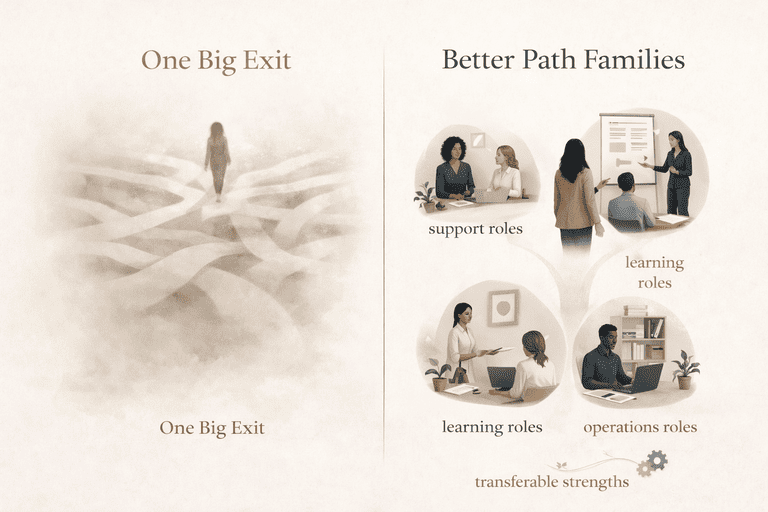
Those are real reasons to leave. Teacher attrition research has spent years documenting how much workload, emotional strain, and organizational conditions shape the decision to step away.[4] Teacher-burnout research reinforces the same pattern from a more direct stress and health angle.[5]
But "non-classroom" still leaves open a bigger question:
- do you want less live teaching, or just less school stress?
- do you want less human intensity, or a different audience?
- do you want more design work, more coordination work, or more one-to-one support work?
Until that part is clear, the search stays wider than it needs to be.
What K-12 Usually Trains Better Than Teachers Realize
Teachers often undervalue themselves because they describe their experience too narrowly.
They say:
- I taught English
- I taught fourth grade
- I taught high school science
Those titles are true. They are not the whole work.
K-12 teaching usually develops a broader professional toolkit:
- explaining complex material clearly
- structuring progression and sequence
- reading confusion in real time
- facilitating groups with different needs
- documenting progress
- handling difficult conversations diplomatically
- coordinating with multiple stakeholders
- keeping a system moving with limited resources
That is why adjacent paths usually emerge from task overlap, not title overlap. O*NET's occupation framework reflects that same underlying logic: jobs connect through shared activities, skills, and work demands, not only through labels.[2] The broader occupation structure resources make the same point from the summary-report side rather than just the search interface.[3]
Once you stop describing yourself only as a teacher and start describing the work you actually did, the search gets much more practical.
Four Better Path Families To Explore After K-12
If you want non-classroom roles, start with path families, not isolated job titles.
The former-teacher career comparison adds entry barriers, portfolio ideas, and a condition to investigate for six possible directions.
That keeps the search broad enough to be useful, but narrow enough to stay coherent.
1. Student Support And Education-Adjacent Guidance
Some teachers do not want out of mission-driven work. They want out of the classroom format.
That often points toward roles like:
- student success
- academic advising
- tutoring program leadership
- college and career counseling support
- family or learner support functions
These paths keep more of the developmental and relational side of teaching while reducing some of the constant performance load of classroom delivery.
What transfers well:
- relationship-building
- expectation setting
- progress monitoring
- difficult conversations
- motivation support
- communication with families and students
This path is strongest for teachers who still want to work close to learners, but not inside full classroom responsibility.
2. Learning, Training, And Design Work
This is one of the most natural post-K-12 families, but it is still wider than many teachers first realize.
It includes paths like:
- instructional design
- learning and development
- corporate training
- onboarding
- customer education
- curriculum and content development
These roles work best when a teacher wants to preserve the learning side of their background, but in a different environment or delivery mode.
For some people, that means more design and less facilitation. For others, it means still facilitating, but with adults instead of children. For others, it means building learning content behind the scenes.
Adult career guidance increasingly emphasizes exactly this kind of translation problem: how to surface existing skills, identify transferable strengths, and connect them to realistic new paths rather than treating change like a full reset.[1] Recent employability and transition research reinforces that same move away from identity-reset thinking.[6]
This family is strongest for teachers who still want work organized around learning, clarity, and development.
3. Program Coordination, Operations, And Systems Work
Some teachers discover that what they want to keep is not teaching itself. It is the ability to run a complicated human system under imperfect conditions.
Schools make teachers coordinate:
- schedules
- deadlines
- communication
- behavior and issue escalation
- documentation
- materials and process
- competing needs across multiple groups
That kind of experience can translate into:
- program coordination
- education-adjacent operations
- nonprofit operations
- training operations
- implementation support
- administrative and systems-heavy roles
This family is strongest for teachers who liked creating order, moving work forward, and handling complexity, but do not want their days built around classroom energy.
4. Communication, People, And Trust-Based Roles Outside School
This is the family many teachers overlook at first because it does not obviously look like education.
Depending on the teacher, adjacent options can include:
- recruiting
- onboarding
- community-facing support roles
- customer success or customer education
- enablement
- internal communications or people-support work
These roles make the most sense when the teacher's strongest assets were:
- explaining clearly
- managing expectations
- building trust quickly
- handling friction without escalation
- helping people move from uncertainty to confidence
This family is not the right fit for every teacher. But it is often more credible than it first appears.
Common Traps In The Search
Teacher-exit content gets repetitive because it often makes the same mistakes.
It Treats Every Former Teacher Like The Same Person
One teacher may want less human intensity. Another may want to keep the human part and leave only the institution. Another may want more design work. Another may want more process and systems work.
Those are not small differences. They change the target role completely.
It Confuses “Outside The Classroom” With “Outside Your Strengths”
Many list-based articles quietly imply that the only way to leave K-12 is to become almost unrecognizable.
That is usually the wrong move. The stronger exits preserve something real:
- facilitation
- learner empathy
- writing and explanation
- coordination
- progress tracking
- stakeholder communication
The point is not to abandon your background. It is to stop forcing it to live inside one institutional format.
It Optimizes For Fast Escape Instead Of Better Fit
Fast escape can be necessary. It is still different from a better long-term move.
If a job is attractive only because it is "not teaching," that is weak evidence. Better-fit exits usually have a positive logic too. You are not only leaving something. You are moving toward a mode of work that makes more sense.
Five Practical Move Patterns That Often Work
These are not the only options. They are examples of how K-12 experience often translates more credibly than people expect.
1. Teacher To Student Success Or Advising
This move works when the teacher still wants:
- learner contact
- developmental support
- guidance conversations
- progress tracking
and wants less:
- full-classroom delivery
- lesson planning volume
- behavior management
This is a strong move when the person still likes helping people grow, but wants a narrower, lower-volume human structure.
2. Teacher To Instructional Design Or Curriculum Work
This move works when the teacher's strongest fit was always in:
- structuring material
- sequencing learning
- assessment logic
- editing and revision
and not primarily in live classroom energy.
This is often a better move for teachers who liked building the lesson more than carrying the room.
3. Teacher To Training, Onboarding, Or Customer Education
This move works when the teacher still likes:
- live facilitation
- explanation
- helping people gain confidence
- adapting in real time
but wants:
- adults instead of children
- clearer boundaries
- different institutional context
This is one of the most practical bridges out of K-12 for teachers who still want to teach, just not in schools.
4. Teacher To Recruiting Or People-Support Work
This move works when the teacher is especially strong in:
- reading people quickly
- asking good questions
- setting expectations
- navigating emotionally charged conversations
- building trust under time pressure
This path is often more plausible than teachers first assume because teaching develops a lot of judgment-heavy interpersonal work, not just content delivery.
5. Teacher To Program Coordination Or Operations
This move works when the teacher's most durable strength is not delivery itself, but the ability to keep complicated moving parts aligned.
That can translate well into:
- nonprofit programs
- education operations
- training operations
- implementation support
- internal coordination roles
This is often the right move for teachers who want less performance energy and more structured execution.
Do Not Choose Only By Escape
This is where many teacher-exit decisions go wrong.
If you are depleted enough, any non-classroom job can sound like relief. Relief matters. It is still not the same thing as fit.
A role may remove one painful part of K-12 while introducing a different mismatch:
- training may still demand too much live social energy
- advising may still feel too emotionally saturated
- operations may remove students but also remove the mission connection you cared about
- recruiting may use your communication strengths but overexpose you to another kind of people pressure
That is why the better question is not only:
- what do I want to stop doing?
It is also:
- what kind of work do I still want my next life to be built around?
Career adaptability research is useful here because strong transitions are not only reactive exits. They are structured moves that combine curiosity, control, confidence, and realistic planning over time.[7]
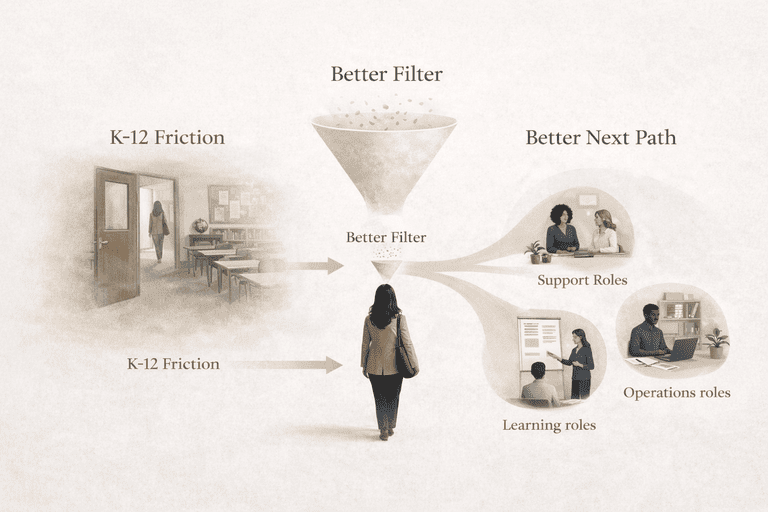
How To Choose And Validate The Right Path
If the whole search still feels too broad, use these filters.
If you want to keep some form of teaching, the learning, training, and design guide helps distinguish live facilitation from asynchronous design and content work.
Do You Still Want To Teach Live?
If yes, look harder at:
- training
- customer education
- onboarding
- facilitation-heavy L&D work
If no, look harder at:
- instructional design
- curriculum and content
- operations
- systems-heavy support roles
Do You Want To Stay Close To Education Or Leave The Sector?
If you still care a lot about education as a mission, look harder at:
- advising
- student success
- curriculum
- education nonprofits
- education operations
If you mostly want a healthier environment and are open to other sectors, look harder at:
- corporate training
- enablement
- recruiting
- customer education
- implementation or operations work
Do You Want More Human Contact Or Less?
If you still want high human contact:
- student support
- training
- customer education
- recruiting
If you want less:
- design
- content
- operations
- systems and process work
This kind of narrowing matters because career exploration works best as an active information problem, not just a feeling problem.[8] The point is to reduce noise until the path families start becoming usable.
What To Look For In Real Job Postings
Once you have two or three path families, stop reading generic teacher-exit content and start reading real postings closely.
Look for repeated patterns in:
- outputs you would be responsible for
- the amount of live facilitation versus back-end work
- stakeholder load
- tools and systems
- whether the role is more support, design, delivery, or coordination
This matters because titles can hide very different daily lives.
A "program coordinator" role in one organization may be mostly logistics and scheduling. In another, it may be much more learner-facing. A "trainer" role may mean live facilitation in one setting and mostly onboarding documentation in another. A "curriculum" role may be deeply editorial or much closer to project management.
The title is not enough. The task mix tells the truth.
What A Strong Next Move Usually Looks Like
A strong non-classroom move after K-12 usually has three characteristics.
It Preserves Something Real
The move should preserve a genuine strength, not just your ability to endure hard work.
That might be:
- facilitation
- design
- communication
- coordination
- learner support
- structured problem-solving
It Removes The Part That Was Breaking Fit
The new role should not only sound different. It should remove a real source of friction:
- classroom intensity
- school bureaucracy
- family conflict load
- constant interruption
- emotional saturation
It Is Easy Enough To Explain
The best adjacent moves have a visible through-line.
That matters because if you can explain the move clearly, you can position it more credibly in interviews, networking conversations, and future transitions.
For example:
- I want to stay close to learning work, but move from classroom delivery into instructional design.
- I want to keep the communication and support side of teaching, but in a student-success or advising context.
- I want to use the systems and coordination side of my background in a more operations-focused role outside K-12.
That is much stronger than saying only:
- I want out of teaching.
Final Answer
Non-classroom jobs for teachers are worth exploring after K-12, but "non-classroom" is only a starting filter, not a final answer.
The real task is to identify what teaching actually trained you to do, what part of K-12 you want to leave behind, and which adjacent path families preserve the right strengths in a better environment.
Once you frame it that way, the search becomes much more practical. You are no longer looking for random jobs that happen to accept teachers. You are looking for better-fit work that still makes sense from the skills and judgment you already built.

References
[1] OECD. Career Guidance for Adults in a Changing World of Work.
[2] O*NET OnLine. Advanced Search.
[3] O*NET OnLine. Summary Report and Occupation Structure Resources.
[4] Madigan, D. J., & Kim, L. E. (2021). Towards an understanding of teacher attrition: A meta-analysis of burnout, job satisfaction, and teachers' intentions to quit. Teaching and Teacher Education, 105, 103425.
[5] Arvidsson, I., et al. (2019). Burnout among school teachers: Quantitative and qualitative results from a follow-up study in southern Sweden. BMC Public Health, 19, 655.
[6] De Vos, A., et al. Career transitions and employability. Journal of Vocational Behavior, 2021.
[7] Savickas, M. L., & Porfeli, E. J. (2012). Career Adapt-Abilities Scale: Construction, reliability, and measurement equivalence across 13 countries. Journal of Vocational Behavior, 80(3), 661-673.
[8] Jiang, Z., Newman, A., Le, H., Presbitero, A., & Zheng, C. (2019). Career exploration: A review and future research agenda. Journal of Vocational Behavior, 110, 338-356.
See Your Stronger-Fit Next Moves
Get a clearer picture of which adjacent paths fit you better before making a bigger jump.

Builds CareerMeasure hands on and writes about career fit, role transitions, and the gap between generic personality advice and evidence-based career decisions.
Community Discussion
Share your thoughts about this article
Delete Comment?
Are you sure you want to delete this comment? This action cannot be undone.