

My Job Looks Good on Paper but Feels Wrong

This is one of the hardest work problems to explain to other people because the evidence seems to point in the opposite direction.
The salary may be fine. The title may be respectable. The company may be recognizable. The path may make sense to everyone around you. And still some part of you keeps saying: this does not feel right.
That feeling can create a strange kind of self-doubt. You start wondering whether you are too negative, too hard to satisfy, or simply unable to appreciate what you have. But a job can be objectively attractive in several external ways and still be wrong for the person living inside it.
That is the distinction this kind of problem usually needs.
The Short Answer
A job can look good on paper and still feel wrong because external markers of success do not measure the same thing as internal fit.
The paper version of a job usually emphasizes things like:
- title
- compensation
- stability
- prestige
- brand signal
- upward mobility
The lived version of a job is different. It is made of:
- daily task content
- pace
- incentives
- political load
- social exposure
- autonomy
- the future life the path is building

That is why someone can be in a "good job" by external standards and still feel chronically wrong inside it. When the job looks good but feels wrong, the problem is often not gratitude. It is that the external logic and the internal logic are no longer aligned.
Why The Job Can Be Good and Wrong At The Same Time
People often speak as if good jobs should feel good automatically.
That assumption fails because "good" is doing too much work in the sentence.
A job can be good for:
- income
- status
- resume signal
- family expectations
- professional leverage
- long-term security
None of those guarantees it is also good for:
- your motivation
- your energy
- your preferred operating style
- your relationship to meaning
- your tolerance for the daily life the job creates
This is one reason person-environment fit matters so much. Research across person-job, person-organization, and related fit layers consistently shows that work outcomes like satisfaction, commitment, and turnover intention are not explained by performance or prestige alone.[1] Fit still matters at multiple layers even when the external story looks strong.[2] In plain language: what looks strong from the outside can still fit badly from the inside.
What “Good on Paper” Usually Means
It helps to name what people are usually protecting when they say this.
Most often, "good on paper" means some combination of:
- strong compensation
- title growth
- recognizable employer
- social proof
- a path other people understand
- a story that makes sense at dinner tables and on LinkedIn
Those are not fake benefits. They matter. The problem is that they can be mistaken for proof that the role is right.
This is where many adults get trapped. The job does not only pay them in money. It pays them in legitimacy. It tells a coherent story to other people. That makes it harder to admit when the day-to-day experience of the role is increasingly off.
This kind of legibility has power because it reduces social friction. Other people stop questioning your direction. Family members relax. Recruiters understand your profile. The path becomes easier to explain publicly even while it becomes harder to defend privately.
Why It Can Feel So Wrong Anyway
The internal experience of work depends on questions the paper version never really answers.
For example:
- Do you like the actual work, or only what it signals?
- Does the job use your strengths in a satisfying way, or only in a profitable way?
- Do you want the future version of success in the path?
- Is the daily task mix compatible with the way you work best?
- Does the role ask too much from the parts of you that are easiest to exploit?
These are fit questions, not prestige questions.
This is also why the feeling often gets stronger over time. Early on, external rewards can carry a path. Later, the novelty wears off and the person has to live more directly with the actual work itself. That is where misfit often becomes much harder to ignore.
The Paper Benefits Versus The Lived Costs
One reason people stay stuck here is that the paper benefits are easier to name than the lived costs.
Use the keep-and-change exercise for work you do well but dislike to record which tasks feel worthwhile and which demands create costs that the title and compensation do not describe.
Paper benefits are visible:
- salary
- title
- brand
- status
- progression
Lived costs are easier to hide:
- constant dread
- shallow weeks
- overused strengths
- dead future pull
- a life organized around work you no longer respect enough to keep choosing
That mismatch matters because people often keep comparing visible benefits to invisible costs as if they were on the same scale. They are not. One is legible to other people. The other is lived by you.
Five Common Reasons A Good-Looking Job Still Feels Wrong
This pattern usually has a structure. It is not random.
1. The Status Is Better Than The Fit
The role may be socially admirable while still being privately draining.
This often happens in paths where the external markers are very legible:
- consulting
- law
- finance
- management tracks
- fast-growing tech roles
- prestige-heavy corporate ladders
The admiration around the job can delay the diagnosis. The person keeps thinking, "this should feel better than it does." But the prestige of the path is not the same thing as the lived quality of the work.
2. You Like The Story More Than The Daily Work
This is one of the clearest forms of misfit.
You may like:
- what the role says about you
- the image of the work
- the identity attached to the title
- the feeling of having "made it"
And still dislike:
- the actual meetings
- the actual decision cycles
- the actual stakeholder load
- the actual political friction
- the actual incentives
That gap matters because careers are lived in tasks, not in titles.
3. The Job Rewards Strengths You Have, But Not Work You Want
This is common among capable adults.
You may be good at:
- staying calm under pressure
- handling stakeholders
- carrying responsibility
- solving ambiguous problems
- cleaning up messes
- delivering under deadline
Those strengths may make you look like a strong fit from the outside. But if the role keeps rewarding the exact kind of work that drains you, the job can still feel wrong even while you keep winning inside it.
This is one reason people often stay too long in roles they are competent at. Success keeps validating the same strengths even when the person no longer wants those strengths to keep organizing their life.
4. The Future Version Of Success Looks Worse, Not Better
This is one of the strongest diagnostics in the whole problem.
Look at the next senior version of your path. Does it look like a better life or a more expensive version of the same life you already do not want?
If the future looks less attractive as the rewards get bigger, pay attention. That often means the path is externally strong but internally off.
5. The Job Pays You In Legibility, Not Meaning
Some roles keep working because they are easy to explain.
Other people understand them. The path sounds coherent. The title has weight. Family members stop worrying. Friends respect it. Recruiters recognize it.
That kind of legibility has value. It also has a hidden cost. It can keep people in misfitting roles because the path is easier to defend than to actually live.
Meaningful-work research is useful here because it keeps pointing back to the fact that work needs more than external reward to remain psychologically workable over time.[3] Meaning, significance, coherence, and fit in the lived experience still matter.[4]
Why People Stay Too Long In Jobs Like This
The answer is usually not weakness. It is that the incentives for staying are very coherent.
Staying protects:
- identity
- income
- status
- certainty
- social explanation
- the story that prior effort was leading somewhere
That last one matters a lot. Once a person has invested years in building a path that looks good from the outside, it becomes psychologically harder to admit that the fit may have weakened. The more coherent the paper story gets, the easier it is to keep treating internal misfit like a mood instead of a pattern.
What This Feeling Often Gets Mistaken For
This is where the diagnosis usually goes wrong.
Burnout
Burnout can absolutely make a good-looking job feel terrible. WHO keeps the concept narrow on purpose: chronic workplace stress, exhaustion, mental distance or cynicism, and reduced professional efficacy.[5] CDC guidance reinforces that burnout should not be used as a catch-all for every negative feeling at work.[6]
If the work still feels meaningful when the pressure lifts, the problem may be burnout more than wrong-path misfit.
Ingratitude
People often moralize the feeling instead of diagnosing it.
They say:
- I should be thankful
- other people would want this job
- nothing is objectively wrong
Those statements do not tell you whether the job fits. They only tell you the job has visible benefits.
Restlessness Or Novelty-Chasing
Sometimes people dismiss the problem as if the person simply wants endless newness.
That can happen. But many jobs that feel wrong do so for more serious reasons:
- the work content is misaligned
- the future path feels dead
- the incentive model is corrosive
- the external rewards no longer offset the internal cost
That is not mere restlessness.
A Problem That Should Be Ignored Because The Job Is Privileged
This is another bad reading.
Some people assume that because a job is well paid or respected, feeling wrong inside it must be a luxury complaint. That is not a serious diagnosis. A job can be objectively advantaged and still be a poor fit for the person doing it.
The Fastest Questions To Ask
If you want a cleaner diagnosis quickly, ask these in order.
The job-versus-career decision guide helps you test whether another employer could change those conditions before assuming that the whole profession must change.
If The Pressure Dropped, Would The Work Still Feel Wrong?
This separates burnout from deeper fit issues.
If The Title Stayed the Same But The Daily Work Changed, Would You Feel Better?
This separates identity attachment from task-level fit.
If This Path Went Well for 10 More Years, Would You Want The Life It Creates?
This tests future pull instead of current survival.
What Exactly Are You Protecting By Staying?
Possible answers:
- income
- status
- certainty
- identity
- family stability
- external approval
Those are real. But they are not the same thing as fit.
Are You Staying For The Work Or For The Explanation?
This is one of the hardest questions in the whole article.
If the main reason you stay is that the job is easy to explain and hard to question socially, that is useful information. It means the external logic may be doing more work than the internal logic now.
When The Paper Logic Is Still Real and When It Is Only Delay
Not every practical reason for staying is fake.
Sometimes the paper logic is still real in a way that should shape the decision:
- you genuinely need the income right now
- the role is buying time for a cleaner adjacent move
- the path still contains work you want to preserve
- this moment is not the right moment to pay for a larger shift
That is different from staying only because the job remains externally impressive.
The paper logic becomes dangerous when it is no longer part of a plan and is only helping you postpone the diagnosis.
What Part Of The Work Still Feels Worth Preserving?
This matters because the right next move may not be pure exit. It may be adjacency.
If there is a lot you still want to keep, the issue may be role version rather than full path. If very little feels worth preserving beyond the paper benefits, the signal is stronger.
What A Better Outcome Usually Looks Like
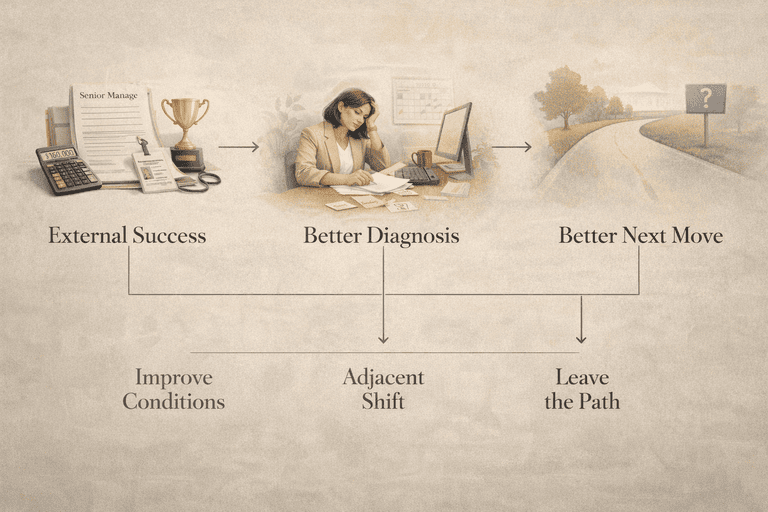
The solution is not always quitting a good job. Sometimes it is diagnosing why the external value and internal fit came apart.
That can lead to:
- a better version of the same field
- an adjacent move that preserves useful strengths
- a narrower role with a different task mix
- a more honest decision that the path was good for a season but not for the next decade
The important thing is that "good on paper" stops functioning like a veto against your own evidence.
Final Answer
A job can look good on paper and still feel wrong because the paper version measures legitimacy, while the lived version measures fit.
When the title, salary, status, or story still look strong but the daily work, future pull, and internal motivation keep degrading, the problem is usually not that you are impossible to satisfy. It is that the external logic of the role and the internal logic of your work life are no longer aligned.
That is not something to moralize. It is something to diagnose.

References
[1] Verquer, M. L., Beehr, T. A., & Wagner, S. H. (2003). A meta-analysis of relations between person-organization fit and work attitudes. Journal of Vocational Behavior, 63(3), 473-489.
[2] Kristof-Brown, A. L., Zimmerman, R. D., & Johnson, E. C. (2005). Consequences of individuals' fit at work: A meta-analysis of person-job, person-organization, person-group, and person-supervisor fit. Personnel Psychology, 58(2), 281-342.
[3] Rosso, B. D., Dekas, K. H., & Wrzesniewski, A. (2010). On the meaning of work: A theoretical integration and review. Research in Organizational Behavior, 30, 91-127.
[4] Allan, B. A., et al. (2018). Meaningful work and mental health: Job satisfaction as a moderator. Journal of Mental Health.
[5] World Health Organization. Burn-out an occupational phenomenon.
[6] CDC NIOSH. What burnout is and is not.
[7] Yang, W.-N., Niven, K., & Johnson, S. (2019). Career plateau: A review of 40 years of research. Journal of Vocational Behavior, 110, 286-302.
[8] CareerMeasure. Methodology.
Get A Clearer Career Signal
Take the assessment to see what fits, what feels off, and which roles are more likely to suit you.

Builds CareerMeasure hands on and writes about career fit, role transitions, and the gap between generic personality advice and evidence-based career decisions.
Community Discussion
Share your thoughts about this article
Delete Comment?
Are you sure you want to delete this comment? This action cannot be undone.