

Jobs for Former Teachers:
Practical Career Paths That Build on What You Already Do Well

Former teachers can investigate learning design, staff training, curriculum work, advising, customer education, and program coordination. The right option depends on which teaching tasks you want to keep and which conditions you want to leave. A role outside the classroom can still involve live facilitation, emotional support, demanding stakeholders, or evening work.
Start by comparing entry barriers and a small example of the work. The table below gives you one artifact to build and one possible source of friction to check for each direction.
Compare Six Directions Before Retraining
These are investigation prompts, not guarantees that a teaching credential qualifies you for each job. Review vacancies in your location before paying for a course. For U.S. context, BLS lists related experience alongside education for training and development specialists, while public-school instructional coordinator roles can require a master's degree and state-issued license.[9][10] Corporate learning design and school curriculum coordination should not be treated as identical entry routes.
| Direction | Teaching work to translate | Entry barrier to check | A small portfolio artifact | Friction that might remain |
|---|---|---|---|---|
| Learning design | Sequencing material and revising after feedback | Tools, accessibility, and production standards in vacancies | A short self-guided lesson with a check for understanding | Review cycles and competing stakeholder requests |
| Staff training | Live explanation and adapting to a group | Adult workplace context and relevant experience | A facilitator guide plus a brief practice session | Live delivery, travel, or a full teaching schedule |
| Curriculum or assessment | Standards alignment and evaluating learning | Subject expertise; school roles may have credential requirements | An annotated revision explaining a material's weaknesses | Education policy, deadlines, and institutional constraints |
| Advising or student support | Progress tracking and explaining next steps | Qualifications and scope of the particular advising role | A fictional process map for a student support referral | Caseloads, emotional support, and enrollment targets |
| Customer education | Explaining unfamiliar systems | Product knowledge and any commercial responsibilities | An onboarding guide for a publicly accessible tool | Customer escalation or adoption targets |
| Program coordination | Planning, documentation, and follow-through | Budget, software, and project experience expected | A fictional event plan with owners, dependencies, and risks | Interruptions and responsibility without full authority |
Build examples with invented or public material. Do not reuse identifiable student work, school records, or materials you do not have permission to share. Explain the decision behind the artifact, including what you changed after feedback; a polished file without reasoning gives a reviewer less to assess.
For a closer look at the portfolio work, see learning, training, and design after teaching. If you want to remain close to education, compare the settings in our non-classroom jobs guide. The transferable-skills worksheet helps connect your evidence to an actual vacancy.
Why Former Teachers Often Misread Their Own Value
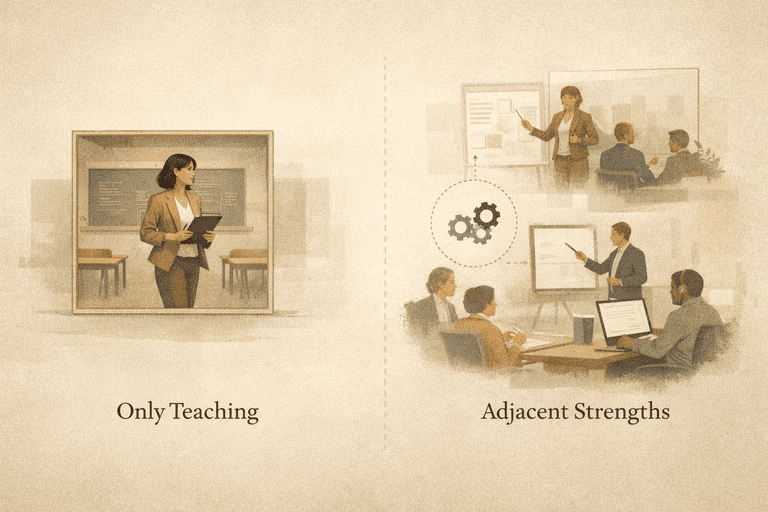
Teaching is one of those professions where people outside the field often flatten the work, and people inside the field often absorb that flattening.
Teachers get described as if they only "deliver lessons" or "care about students." In reality, classroom teaching usually requires a much richer mix of skills:
- live facilitation
- behavior and relationship management
- explanation and reframing
- curriculum interpretation
- assessment design
- progress tracking
- written communication
- stakeholder diplomacy
- time and energy management under constant interruption
That is one reason so many former teachers underestimate what transfers. They are used to thinking in the language of service, responsibility, and endurance, not in the language employers use for adjacent roles.
There is another distortion too: burnout can make people want distance from everything associated with teaching.[4] Teacher attrition data points to the same pressure pattern at the system level.[5] When that happens, they sometimes reject not only the institutional context but also the actual strengths they built inside it. They decide they never want to use any of those capabilities again, when the real issue may be that they no longer want to use them in a classroom under school conditions.
That distinction matters.
A former teacher may not want:
- daily classroom management
- parent escalation
- school bureaucracy
- emotionally saturated days
- constant unpaid preparation
- institutional constraints with little control
But that same person may still want:
- designing learning
- explaining clearly
- supporting growth
- structuring information
- facilitating groups
- creating order from messy material
Those are very different questions, and they point toward very different exits.
Start With The Work, Not The Title
If you are trying to leave teaching, do not start by asking what jobs are "for teachers." Start by breaking your current work into transferable parts.
For most teachers, that includes some combination of:
- presenting and facilitating for mixed audiences
- designing lesson flow and learning sequence
- translating complexity into understandable language
- checking comprehension and adjusting in real time
- documenting outcomes and progress
- handling difficult conversations with diplomacy
- coordinating with multiple stakeholders
- keeping systems moving even when resources are thin
That task-level view matters because adjacent roles are usually built from overlap underneath the title. O*NET's related-occupations logic reflects that same underlying truth: occupations connect through shared activities, knowledge, and work demands, not through labels alone.[2] Its advanced-search tools make that overlap visible in a more useful way than title-matching alone.[3]
This is why "teacher" does not map into only one next job. It maps into multiple families of work depending on which part of teaching was strongest for you and which part you want more or less of going forward.
Six Practical Paths That Often Make Sense
This is not a list of every possible exit. It is a list of the paths that most often make practical sense because they preserve real continuity.
1. Instructional Design
This is one of the most common adjacent paths for a reason.
If your strongest teaching work involved structuring content, sequencing learning, anticipating confusion, and building materials that help people understand something difficult, instructional design is often a natural move.
What transfers well:
- learning sequence design
- objective setting
- assessment logic
- explanation clarity
- learner empathy
- revision based on feedback
What changes:
- less live classroom management
- more asynchronous learning work
- more tools, platforms, and production workflows
- more emphasis on documentation and design artifacts
This path is strongest for teachers who liked the architecture of learning, not only the live performance of teaching.
2. Learning and Development or Corporate Training
Some teachers do not actually want to leave facilitation. They want to leave schools.
That difference matters. If you still enjoy leading sessions, helping people learn in real time, reading a room, adjusting pace, and making material land for mixed audiences, training and L&D may be a better fit than a more back-end content role.
What transfers well:
- live facilitation
- explaining for varied levels of prior knowledge
- handling disengagement
- designing for attention and retention
- reading confusion and recalibrating quickly
What changes:
- adult learners instead of children
- more explicit business context
- closer connection to performance goals
- sometimes more stakeholder influence and internal client work
This path is strongest for teachers who still like human-facing teaching energy but want a different environment, different audience, or different constraints.
3. Curriculum, Assessment, or Education Content Work
Some teachers are most energized not by classroom delivery but by content quality.
If you cared deeply about building strong materials, aligning standards, improving assessments, revising weak content, or creating more coherent instructional resources, this family can be a better fit than live teaching.
What transfers well:
- content design
- standards interpretation
- assessment creation
- revision and quality judgment
- audience-aware writing
What changes:
- less daily student interaction
- more editorial or production rhythm
- more isolated deep work
- often stronger need for portfolio evidence
This path is strongest for teachers who want more intellectual and design-focused work and less real-time emotional load.
4. Student Success, Advising, or Academic Support
Not every former teacher wants out of education-adjacent work. Some want out of the classroom while keeping a helping role.
Student success, advising, tutoring leadership, academic coaching, and related support roles can make sense when the teacher's strongest fit is relational guidance rather than classroom delivery.
What transfers well:
- developmental support
- progress monitoring
- expectation setting
- communication with students and families
- reading motivation and friction
- persistence coaching
What changes:
- less content delivery
- more one-to-one or small-group support
- more case management
- often less lesson design and more coordination
This path is strongest for teachers who still want mission alignment and human support work but want a lower-intensity or differently structured version of it.
5. Customer Education, Customer Success Enablement, or Implementation Support
This is the path many teachers overlook at first.
If you are comfortable explaining systems, onboarding people, guiding adoption, and helping confused users build confidence, education-adjacent roles in companies can make a lot of sense. In many organizations, the actual work is not that far from teaching: understand where the learner is, structure the explanation, reduce friction, and help the person become functional faster.
What transfers well:
- onboarding and explanation
- facilitation
- patience under repeated questions
- pattern recognition around confusion
- resource creation
- stakeholder follow-through
What changes:
- commercial context
- tools, process, and product knowledge matter more
- learners may be customers, clients, or internal teams
- success is often tied to adoption and outcome metrics
This path is strongest for teachers who like explaining and helping people succeed, but want more business context and less classroom burden.
6. Program Coordination, Operations, or Education-Adjacent Project Work
Some teachers discover that what they are really good at is not only teaching. It is keeping a complex human system running.
Schools force people to coordinate schedules, materials, deadlines, communication, stakeholder expectations, escalation, and constant small adjustments. That operational work is often invisible to teachers because it sits inside the title rather than outside it.
What transfers well:
- coordination under constraint
- documentation and follow-through
- juggling competing needs
- issue triage
- communication across groups
- keeping work moving without ideal conditions
What changes:
- less direct instruction
- more systems work
- often more explicit project or process ownership
- sometimes a steeper learning curve around tools and workflows
This path is strongest for teachers who liked making complicated things run and are ready for less emotionally saturated work.
How To Choose And Validate The Right Path
The mistake here is to search by title without diagnosing what part of teaching you want to preserve.
A better filter is:
What Part Of Teaching Still Feels Like Yours?
Examples:
- the live facilitation
- the learning design
- the writing and structuring
- the coaching and support
- the coordination and systems work
If you cannot answer that clearly, the search gets noisy fast.
What Part Of Teaching Are You Trying To Stop Doing?
This matters just as much.
Maybe you want:
- less emotional exposure
- less constant performance
- fewer interruptions
- less discipline management
- less institutional rigidity
- better pay-to-effort balance
Different adjacent roles solve different versions of that problem.
What Kind Of Day Do You Want Instead?
Do you want:
- more deep work?
- more one-to-one work?
- more adult learners?
- more business context?
- less live delivery?
- less mission-heavy emotional labor?
That answer often matters more than the title.
Common Traps In The Exit Search
There are two common mistakes.
Overreach
This happens when people assume teaching proves immediate readiness for any people-facing, mission-facing, or vaguely strategic role.
Not everything transfers at full strength. Some roles require domain knowledge, tool depth, commercial judgment, or portfolio evidence that classroom teaching does not automatically provide. Career adaptability helps people bridge those gaps.[6] It does not erase every gap automatically just because the work is adjacent.[7]
Undersell
This happens when teachers describe their work too modestly or too narrowly:
- "I just taught English."
- "I only worked with students."
- "I do not have corporate experience."
That language hides too much of the actual work. It makes the experience sound smaller than it is.
The stronger move is to name the work truthfully and specifically:
- designed and delivered structured learning for mixed audiences
- built materials and assessments tied to measurable outcomes
- managed stakeholder communication across students, families, and colleagues
- tracked progress, identified issues, and adjusted approach in real time
That is not resume inflation. It is clearer reporting.
How To Make The Transition More Credible
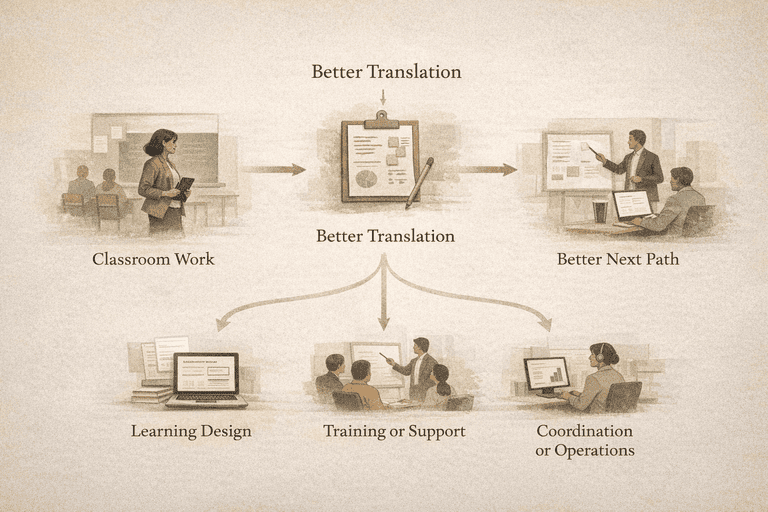
Former teachers usually do better when they treat the move like a translation problem, not a total identity rebuild.
Practical steps:
- Choose one or two adjacent paths, not eight.
- Rewrite your experience at the task and outcome level.
- Learn the language of the target role without copying jargon blindly.
- Build proof where needed:
- a portfolio sample
- a short project
- volunteer work
- internal stretch experience
- tool familiarity
- Apply where the overlap is real, not only where the title sounds hopeful.
This matters because employer confidence increases when the next move looks coherent. People are much easier to hire when the story is not "former teacher trying to escape," but "professional with strong facilitation, learning, communication, and coordination experience moving into a role where those exact capabilities still matter."
Do Not Choose Only By Relief
This is one of the biggest risks in a teacher exit.
When someone is exhausted enough, almost any non-classroom role can sound attractive. Relief becomes the main filter. That is understandable, but it can produce weak moves if it becomes the only logic.
The better question is not just, "What would get me out fastest?" It is also:
- what kind of work would I still respect after the initial relief wears off?
- what parts of teaching am I trying to preserve, not only escape?
- what kind of daily rhythm would actually fit me better?
- which role gives me enough continuity that I can credibly land it without years of rebuilding?
This matters because not every teacher exit is a fit improvement. Some exits simply replace one form of depletion with another. A person may leave classroom overload and land in a role with constant client pressure. Or they may leave school bureaucracy and end up in a company role that feels empty, misaligned, or too commercially driven for what they want.
That does not mean you should stay stuck until you find a perfect answer. It means the best transition logic usually combines two goals:
- reduce the current source of pain
- move toward a more believable longer-term fit
That is why adjacent roles are often so useful. They give you a cleaner bridge between what you already know how to do and what you want more of next.
Final Answer
The best jobs for former teachers are usually adjacent roles that reuse real classroom-built capabilities in a different setting.
Instructional design, training, curriculum work, student success, customer education, enablement, and operations-adjacent coordination roles often make sense because they preserve genuine continuity in learning design, communication, facilitation, stakeholder handling, and work under constraint.
The smartest move is usually not to ask what jobs teachers are "allowed" to do. It is to identify which part of teaching you still want to keep, which part you are relieved to leave, and which next role makes that tradeoff realistic without pretending you are starting from zero.

References
[1] OECD. Career Guidance for Adults in a Changing World of Work.
[2] O*NET Resource Center. O*NET Content Model.
[3] O*NET OnLine. Help: Advanced Searches.
[4] Madigan, D. J., & Kim, L. E. (2021). Towards an understanding of teacher attrition: A meta-analysis of burnout, job satisfaction, and teachers' intentions to quit. Teaching and Teacher Education, 105, 103425.
[5] National Center for Education Statistics. Teacher Turnover: Stayers, Movers, and Leavers.
[6] Brown, A., Bimrose, J., Barnes, S. A., & Hughes, D. (2012). The role of career adaptabilities for mid-career changers. Journal of Vocational Behavior, 80(3), 754-761.
[7] Savickas, M. L., & Porfeli, E. J. (2012). Career Adapt-Abilities Scale: Construction, reliability, and measurement equivalence across 13 countries. Journal of Vocational Behavior, 80(3), 661-673.
[8] National Association of Colleges and Employers. Career Readiness: Development and Validation of the NACE Career Readiness Competencies.
[9] U.S. Bureau of Labor Statistics. Training and Development Specialists. Occupational Outlook Handbook.
[10] U.S. Bureau of Labor Statistics. Instructional Coordinators. Occupational Outlook Handbook.
See Your Stronger-Fit Next Moves
Get a clearer picture of which adjacent paths fit you better before making a bigger jump.

Builds CareerMeasure hands on and writes about career fit, role transitions, and the gap between generic personality advice and evidence-based career decisions.
Community Discussion
Share your thoughts about this article
Delete Comment?
Are you sure you want to delete this comment? This action cannot be undone.