

Jobs for Former Project Managers:
Adjacent Roles That Still Use Coordination and Judgment

Many project managers who want out of project management make the same mistake at the start of the search: they assume the title explains their whole value.
That is usually the wrong frame.
Project management compresses a lot of work into one label. It is part orchestration, part stakeholder handling, part risk judgment, part process management, part communication under ambiguity, and part emotional endurance inside systems you do not fully control. When people burn out on the role, they often reject the whole package. But the part they want to leave is usually narrower than that.
Often, the real desire is not: I need a completely different identity. It is: I want to keep the strongest parts of what I built, but stop living inside endless follow-up, low-control accountability, and constant dependency management.
That is a much more practical career problem.
The Short Answer
The best jobs for former project managers are usually not random coordination-heavy jobs. They are adjacent roles that preserve real PM strengths while changing the pressure structure around them.
That often includes paths like:
- operations
- program management
- implementation or delivery work
- internal systems or business-process roles
- service delivery or customer-facing execution roles
- product-adjacent or process-improvement work
The better question is not only "What can project managers do next?" It is: which parts of project management still fit me, and which parts of the PM environment do I most want to stop carrying?
Why Former PMs Often Misread Their Own Value
Project managers are used to describing themselves through the visible workflow:
- timelines
- stakeholders
- meetings
- status tracking
- risks
- dependencies
Those are real parts of the work. They are not the whole value.
Project management also builds a less obvious set of strengths:
- turning ambiguity into sequence
- seeing where execution will break before it breaks
- keeping multiple parties aligned without perfect authority
- structuring decisions when incentives are messy
- identifying what matters now versus later
- carrying motion through a system that wants to fragment
That is why adjacent transitions can make much more sense than people first assume. The move often works not because another role is vaguely "organized," but because the underlying work patterns are closer than the titles suggest. Career-transition and employability research keeps returning to the same point: successful moves depend partly on how well people reinterpret existing capabilities and apply them in adjacent contexts, not only on whether they start over entirely.[1]
First Separate What You Want To Keep From What You Want To Leave
This is the most important step in the whole article.
Many former PMs are not trying to leave all of the following:
- execution judgment
- prioritization
- communication
- sequencing
- cross-functional awareness
- process design
They are trying to leave more specific things:
- endless follow-up
- low-control accountability
- status theater
- meeting saturation
- being trapped between teams with misaligned incentives
- timeline pressure without enough decision power
Different adjacent roles solve different versions of that problem.
If you skip this step, every operations or delivery title starts to look attractive even though the day-to-day fit may still be wrong.
What Project Management Usually Trains Better Than People Notice
Project management is one of those jobs where outsiders often flatten the work and insiders often normalize its complexity.
Good PMs are usually not only organized. They are usually good at:
- seeing dependency structure quickly
- noticing where ownership is ambiguous
- separating signal from noise in messy execution systems
- keeping communication usable across very different stakeholders
- balancing urgency, sequence, and tradeoffs in real time
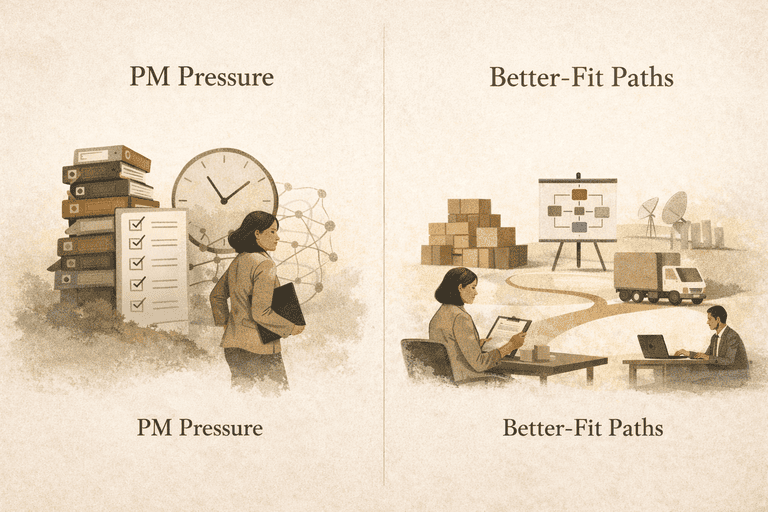
Those are durable strengths.
That is one reason adjacent paths usually emerge from work-pattern overlap rather than title similarity. O*NET's occupational framework reflects the same basic logic: related roles often connect through shared work activities, skills, and demands rather than through public labels alone.[2]
Once you think at that level, the next-move map gets cleaner.
What Former PMs Often Misdiagnose About Themselves
This is where the search usually goes off track.
#### “I Only Know How To Run Projects”
This is rarely true.
What is usually true is that the PM has spent years using their strengths inside one formal delivery structure. Once that structure gets old, they start mistaking familiarity for identity.
They say:
- I only know timelines
- I only know status meetings
- I only know project plans
But what they often actually know is:
- how to create momentum under ambiguity
- how to reduce execution friction
- how to coordinate interdependent work
- how to see risk and operational weakness early
- how to keep systems functional when ownership is messy
That distinction matters because the first framing collapses the search. The second opens it up.
#### “If I Leave PM, I Have To Leave Coordination Entirely”
Not necessarily.
Some PMs absolutely do want much less coordination. Others only want less of one type of coordination. That is a critical difference.
A PM may be tired of:
- chasing updates
- forcing accountability without authority
- mediating avoidable stakeholder conflict
- living inside constant follow-up
without being tired of:
- sequencing work
- operational clarity
- structured execution
- making things actually move
If you confuse those two, you can overcorrect into a role that removes the wrong thing.
“Any More Strategic Role Will Feel Better”
Not necessarily.
Some roles that sound more strategic simply replace operational follow-up with:
- more decks
- more diffuse influence
- more alignment theater
- even less direct ownership
That is why the target role has to be judged by daily work structure, not only by whether it sounds more senior.
Six Adjacent Paths That Often Make Sense
These are not the only options. They are the paths that most often make practical sense because they preserve something real.
The comparison of roles similar to project management helps check the responsibility, authority, and coordination demands behind a promising title.
1. Operations
This is often the strongest adjacent move for PMs who still like order, execution, and systems, but want more durable ownership.
What transfers well:
- process thinking
- issue triage
- cross-functional communication
- workflow visibility
- turning ambiguity into motion
What changes:
- less temporary project framing
- more recurring system ownership
- less project theater
- often more direct control over what gets improved
This path fits best when you want less orchestration around a broken system and more influence over the system itself.
2. Program Management
This is often attractive to PMs who still like orchestration, but want the work to sit at a broader or more integrated level.
What transfers well:
- cross-functional coordination
- sequencing and dependency judgment
- stakeholder alignment
- escalation thinking
- execution visibility
What changes:
- the scope often becomes broader
- the time horizon is usually longer
- the work may become more connected to larger initiatives rather than one execution track
- ambiguity can increase, but so can leverage
This path fits best when you still like the coordination spine of PM work, but want it to feel more consequential and less administratively repetitive.
3. Implementation Or Delivery Roles
Some former PMs do not want less execution. They want execution that is closer to the thing being delivered.
What transfers well:
- sequencing
- expectation-setting
- issue management
- dependency handling
- stakeholder communication
What changes:
- more concrete outputs
- clearer scope boundaries
- less abstract project language
- often a stronger connection to customer or product outcomes
This path fits best when you still like making things happen, but want less “professional follow-up” energy.
4. Internal Systems Or Business Process Roles
Some PMs discover the part they actually like is not project administration. It is making messy systems cleaner.
That can point toward:
- workflow improvement
- internal systems
- process design
- business-process roles
- tooling-adjacent operational work
What transfers well:
- process mapping
- documentation
- issue spotting
- implementation discipline
- cross-functional coordination
What changes:
- less visible deadline theater
- more repeatability-focused work
- more direct process ownership
- less pressure to keep restarting motion from scratch
This path fits best when you want coordination skill to turn into better infrastructure, not another pile of updates.
5. Service Delivery Or Customer-Facing Execution Roles
Some PMs still like external-facing work. They just want the value chain to feel clearer.
What transfers well:
- expectation management
- continuity from handoff to outcome
- delivery communication
- problem-solving under real-world constraints
What changes:
- the work often feels more tangible
- success may be easier to see
- the role may feel less abstract than internal PM work
- pressure can still be real, but often less dependent on pure internal alignment theater
This path fits best when you still want people and delivery, but in a role where the work feels more concretely tied to outcomes.
6. Product-Adjacent Or Process-Direction Roles
Some PMs were always strongest not in chasing tasks, but in clarifying scope, sequencing decisions, and turning ambiguity into a usable plan.
That can point toward product-adjacent roles or process-direction work when the person likes:
- priority setting
- requirement clarification
- framing tradeoffs
- aligning work to actual outcomes
What changes:
- less generic coordination
- more decision logic
- more product, service, or process context
- sometimes less follow-up fatigue, but often more ambiguity
This path fits best when you want to stay close to execution but closer to the “what and why” than to pure project administration.
Common Traps In The Exit Search
This is where former PMs make avoidable mistakes.
“Anything In Operations”
Operations is not one thing.
Some PMs imagine they can move into operations as a clean umbrella answer. In practice, operations can mean process ownership, service delivery, business systems, internal support, workforce planning, or ongoing execution work with very different levels of control.
Some of those paths fit PM backgrounds well. Others reproduce the same coordination pain with a different label.
Another Coordination Role With The Same Accountability Pattern
Sometimes the new title sounds different but reproduces the same structure:
- low authority
- high follow-up
- constant responsiveness
- dependence on other people’s incentives
If that pressure pattern is what broke fit in project management, changing the title alone will not help much.
Roles Chosen Only Because They Sound More Senior
People often default to the move that sounds easiest to defend publicly instead of the one that most directly solves the fit problem. That can keep the transition socially legible while preserving the wrong work pattern underneath it.
How To Choose And Validate The Right Path
Once you have two or three likely path families, stop relying on title appeal and start reading real postings closely.
Look for repeated signals in:
- how much of the work is still meeting-heavy coordination
- whether the role owns systems and process or only tracks them
- how much direct authority comes with accountability
- whether success is measured through delivery milestones, operational efficiency, implementation quality, or stakeholder alignment alone
- whether the role is closer to execution, systems improvement, service delivery, or priority-setting
This matters because titles like:
- operations manager
- program manager
- implementation lead
- delivery manager
- business process manager
can describe very different daily lives across different companies.
The title is not enough. The task mix tells the truth.
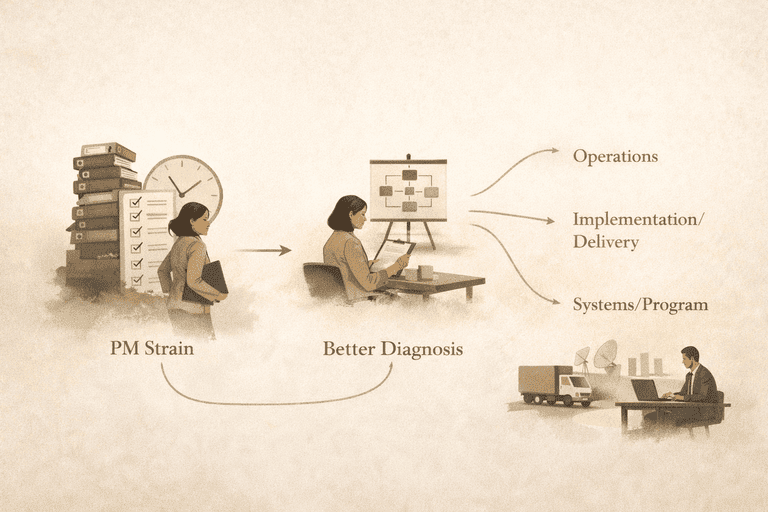
Use These Fit Filters
At this point, the best question is not which title sounds safest. It is which part of project management still feels like yours.
Use these filters.
#### If You Still Like Orchestration But Want More Leverage, Look Harder At Program or Ops
These paths preserve cross-functional movement while often improving the control-to-accountability balance.
#### If You Like Execution More Than Status Management, Look Harder At Implementation or Delivery
This usually fits when you still like momentum and completion, but want the work to be closer to the actual thing being delivered.
#### If You Like Fixing The Machine More Than Carrying The Timeline, Look Harder At Systems or Process Work
This usually fits when you were always noticing workflow breakdowns, handoff failures, and structural friction more than enjoying project administration itself.
What A Strong Former-PM Exit Usually Preserves
The best adjacent move usually preserves at least one of these:
- execution judgment
- sequencing and prioritization
- stakeholder management
- operational clarity
- the ability to keep interdependent work moving
If the next role uses almost none of that, the move may still be right, but it is no longer a simple adjacent transition. It becomes a larger reset with a different risk profile.
How To Pressure-Test The Next Role Before You Move
Do not stop at title appeal.
Pressure-test the role against the actual problem.
Ask:
- does the role still depend on constant follow-up without authority?
- does it preserve the execution strengths I still value?
- does it give me more control, more ownership, or more clarity than classic PM work did?
- does it move me toward work I want more of, or only away from the current pain?
This matters because adjacent roles can still hide the same pattern under more attractive language.
How To Explain The Move So It Sounds Coherent
Former PMs often undersell themselves here by making the story too generic.
The guide to explaining a career change helps turn an example of coordination or judgment into a clear account of what you can contribute to the target role.
Weak version:
- I want to do something less chaotic
- I am burned out on project management
- I want a more strategic role
Stronger version:
- Project management taught me strong execution judgment, cross-functional coordination, and the ability to move ambiguous work forward under pressure. Over time I realized the part of the work I want more of is systems ownership and less of is pure dependency management, which is why operations is a stronger next fit for me.
Or:
- My background in project management built strong skills in sequencing, issue triage, and stakeholder handling. I found that the part of the work I wanted more of was delivery and tangible outcomes, and less of was status-heavy orchestration, which is why implementation is a more fitting next move.
That kind of explanation preserves continuity while making the move sound deliberate.
Final Answer
The best jobs for former project managers are usually adjacent roles that preserve real PM strengths while changing the pressure structure around them.
Once you separate what project management trained you to do from the exact shape of PM-style follow-up and low-control accountability, the options get much clearer. You are no longer asking what random role might accept a former PM. You are asking where coordination, execution judgment, and systems awareness can be used in a way that fits you better now.

References
[1] De Vos, A., et al. Career transitions and employability. Journal of Vocational Behavior, 2021.
[2] O*NET OnLine. Advanced Search.
[3] O*NET OnLine. Summary Report and Occupation Structure Resources.
[4] Fugate, M., Kinicki, A. J., & Ashforth, B. E. (2004). Employability: A psycho-social construct, its dimensions, and applications. Journal of Vocational Behavior, 65(1), 14-38.
[5] OECD. Career Guidance for Adults in a Changing World of Work.
[6] Savickas, M. L., & Porfeli, E. J. (2012). Career Adapt-Abilities Scale: Construction, reliability, and measurement equivalence across 13 countries. Journal of Vocational Behavior, 80(3), 661-673.
[7] Project Management Institute. Pulse of the Profession.
[8] CareerMeasure. Methodology.
See Your Stronger-Fit Next Moves
Get a clearer picture of which adjacent paths fit you better before making a bigger jump.

Builds CareerMeasure hands on and writes about career fit, role transitions, and the gap between generic personality advice and evidence-based career decisions.
Community Discussion
Share your thoughts about this article
Delete Comment?
Are you sure you want to delete this comment? This action cannot be undone.