

Is My Career Right for Me? How To Tell If Your Current Role Actually Fits

If you are asking whether your career is right for you, that question usually shows up after a pattern. You are performing well enough, but the work keeps draining you. Or you keep telling yourself the problem is just this company, this boss, this quarter, or this client set, and yet the same friction keeps coming back.
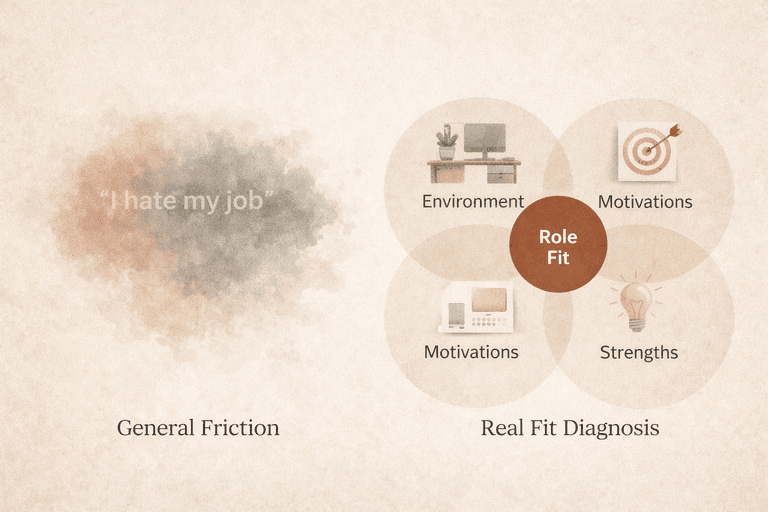
Most adults do not need a dramatic identity answer to this question. They need a better diagnosis. They need to know whether the issue is burnout, bad management, a poor team, weak job design, missing skills, or a deeper mismatch between the kind of work they are doing and the kind of work they can actually sustain. OECD guidance on adult career support reflects the same reality: adults typically seek career guidance because they want to progress, change jobs, or navigate labor-market shifts, not because they are choosing from zero for the first time.[1]
That is why "Is this career right for me?" is usually the wrong first question. The better first question is: what kind of mismatch am I actually experiencing?
The Short Answer
Your career is probably not the right fit if the same kind of friction keeps showing up across roles, managers, and contexts, especially when the mismatch touches the actual content of the work and the motivations that sustain you.
But do not jump too fast. Chronic exhaustion can come from burnout, and burnout is specifically a work-related phenomenon tied to chronic workplace stress that has not been successfully managed.[2][3] That matters because some people do not need a new career. They need a different team, workload, structure, or environment.
The right diagnosis usually sits inside four questions:
- Do I dislike the actual work, or only the current conditions around it?
- Does the mismatch keep repeating across jobs, or only in this specific place?
- Is the problem fixable through role redesign, stronger boundaries, or a better environment?
- If I removed the current stressors, would this kind of work still feel wrong for me?
If the answer to the last question is still yes, you are closer to a real career-fit problem than a temporary work problem.
What "Career Right For Me" Actually Means
People often talk about the "right career" as if it should feel obvious, stable, and perfect. That is not a useful standard.
A better standard is fit. Not perfect fit, but workable fit.
In practical terms, fit means the work is compatible enough with your interests, your motivations, your abilities, and your preferred way of operating that you can do it well without paying an unreasonable long-term cost. That is why fit research matters here. Meta-analytic work on person-organization fit found meaningful relationships with job satisfaction and commitment, along with a negative relationship with intent to leave.[4] Later research that looked at person-organization, person-group, and person-job fit together also found that these fit perceptions are linked to turnover intention in the expected direction.[5]
That does not mean "fit" is everything. It does mean the question is not imaginary. People are not making up the difference between a role that mostly suits them and a role that keeps grinding them down.
The Most Common Misdiagnosis
The most common mistake is confusing "my current work life is bad" with "this entire career path is wrong for me."
Those are not the same thing.
A career can feel bad because the manager is bad. Or because the pace is unsustainable. Or because the company rewards the wrong behavior. Or because the role has drifted away from what you were hired to do. Or because you are in a period of burnout severe enough that even a decent job now feels intolerable.
WHO's ICD-11 definition of burnout is useful here because it keeps the concept narrow. Burnout is tied to chronic workplace stress that has not been successfully managed, and it shows up through exhaustion, mental distance or cynicism, and reduced professional efficacy.[2] That is different from saying "this whole field is not for me." The overlap is real, but they are not identical.
So before you declare the entire career wrong, you need to separate at least three possibilities:
- wrong environment
- wrong role design
- wrong role family or career path
If you skip that step, you risk making a much bigger move than the problem actually requires.
Four Signs Your Current Career May Actually Be Wrong
1. You Dislike The Core Work, Not Just The Conditions
The guide to signs of a wrong-career pattern considers recurring evidence across roles and the reasons a single difficult period is insufficient.
This is the most important signal.
If the job became calmer, better managed, and better paid tomorrow, would you still dislike the actual work itself? Not the stress around it. The work.
Would you still resist spending your days persuading, managing, troubleshooting, presenting, selling, negotiating, analyzing, documenting, coordinating, or serving in the way the role requires?
If the answer is yes, that is much stronger evidence of a career-fit problem than any mood you have on a bad week.
2. The Same Friction Keeps Following You
If you have changed teams, companies, or managers and the same basic dissatisfaction keeps returning, that is another strong signal.
Maybe every version of the work eventually feels too socially draining. Or too chaotic. Or too repetitive. Or too externally driven. Or too detached from outcomes you care about. When the pattern survives multiple environments, the explanation becomes less "bad luck" and more "there is something about this kind of work that is not fitting me well."
That does not have to mean a total reinvention. It may mean the role family is wrong, but the broader domain still fits. Still, repeated friction matters.
3. Small Fixes Help, But Never Solve The Real Problem
Some job pain is fixable. Better boundaries help. Better workload distribution helps. Better communication helps. More autonomy helps.
That is one reason job crafting matters. Career-exploration research supports the broader idea that people actively gather information and test possibilities rather than only waiting for identity clarity to arrive.[6] A two-wave study of hospitality employees found associations between job crafting, perceived fit, and engagement.[7] That setting-specific evidence does not establish that a particular change will improve your job. In plain English, some roles can be made meaningfully better by changing how the work is structured, how support is accessed, or how demands are handled.
But if every improvement only makes the job slightly less bad, and the core dissatisfaction keeps returning, that is a clue. It suggests the problem is not only the conditions. It may be the role itself.
4. The Future Version Of Success Does Not Appeal To You
This signal gets ignored too often.
If you look at the next logical promotion or the respected senior version of your role and feel relief that you are not there, pay attention. If the future version of success in your path looks like a more intense version of the same life you already do not want, that is a meaningful signal.
A career should not require perfect passion. But if the future arc feels like a trap rather than a direction, the problem is probably larger than a rough quarter.
Four Signs The Career May Be Right, But The Current Setup Is Wrong
1. You Still Like The Core Work When Conditions Improve
If the job becomes noticeably better when you get space, support, autonomy, or better collaborators, that points away from a full career mismatch.
2. You Can Name Specific Environmental Problems
Examples:
- quota pressure is the issue, not helping customers
- politics is the issue, not strategy work
- nonstop interruptions are the issue, not problem solving
- lack of clarity is the issue, not ownership
That kind of specificity is useful. It means the job may be repairable through a better role version rather than a new field entirely.
3. Adjacent Roles Still Sound Attractive
If you dislike your current role but feel drawn to nearby roles that use similar strengths with different demands, that usually points to a role-level mismatch, not a full career-level mismatch.
A burned-out recruiter may still fit talent operations, people analytics, employer branding, or L&D better than a total reset into something unrelated. A drained account manager may still fit partnerships, customer education, or implementation better than staying in pure client servicing. This is why adjacent-role logic matters more than romantic reinvention.
4. Your Problem Gets Better When The Work Fits Your Natural Operating Style
Some people do badly in constant interruption and do much better in deep individual work. Some do badly in highly ambiguous solo problem solving and do much better in interactive, people-facing environments. Some can tolerate pressure but not endless politics. Some like challenge but need clearer structure.
If the work feels better when the operating conditions fit you, the issue may be fit at the environment or job-design layer rather than at the whole-career layer.
A Better Diagnostic Process
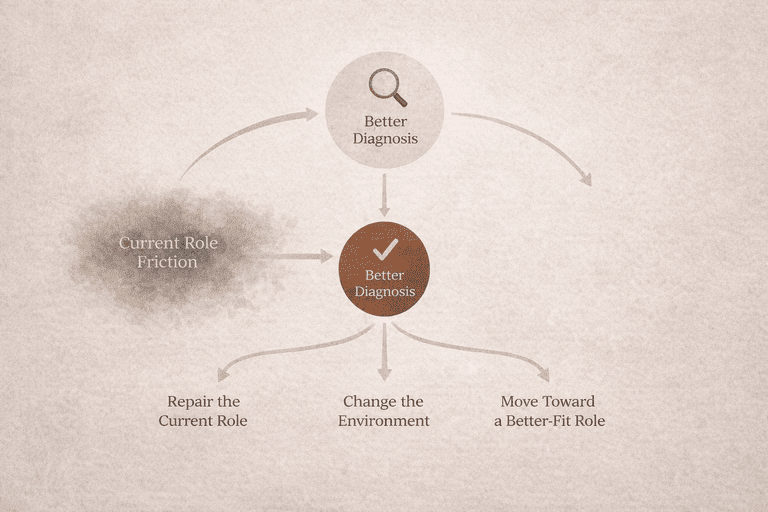
If you are trying to answer this honestly, do not ask the question in one giant leap. Break it down.
Use the job-versus-career comparison to test whether the change you are considering addresses the work itself or mainly its current conditions.
Step 1: Separate Burnout From Deeper Mismatch
Ask:
- Am I exhausted because the work is badly managed?
- Am I cynical because the environment is corrosive?
- Or do I still feel wrong even when the stress temporarily lifts?
Burnout is real and deserves its own diagnosis.[2] CDC guidance reinforces the same boundary and warns against treating burnout as a catch-all label for every form of distress at work.[3] But burnout and mismatch can overlap, which is why you need to look at the work itself, not only your current energy level.
Step 2: Identify The Layer Of Fit That Is Breaking
Possible layers:
- person-job fit: the day-to-day work itself
- person-organization fit: the company's values, culture, incentives, or environment
- person-group fit: the team context and working relationships
This matters because each layer implies a different fix. Meta-analytic work on person-organization fit links it to satisfaction, commitment, and intent to leave.[4] Related research that looks across fit layers points in the same general direction for turnover-related outcomes.[5]
Step 3: Test The Smallest Plausible Fix First
Before making a full career jump, test smaller hypotheses where possible:
- new team
- new scope
- more autonomy
- less client exposure
- more strategy and less execution
- more execution and less stakeholder management
- adjacent internal move
If smaller interventions change everything, you just learned something important. If they barely change the experience, you learned something important too.
Step 4: Look For Repeating Evidence, Not One Emotional Week
Do not diagnose your entire career on the basis of one bad sprint or one hard manager. Look for stable patterns:
- what work consistently energizes you
- what work consistently depletes you
- what stress feels costly but meaningful
- what stress feels pointless and identity-eroding
That is the evidence base you should trust most.
So, Is Your Career Right For You?
The honest answer is usually not yes or no in one step.
A better answer sounds more like this:
- "The field is probably fine, but this role version is wrong."
- "The work itself keeps misfitting me, even across contexts."
- "The job is not wrong, but the environment is unsustainable."
- "I do not need a total reset. I need an adjacent move."
That is a better answer because it gives you something usable.
This is also why CareerMeasure is built around current-role interpretation first rather than only abstract career matching. The point is not just to ask what sounds good. The point is to understand what is happening in the role you already have, where the mismatch sits, and whether the next move should be repair, adjacency, or a bigger shift.[8]
Final Answer
Your career is probably wrong for you if the actual work keeps draining you, the same mismatch keeps repeating across contexts, small fixes never solve the real problem, and the future version of success in that path does not appeal to you.
But do not confuse burnout, bad management, or a broken environment with a broken career. The smartest move is to diagnose the layer of mismatch first: the environment, the role design, the team, or the career path itself.
That is how you stop making emotional guesses and start making better career decisions.

References
[1] OECD. Career Guidance for Adults in a Changing World of Work.
[2] World Health Organization. Burn-out an occupational phenomenon.
[3] CDC NIOSH. What burnout is and is not.
[4] Verquer, M. L., Beehr, T. A., & Wagner, S. H. (2003). A meta-analysis of relations between person-organization fit and work attitudes. Journal of Vocational Behavior, 63(3), 473-489.
[5] Abdalla, A., et al. (2018). Perceived person-organization fit and turnover intention in medical centers. Personnel Review, 47(4), 863-881.
[6] Jiang, Z., Newman, A., Le, H., Presbitero, A., & Zheng, C. (2019). Career exploration: A review and future research agenda. Journal of Vocational Behavior, 110, 338-356.
[7] Ok, C., & Lim, S. (2022). Job crafting to innovative and extra-role behaviors: A serial mediation through fit perceptions and work engagement. International Journal of Hospitality Management, 106, 103288.
[8] CareerMeasure. Methodology.
Check What Is Actually Misfitting
Use the assessment to separate current-role friction, deeper mismatch, and stronger-fit next moves.

Builds CareerMeasure hands on and writes about career fit, role transitions, and the gap between generic personality advice and evidence-based career decisions.
Community Discussion
Share your thoughts about this article
Delete Comment?
Are you sure you want to delete this comment? This action cannot be undone.