

I’m Good at My Job but I Hate It:
What That Usually Means

Being good at your job and wanting to keep doing it are separate questions. Before deciding that the whole career is wrong, identify the work you do well, the parts you dread, and the conditions around them. A change of duties or employer may address one problem; a different occupation may be needed for another.
Start with a few concrete examples from your week. The exercise below helps you turn "I hate it" into a question you can investigate, without treating career dissatisfaction as a diagnosis.
Record What You Want To Keep And Change
This is a reflection exercise, not a clinical instrument or a validated burnout test. Use tasks from a recent ordinary week, and describe what happened before deciding what it means. If exhaustion or distress is persistent or affects life beyond work, a health professional can help you assess that separately from a career decision.
| Evidence from this week | Keep | Change | Small test |
|---|---|---|---|
| A task I did well and wanted to repeat | Name the activity and why it mattered | Record conditions that made it easier | Repeat the task under comparable conditions |
| A task I did well but dreaded | Identify any useful skill underneath it | Name the demand, incentive, or environment that caused friction | Change one condition, where you have permission, and observe the result |
| A task I avoided or found difficult | Identify anything you still want to learn | Separate missing practice from unwanted work | Try supported practice before treating difficulty as permanent mismatch |
Illustration: an account manager enjoys untangling a customer's problem but dreads the renewal negotiation afterward. Their first hypothesis is that commercial pressure is the problem. A customer-education task may help them test that hypothesis, but they should also ask whether the target role owns renewals or expansion. A new title can retain the same pressure.
Try writing a similarly specific sentence: "I want to keep explaining complex issues, while reducing individual revenue targets." That gives you something to compare against vacancies. "I need a meaningful job" leaves much more room for an attractive title to mislead you.
If the evidence points mainly to conditions around the work, use the job-versus-career decision guide. If the work itself needs to change, the transferable-skills worksheet helps you retain useful evidence without carrying every old duty into the next role.
Why Success Makes This Harder To See
People are taught to treat performance as proof. If you are succeeding, the assumption is that you are in the right place.
That logic sounds practical, but it misses something important. Human beings can become competent for many reasons that have little to do with healthy fit.
You can become good because:
- the job forced you to adapt
- the stakes were high enough that you learned quickly
- your strengths happened to match the job's demands even if your motivations did not
- you are conscientious and capable enough to perform in roles that are still wrong for you
- other people kept rewarding the visible outcomes without asking what the work was costing you
This is one reason fit matters so much. A role can extract strong performance from someone and still be a poor long-term match. Meta-analytic work on person-organization fit found meaningful links with job satisfaction, commitment, and intention to leave, which is exactly the zone where this problem lives.[1] Broader person-environment fit research shows the same general pattern across person-job, person-group, and person-organization levels.[2]
Why High Performers Stay Too Long
People who are bad at a role usually get forced into clarity faster. High performers have the opposite problem: they get rewarded for staying.
The better you perform, the easier it is for other people to assume you belong there. They give you more trust, more responsibility, and more evidence that this path is "working."
This is one reason career plateau research is useful here. Plateau is not only about promotions stopping. It also includes job-content plateau, where the work stops feeling developmental, energizing, or worth the tradeoffs even if the career still looks acceptable from the outside. A major review of 40 years of plateau research found that plateaued workers tend to report worse satisfaction and well-being, along with stronger turnover intentions and weaker work outcomes over time.[7]
That does not mean everyone who hates a job is plateaued. It does mean there is a well-studied pattern where externally acceptable careers become internally deadening long before they become publicly unsustainable.
That is why this feeling should not be reduced to "I guess I need to be more positive." Sometimes the real issue is that you stayed on a successful path past the point where it still felt alive.
Five Real Readings Of The Sentence
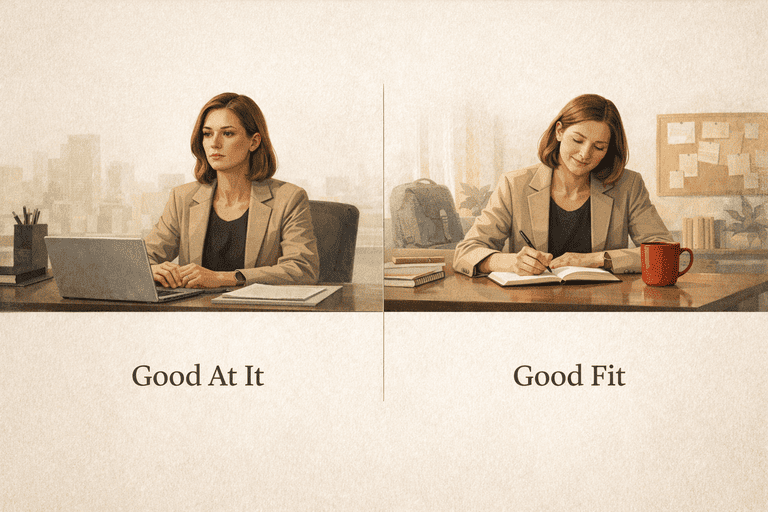
When someone says, "I’m good at my job but I hate it," the answer is usually hiding inside one of five readings of that sentence.
You Built Competence In Work That Does Not Actually Motivate You
You may be effective at the work because you are disciplined, smart, organized, persuasive, steady under pressure, or quick to learn. None of that guarantees the work is intrinsically rewarding for you.
A person can be excellent at account management and still hate spending their day maintaining relationships they do not care about. A person can be excellent at operations and still hate living inside constant follow-up, cleanup, and escalation. A person can be excellent at leadership and still hate the emotional load of managing people all day.
This matters because motivation is not decorative. Self-determination theory has been influential for a reason. When work consistently frustrates autonomy, competence, and relatedness in the wrong ways, the result is not just lower mood. It affects energy, engagement, and the quality of motivation sustaining the work over time.[5]
So if you are performing well while your motivation keeps collapsing, do not dismiss that as immaturity. It may simply mean the work fits your abilities better than it fits your reasons for wanting to work.
Another way to say it: ability answers whether you can do the work. Motivation answers whether you want your life to keep being organized around it. Those are related, but they are not the same test.
Your Strengths Are Real, But They Are Being Overused Or Used In The Wrong Mix
Some jobs trap people precisely because they are good at them.
If you are calm under pressure, you get handed every urgent problem. If you are socially skilled, you get pushed toward more client work, stakeholder management, or conflict mediation. If you are detail-oriented, you get buried in quality control, documentation, and operational cleanup. If you are persuasive, you get pulled into sales, influence, or politics-heavy functions even if that is not the way you want to spend your life.
This is why "I’m good at it" needs more precision. Good at what, exactly?
Maybe you are good at a narrow slice of the role but hate the total package. Maybe you are good at winning inside a system whose rewards do not actually match your values. Maybe one strength became your professional identity, and now the job keeps over-rotating around that strength in a way that makes the rest of your work life worse.
That is not fake competence. It is misallocated competence.
The Environment Makes The Job Feel Worse Than The Work Itself
Sometimes the role family is not the real problem. The environment is.
Examples:
- you are good at advising clients, but hate the quota pressure around the work
- you are good at teaching, but hate the bureaucracy and emotional overload of the institution
- you are good at project work, but hate the chaos, politics, and dependency management of the current organization
- you are good at analytical work, but hate the speed, fragmentation, and poor decision-making culture around it
That distinction matters because burnout and fit problems can overlap without being identical. WHO's burnout definition keeps the focus on chronic workplace stress, exhaustion, increased mental distance or cynicism, and reduced professional efficacy.[3] CDC guidance reinforces the same point: work conditions matter, and burnout should be understood as a workplace issue, not just a personal weakness.[4] Research on job-occupation misfit also supports the broader point that when the pressure and autonomy people experience diverge from what the role should normally demand, satisfaction drops and distress rises.[6]
If the work becomes meaningfully better when the environment improves, you may not hate the career. You may hate this version of it.
You Respect The Outcomes, But Not The Way The Job Makes You Live
This one is common among high performers.
You may respect the external result. The job pays well. It creates status. It gives you credibility. It makes use of your ability. Other people think it is a great path. But the day-to-day pattern may still feel wrong.
Maybe the role demands too much constant availability. Maybe it makes every week reactive. Maybe it keeps you in shallow urgency when what you want is deeper work. Maybe it turns every strength you have into output for goals you do not care about enough.
This is where the future version of success becomes a powerful diagnostic tool. If the senior version of your role looks like a more expensive version of a life you already dislike, pay attention. Success is not only about whether you can win. It is also about whether the win is taking you somewhere you actually want to go.
You Have Outgrown The Story That Once Made The Job Make Sense
Some roles fit for a season and then stop fitting.
Maybe the job originally gave you learning, momentum, security, prestige, or proof that you could succeed. Those are valid reasons to stay for a while. But they are not always good enough reasons to keep building the next ten years around the same path.
People often feel guilty about this because nothing looks obviously broken from the outside. They are still effective. They are still employable. They still know how to do the work. But the meaning of the work has changed for them, or their tolerance for the tradeoffs has changed, or the kind of life they want now asks for a different fit.
That does not make the earlier choice wrong. It means the old story no longer carries the load.
What Not To Assume Too Early
It does not automatically mean:
The reflection guide on burnout and boredom at work can help you describe the work pattern. Its prompts cannot determine whether you have a health condition.
- you should quit immediately
- your career has been a mistake
- you need a total reinvention
- you are ungrateful
- the job has no value
High performers often swing between two bad interpretations: minimization or overcorrection. Both are too blunt.
The real question is whether the problem lives at the level of:
- burnout
- environment
- role design
- overused strengths
- motivation
- a deeper career-path mismatch
Once you know the layer, the next move gets much clearer.
Run The Diagnosis In This Order
If this is your situation, do not ask one giant emotional question. Run the diagnosis in order.
First: Separate The Core Work From The Conditions Around It
Ask:
- If the job were calmer, would I still dislike the work itself?
- If the manager improved, would the role still feel wrong?
- If I had more autonomy, would I want more of this kind of work or just a less painful version of it?
If better conditions would make the work meaningfully good again, that points toward environment or role-design problems. If better conditions only make the job slightly less bad, that points toward deeper fit issues.
Second: Identify What You Are Actually Good At
Do not answer with the job title. Answer with the functional pattern.
Examples:
- building trust quickly
- simplifying ambiguity
- persuading stakeholders
- creating structure
- spotting risk
- handling escalation
- teaching clearly
- driving execution
Then ask whether you hate the strength itself, or only the context where that strength is being used.
Third: Identify What You Actually Hate
Be precise.
Do you hate:
- the core activity
- the pace
- the incentives
- the social exposure
- the politics
- the lack of autonomy
- the repetition
- the pressure
- the future path the role points toward
Until you name that precisely, every next-step decision stays fuzzier than it needs to be.
Fourth: Look At The Pattern Across Roles, Not Only This One
Has this same dissatisfaction followed you across teams, managers, or companies?
If yes, the explanation is more likely to be role-family or career-path fit.
If no, and this version of the job is uniquely corrosive, the explanation may be more local.
The difference matters because one points toward repair or adjacency, while the other points toward a larger shift.
Fifth: Test The Smallest Plausible Fix Before The Largest Leap
Before you treat this as a full career crisis, test smaller hypotheses where possible:
- less client exposure
- more strategy, less execution
- more execution, less politics
- fewer emergencies
- more autonomy
- a different team
- a different business model
- an adjacent role that uses the same strengths differently
This is a better way to learn than forcing a dramatic identity answer too early. It also fits what job crafting research has found: when people increase useful resources, reshape demands, or reduce hindering demands, person-job fit and meaningfulness can improve.[8]
The Decision Line Most People Never Draw Clearly Enough
"I can do this" may mean:
- I have the skill
- I know the system
- I can survive the pressure
- I know how to win here
"I want this to keep being my life" means something else:
- I can respect the tradeoffs
- I want more of the work, not only relief from today's stress
- the future version of success still looks attractive
- this path uses my strengths in a way that feels sustainable
Those are different questions, and a lot of career confusion comes from using the first one to answer the second. If you are good at your job, that is useful information. If you hate it, that is useful information too. Taken together, those facts usually point toward reallocation: which parts of your competence belong in your next role, and which parts of your current role should stop organizing your life?
Translate The Diagnosis Into A Move
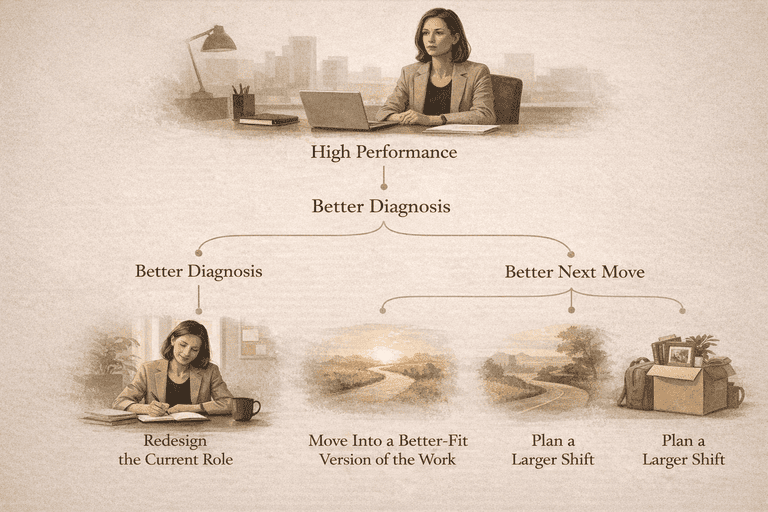
The right next step usually falls into one of three buckets.
1. Repair The Current Role
This is right when:
- the work still has value for you
- the conditions are the main problem
- your hatred of the job softens noticeably when pressure, chaos, or bad management improve
Possible moves:
- redesign scope
- renegotiate boundaries
- reduce one kind of work that drains you disproportionately
- change teams
- change manager
2. Make An Adjacent Move
This is right when:
- your strengths are still real
- you do not want to throw away your experience
- the role family is partly right but the current version is wrong
Examples:
- sales to partnerships, customer success, or enablement
- teaching to learning design or training
- recruiting to people operations or employer brand
- account management to implementation or client education
This is often the most intelligent move when the issue is not "I am in the wrong universe," but "I am using the right strengths in the wrong configuration."
3. Make A Larger Career Shift
This is right when:
- you dislike the core work itself
- the pattern has repeated across contexts
- small fixes never solve the real problem
- the future version of success in the path does not appeal to you
That does not mean act recklessly. It means stop pretending the answer is hidden inside one more productivity trick or one better manager.
Final Answer
If you are good at your job but hate it, the most likely explanation is not that you are broken or ungrateful. It is that competence and fit have come apart.
You may be effective in work that does not motivate you, in an environment that keeps overusing your strengths, or on a path whose future you do not actually want. The goal is to diagnose the mismatch precisely enough that your next move becomes clearer: repair the role, move adjacently, or change direction more seriously.

References
[1] Verquer, M. L., Beehr, T. A., & Wagner, S. H. (2003). A meta-analysis of relations between person-organization fit and work attitudes. Journal of Vocational Behavior, 63(3), 473-489.
[2] Kristof-Brown, A. L., Zimmerman, R. D., & Johnson, E. C. (2005). Consequences of individuals' fit at work: A meta-analysis of person-job, person-organization, person-group, and person-supervisor fit. Personnel Psychology, 58(2), 281-342.
[3] World Health Organization. Burn-out an occupational phenomenon.
[4] CDC NIOSH. What burnout is and is not.
[5] Deci, E. L., Olafsen, A. H., & Ryan, R. M. (2017). Self-determination theory in work organizations: The state of a science. Annual Review of Organizational Psychology and Organizational Behavior, 4, 19-43.
[6] Ford, M. T. (2012). Job-occupation misfit as an occupational stressor. Journal of Vocational Behavior, 80(2), 412-421.
[7] Yang, W.-N., Niven, K., & Johnson, S. (2019). Career plateau: A review of 40 years of research. Journal of Vocational Behavior, 110, 286-302.
[8] Tims, M., Derks, D., & Bakker, A. B. (2016). Job crafting and its relationships with person-job fit and meaningfulness: A three-wave study. Journal of Vocational Behavior, 92, 44-53.
Check What Is Actually Misfitting
Use the assessment to separate current-role friction, deeper mismatch, and stronger-fit next moves.

Builds CareerMeasure hands on and writes about career fit, role transitions, and the gap between generic personality advice and evidence-based career decisions.
Community Discussion
Share your thoughts about this article
Delete Comment?
Are you sure you want to delete this comment? This action cannot be undone.