

How Transferable Skills Actually Work in a Career Change

A transferable skill is a capability you can apply to a target job, supported by evidence from work you have already done. The useful unit is a task and its result: what you did, under what conditions, and how it connects to the new role. "Communication" on its own tells an employer much less.
Use the worksheet below with a real vacancy. It separates relevant evidence from the context you still need to learn, so you can identify a useful next step without claiming that experience transfers automatically.
A Worksheet You Can Use With A Vacancy
Copy this table into your own notes. Write one row for each important target task, and keep a link or date for the vacancy you are using. This is a practical evidence checklist, not a score or a validated employability assessment.
| Old task: what I actually did | Target task in the vacancy | Evidence I can show | Context or qualification still missing | Next test |
|---|---|---|---|---|
| Describe one specific action and its purpose | Copy or summarize the employer's relevant requirement | Name an artifact, observed result, or example you can lawfully discuss | Mark demonstrated, partial, missing, or unclear, and explain why | Choose one action that could resolve the gap |
| Add your next example | Add a target task | Add evidence | Add the gap | Add the test |
Avoid turning "partial" into "ready" simply because the verbs match. Explaining a school topic, a software configuration, and a clinical instruction all involve communication, but the knowledge, audience, and consequences differ. O*NET's occupation information helps separate skills and activities from education and other requirements.[2]
Worked Example: Teaching To Customer Education
This is an illustration using invented work, not a customer outcome or a claim about every customer-education vacancy. Suppose the target job asks for written onboarding materials, live sessions, and collaboration with a product team. The teacher maps those tasks separately instead of writing "my teaching skills transfer."
| Old task | Target task | Possible evidence | Remaining gap | Next test |
|---|---|---|---|---|
| Revised a lesson after observing a recurring misunderstanding | Create onboarding instructions | An original before-and-after lesson with the reasoning for each revision | Product knowledge and the target audience's starting point | Make a guide for a public tool and observe someone using it |
| Led a lesson and adjusted the explanation to questions | Run a customer learning session | A short recorded practice session using invented material | Customer context, commercial expectations, and product limits | Teach a willing adult a task and ask them to demonstrate it unaided |
| Coordinated a change with colleagues | Work with product and support teams | A fictional brief showing the problem, decision, owner, and follow-up | The employer's workflow and tools | Ask a practitioner how requests reach the team and how priorities change |
The guide and session can demonstrate explanation and revision. They cannot establish experience with the employer's product, prove you can handle all customer situations, or replace a required credential. Record those gaps instead of hiding them.
The former-teacher guide compares other directions if you want less live instruction. If you are moving from a commercial role, the sales alternatives guide helps check whether a new title retains the targets you want to leave.
Why The Phrase "Transferable Skills" Confuses So Many People
The phrase is too broad for the decision people are actually trying to make.
Most adults hear it in one of two distorted ways.
The first distortion is false comfort. It sounds like reassurance that your past work will count more than it actually does. That can lead people to aim too far, too fast, and then conclude that the market is irrational when employers do not buy the story.
The second distortion is false pessimism. People assume that if they have not held the exact target title, none of their experience matters. That can trap them in narrower career identities than they actually need.
The reality sits in the middle. Transferable skills are not fake, but they are not a universal passport either. Adult career guidance increasingly reflects this more practical view. People do not only need help imagining new futures. They need help understanding what they can carry forward from where they already are, what must be rebuilt, and what kind of move is realistic in the current labor market.[1]
That is why vague encouragement is not enough. The problem is not whether you are capable of learning. The problem is whether the transition logic is real.
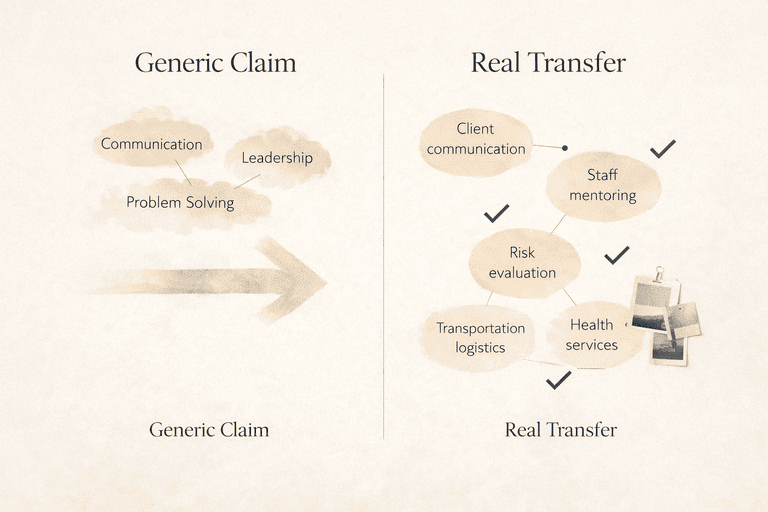
Transfer Usually Happens Through Task Families, Not Job Titles
One reason people misunderstand career change is that they think in titles first.
They ask questions like:
- can a teacher become a learning designer?
- can a recruiter become a customer success manager?
- can an accountant move into finance systems or operations?
Those are natural questions, but titles are a blunt way to reason about transfer.
In practice, transfer works through shared work underneath the titles. Occupations overlap because they involve related tasks, similar knowledge, recurring decision patterns, and comparable work demands. O*NET's content model distinguishes tasks, work activities, skills, knowledge, and experience requirements. Those categories let you compare the work underneath two titles.[2] The same logic appears in O*NET's advanced search tools, which let users explore occupations through shared job duties, related activities, soft skills, and technology skills.[3]
That is much closer to how real transitions work.
A teacher and a trainer do not transfer because both are "education jobs." They transfer because both may require facilitation, explaining complex material, reading learner confusion, structuring progression, and maintaining attention in a room. A recruiter and a customer success manager do not transfer because both are vaguely "people roles." They transfer because both may rely on discovery conversations, relationship management, expectation setting, follow-through, and pattern recognition across repeated interpersonal interactions.
This is why the strongest career-change analysis usually begins by decomposing the current role:
- What work do you actually do repeatedly?
- What judgment do you apply?
- What problems do you solve?
- What tools, systems, or workflows do you already use?
- What part of the target role looks genuinely familiar underneath the new title?
When that overlap is clear, transfer becomes more credible. When it is not, people are often trying to bridge too much distance with too little evidence.
Not Every Skill Transfers At The Same Level
This is where a lot of career-change advice becomes misleading.
People talk about transferable skills as if they all move together. They do not.
Some skills are broadly portable:
- writing clearly
- structuring information
- analyzing problems
- facilitating meetings
- coordinating stakeholders
- presenting recommendations
- building trust
But even when those skills transfer, the level at which they transfer may change.
You may have persuasive skill from sales, but not yet have the kind of executive influence expected in partnerships. You may have project coordination skill from education, but not yet the same comfort with budget ownership, vendor risk, or software implementation expected in a more operational role. You may have strong analytical ability from accounting, but not yet the strategic framing expected in finance planning or business operations.
That distinction matters because employers do not only evaluate whether a skill exists. They evaluate how fully it exists for the job they need filled.
This is one reason career adaptability matters so much in mid-career transitions. Savickas and Porfeli describe concern, control, curiosity, and confidence within career adaptability.[6] Brown and colleagues examine adaptability in mid-career change.[4] Neither makes a person instantly qualified for a target job. In other words, it helps people bridge a gap. It does not erase the gap.
The practical takeaway is simple:
You do not need every target skill at full target depth before moving. But you do need an honest read on which skills already transfer strongly, which transfer partially, and which still need to be built.
Context Changes The Value Of The Same Skill
Another reason transfer gets overstated is that skills do not live in a vacuum. They are always embedded in context.
Take communication. "Strong communication" can mean:
- calming an anxious customer
- leading a room
- writing concise executive updates
- persuading skeptical stakeholders
- teaching a structured curriculum
- negotiating scope under pressure
Those are related, but they are not identical. The skill label may stay the same while the actual demand changes significantly.
The same goes for problem solving, leadership, analysis, organization, or collaboration. Career readiness frameworks are useful partly because they give a shared vocabulary for these cross-cutting capabilities.[7] But a vocabulary is not the same thing as direct substitution. Two people can both claim "critical thinking" while doing very different work with very different stakes.
That is why transfer depends on more than the presence of a skill. It depends on:
- the context where the skill was used
- the complexity level
- the consequences of getting it wrong
- the speed and ambiguity of the environment
- the tools and systems wrapped around the work
This is also why person-job fit still matters after the transition logic is established. A role can look reachable on paper because the skills overlap, and still fit badly in the lived experience because the pace, structure, values, or social demands are wrong.[8]
So when people say, "I already have the transferable skills," the next question should usually be: in what context, at what level, and with what proof?
Employers Need Evidence, Not Just Claims
This is where many career changers lose credibility without realizing it.
They are not wrong that their past work matters. They are wrong in how they present it.
The weakest version sounds like this:
- I am adaptable
- I am a fast learner
- my skills are transferable
- I know I can do the job if someone gives me a chance
All of that may be true. None of it is strong evidence.
Skills-based hiring has increased the pressure to think more concretely, but the gap between rhetoric and actual hiring practice is still real. Burning Glass Institute's work shows that many employers talk about skills-first hiring much more than they fully implement it.[5] That means candidates still need to do harder translation work than optimistic internet advice often implies.
What persuades better is specific evidence:
- "I managed 40 client relationships with renewal risk and ongoing issue resolution."
- "I built and facilitated training sessions for mixed-experience audiences."
- "I coordinated cross-functional delivery with deadlines, scope changes, and stakeholder escalation."
- "I used CRM and reporting workflows daily to track pipeline, follow-up, and outcomes."
That kind of language does two things. It shows what you did, and it helps the employer imagine where it maps.
A strong career-change story usually has three layers:
- skill evidence: the work you have already done
- fit logic: why the new role is a coherent next step rather than a random jump
- gap management: what you still need to learn and why the distance is still realistic
Without those three layers, "transferable skills" often sounds like hope wearing professional language.
Adjacent Moves Are Where Transfer Usually Works Best
This is the part many adults resist emotionally and benefit from practically.
People often want transferable skills to justify a complete reset. In reality, transferable skills usually create the strongest advantage in adjacent moves.
An adjacent move does not mean a timid move. It means a move where enough of the old work still counts that the transition is believable.
Examples:
- teacher to instructional designer, trainer, curriculum writer, student success, or enablement
- recruiter to customer success, partnerships coordination, talent programs, or account-facing operations
- project manager to implementation, operations, program management, internal systems, or service delivery
- marketer to content strategy, product marketing, research, lifecycle work, or audience insights
What makes those moves strong is not that they are easy. It is that they often preserve meaningful continuity:
- communication style
- stakeholder management
- workflow coordination
- instructional or persuasive structure
- documentation habits
- planning logic
- judgment under recurring constraints
Adult career guidance includes identifying existing skills and considering further learning. That is a reason to inspect what you can reuse, rather than assume a larger change wastes your experience.[1] The mid-career study by Brown and colleagues discusses adaptability in transitions; it does not establish that every adjacent move is more successful than a larger change.[4] The more distance you add, the more proof you need and the more risk you absorb.
This is also why some people do not need a full career change as much as a different expression of the same underlying strengths.
Where People Usually Overstate Transferability
There are a few predictable mistakes.
They Confuse General Talent With Job Readiness
Being smart, conscientious, likable, articulate, or resilient is valuable. But employers still hire into specific work.
General talent helps you learn. It does not automatically make you qualified now.
They Transfer Identity Instead Of Work
People say things like:
- "I am a natural leader."
- "I am strategic."
- "I am good with people."
Those may describe them, but they do not explain what they have actually done that maps into the target role.
They Ignore Domain Friction
Sometimes the cross-cutting skills transfer, but the domain still matters enough to slow or block the move.
A trainer moving into software enablement may still need product fluency. A recruiter moving into customer success may still need stronger commercial judgment. A project manager moving into operations may still need process depth or systems exposure they have not yet built.
Ignoring that friction makes the move sound cleaner than it is.
They Treat the Resume As The Whole Argument
A career change usually needs more than a resume update. It often needs:
- portfolio evidence
- project examples
- sharper role targeting
- clearer narrative sequencing
- smaller bridge steps
Transfer works better when the proof architecture is as good as the underlying ability.
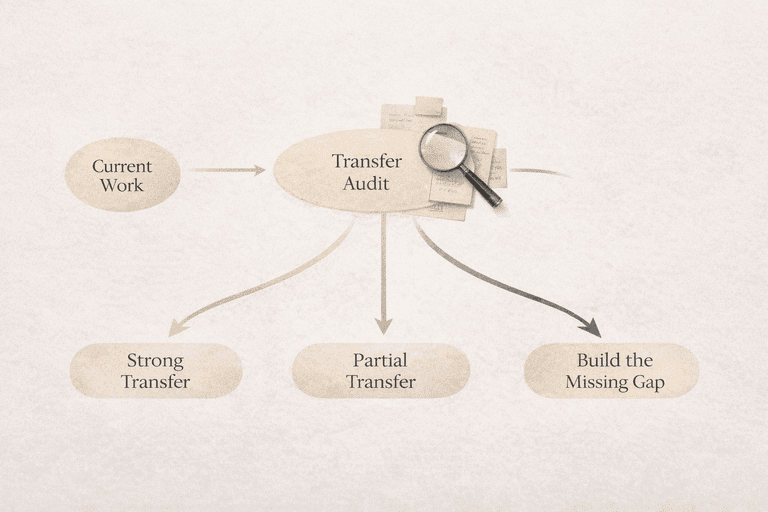
How To Run A Real Transferable Skills Audit
If you want a practical method, use this.
1. Break Your Current Role Into Repeated Work
Do not start with personality adjectives. Start with the actual work:
- what you do each week
- what decisions you make
- what problems you solve
- who you interact with
- what tools or systems you use
2. Identify The Parts You Want To Keep
Not every transferable skill should be carried forward just because it exists.
Ask:
- what part of the work energizes me?
- what part am I happy to reuse?
- what part do I want less of even if I am good at it?
This matters because people often overbuild around strengths they are actually tired of using.
3. Compare Against The Target Role At The Task Level
Read target roles for recurring work, not for branding language. Look for overlap in:
- task families
- judgment demands
- stakeholder patterns
- systems and tools
- operating cadence
This is where O*NET, real job descriptions, and related-role analysis become useful together.[2] O*NET gives the occupational structure, while the related-role logic helps you compare neighboring paths rather than staring at one title in isolation.[3]
4. Mark Each Skill As Strong Transfer, Partial Transfer, or Weak Transfer
Force yourself to grade honestly.
- Strong transfer: you have already done meaningfully similar work
- Partial transfer: the underlying skill is real, but the context or level changes
- Weak transfer: the claim is more aspirational than proven
This step alone makes most career-change stories much more realistic.
5. Build Proof Before You Build Ambition
If the target move still looks right, ask what additional evidence would reduce skepticism:
- better examples on your resume
- a stronger LinkedIn summary
- a side project
- internal stretch work
- volunteer work with relevant scope
- a smaller bridge role first
That is how transferable skills actually become marketable. Not by naming them, but by showing them in the right frame.
Once you can explain a row of the worksheet clearly, use it to build your application story. Our guide to explaining a career change shows how to connect the old work, the new requirement, and the evidence without inventing achievements.
Final Answer
Transferable skills matter in a career change, but they are often described too vaguely to be useful.
What really transfers is not a whole title but a pattern of work: tasks, judgment, communication demands, systems fluency, and strengths that still make sense in the next role. Some of that transfer can be strong, some partial, and some weak. The size of the move depends on how much overlap is already real and how much proof you can show.
That is why adjacent moves are so often the smartest form of career change. They let you preserve real capital, reduce employer skepticism, and move toward better fit without pretending you are starting from zero or that everything from the old role should carry forward unchanged.
So if you are trying to change careers, do not ask only what skills you have. Ask which parts of your actual work travel well, which do not, and what evidence makes the next step believable.

References
[1] OECD. Career Guidance for Adults in a Changing World of Work.
[2] O*NET Resource Center. O*NET Content Model.
[3] O*NET OnLine. Help: Advanced Searches.
[4] Brown, A., Bimrose, J., Barnes, S. A., & Hughes, D. (2012). The role of career adaptabilities for mid-career changers. Journal of Vocational Behavior, 80(3), 754-761.
[5] Harvard Business School and The Burning Glass Institute. (2024). Skills-Based Hiring: The Long Road from Pronouncements to Practice.
[6] Savickas, M. L., & Porfeli, E. J. (2012). Career Adapt-Abilities Scale: Construction, reliability, and measurement equivalence across 13 countries. Journal of Vocational Behavior, 80(3), 661-673.
[7] National Association of Colleges and Employers. Career Readiness: Development and Validation of the NACE Career Readiness Competencies.
[8] Kristof-Brown, A. L., Zimmerman, R. D., & Johnson, E. C. (2005). Consequences of individuals' fit at work: A meta-analysis of person-job, person-organization, person-group, and person-supervisor fit. Personnel Psychology, 58(2), 281-342.
See Your Stronger-Fit Next Moves
Get a clearer picture of which adjacent paths fit you better before making a bigger jump.

Builds CareerMeasure hands on and writes about career fit, role transitions, and the gap between generic personality advice and evidence-based career decisions.
Community Discussion
Share your thoughts about this article
Delete Comment?
Are you sure you want to delete this comment? This action cannot be undone.