

How To Know If You Need a New Job or a New Career

One of the most expensive career mistakes is solving the wrong problem at the wrong scale.
Some people are living inside a bad job and treating it like evidence that the whole career is broken. Other people keep changing employers, hoping the feeling will disappear, when the real issue is that the work itself keeps misfitting them.
That is why this decision matters so much. The move from one job to another and the move from one career path to another do not cost the same thing. They do not preserve the same capital, and they do not solve the same kind of pain.
So before you move, the real question is not "what sounds exciting?" It is: what exactly is broken, what keeps repeating, and what scale of move would actually fix it instead of only moving it?
The Short Answer
You probably need a new job if the core work still fits, the pain is concentrated in the environment or role design, and better versions of the same field still sound appealing.
You probably need a new career direction if the actual work keeps draining you across contexts, smaller fixes never solve the real problem, and the future version of success in the path does not appeal to you.
Do not rush the distinction if burnout is in the mix. Burnout can make a basically decent role feel intolerable, while a deep mismatch can create a burnout-like experience because you are forcing yourself through work that does not fit.[1] CDC guidance also helps here because it keeps burnout tied to work stress rather than using it as a catch-all label for every hard period.[2] The safer way to decide is to run the evidence in order.
Why People Misdiagnose This So Often
The surface symptoms overlap too much.
A bad boss, quota pressure, chaotic execution, weak role design, burnout, and true career mismatch can all produce the same feelings:
- dread before the week starts
- lower patience
- emotional flatness
- cynicism
- disengagement
- fantasies about leaving everything
From the inside, those feelings can feel identical. That is why people jump to the wrong explanation.
Another reason is that internet advice often makes the scale of the move too dramatic too early. If you are unhappy, you are told to reinvent yourself, follow your passion, or quit and begin again. But adult career guidance and transition research treat change much more broadly than that.[3] A transition can mean a new employer, a new role family, an adjacent move, or a different relationship to the same underlying work.[4]
That is a better starting point because it matches how real careers actually move.
Start With This Question, Not The Big One
Do not begin with:
- should I stay or leave?
Begin with:
- what part of this is local, and what part keeps following me?
That one question is much more useful because it forces you to separate:
- environment pain from work-content pain
- temporary overload from repeating mismatch
- bad role design from bad role family
- an adjacent move from a much larger reset
Most adults do not need a more emotional answer. They need a more disciplined one.
The Six Tests To Run Before You Decide
This is the clearest way I know to do it.
Test 1: The Relief Test
Ask yourself this:
If the role became calmer, better managed, and better bounded tomorrow, would you still dislike the actual work?
Not the stress around it. The work.
Would you still dislike spending your day persuading, coordinating, analyzing, troubleshooting, presenting, documenting, selling, teaching, or serving in the way the role requires?
If the honest answer is yes, that points toward a career-level problem. If the honest answer is no, and what you want is relief from the conditions, that points more toward a job problem.
This is the simplest test because it asks whether the work itself still has a claim on you once the noise comes down.
Test 2: The Repetition Test
Look across roles, not only at the current one.
Does the same dissatisfaction keep coming back across different teams, employers, or role versions?
Repeated evidence matters more than one bad season. If the same kind of friction survives multiple contexts, the explanation becomes less "bad luck" and more "something about this work does not fit me well."
That does not automatically mean total reinvention. But it does mean the problem is probably deeper than one employer.
Test 3: The Future Test
Look at the respected senior version of your current path.
Do you want that life?
If the future arc feels like a more expensive version of the same work you already dislike, pay attention. A better employer may buy time, but it may not solve the real issue.
This is one of the cleanest tests because it cuts through short-term coping. You do not have to love every future version of yourself. But if the visible success path feels actively unappealing, that is meaningful evidence.
Test 4: The Transfer Test
Ask what you want to preserve.
This is where many people make the mistake of focusing only on what they want to escape. A better decision comes from asking:
- what strengths do I still want my work to use?
- what type of problems do I still want to solve?
- what parts of the old role are still assets?
OECD guidance on adult career support treats transferable-skill identification as a central part of useful career guidance for exactly this reason.[5] The goal is not only to leave pain. It is to preserve leverage.
If you can name a lot you want to preserve, the best answer may be a new job or adjacent role. If very little feels worth carrying forward beyond generic work habits, the evidence may point toward a larger shift.
Test 5: The Small-Fix Test
This is the one most people skip because it feels less dramatic.
Before you declare the entire path wrong, ask whether a smaller intervention changes more than you expected:
- different team
- different manager
- narrower scope
- different customer type
- fewer interruptions
- more autonomy
- less quota pressure
- less stakeholder chaos
Research on fit and job crafting matters here because some job pain is genuinely fixable through role redesign, better resources, or a better environment rather than a total path change.[6] A two-wave study in hospitality found associations between job crafting, perceived fit, and engagement.[7] It supports investigating work design, but does not prove that a change will solve a particular reader's dissatisfaction.
If modest changes make the work much more livable, that is strong evidence that you need a different job version, not a different career identity.
Test 6: The Cost Test
Changing jobs and changing careers do not cost the same thing.
A job change may preserve:
- compensation
- credibility
- domain knowledge
- network value
- momentum
A career change may require:
- more learning
- more proof-building
- more narrative work
- more short-term uncertainty
- more tolerance for temporary status loss
That does not mean you should avoid the bigger move. It means you should only pay the bigger price when the evidence supports it.
What Points To A New Job
Once you run the tests, a job-change answer usually looks something like this:
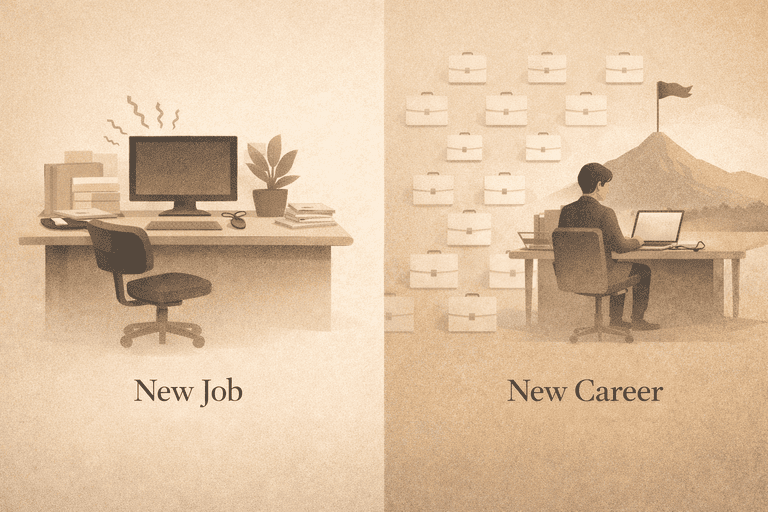
Use the job-versus-career comparison to contrast conditions that could change at another employer with duties that remain central to the occupation.
- the work improves a lot when the environment improves
- the same field still sounds good in a better version
- you can name specific local problems clearly
- you still want the core strengths and work content in your future
- the senior path looks fine in principle, even if the current version does not
This is where people often overreact. They are so tired of the current setup that they confuse relief with reinvention.
Examples:
- you still like helping clients, but not quota pressure
- you still like building learning experiences, but not classroom conditions
- you still like strategic work, but not the politics of the current employer
- you still like solving operational problems, but not the current chaos and dependency load
Those patterns point more toward a new job, better role version, or adjacent move than a total career departure.
What Points To A New Career
A career-change answer usually has a different shape:
- the actual work keeps draining you across contexts
- the same friction follows you no matter where you go
- small fixes reduce pain but do not restore fit
- the future version of success still looks wrong
- there is not much in the underlying work you want to preserve
That is the key distinction. A bad job can poison the present. A bad-fit career path poisons the future too.
When that happens, another employer may buy you time, but it will probably not give you resolution.
The Middle Path Most People Miss
This is where the best answer often lives.
For an adjacent option, complete the transferable-skills worksheet against a real vacancy before assuming the similarity of two titles means you are ready to apply.
The choice is not always:
- stay in the same job family
- or start over completely
Often the best move is adjacency.
An adjacent move keeps more of what still works while changing more of what does not. It is not a timid move. It is a better-calibrated move.
Examples:
- sales to account management, partnerships, customer success, or enablement
- teaching to instructional design, training, curriculum, or student success
- project management to operations, implementation, internal programs, or service delivery
- recruiting to people operations, talent programs, employer brand, or candidate experience
This is also why transition research is useful here. Career change is not only a ladder or a leap.[3] Horizontal and adjacent transitions can still be meaningful and career-strengthening over time.[8]
For many adults, adjacency is the move that solves the real problem without destroying usable capital.
Sometimes You Do Not Need Either Answer Yet
This is another possibility people skip.
Sometimes the evidence is still too noisy to conclude either "new job" or "new career."
That usually happens when:
- you are in a peak-burnout period
- the current environment is so distorted that it is masking the work itself
- you have not tested any smaller change yet
- you are reacting to one acute period rather than a repeated pattern
In that situation, the smartest answer may be: I do not have enough signal yet.
That is not avoidance. It is decision discipline.
If you are missing signal, the goal is not to guess harder. The goal is to generate cleaner evidence:
- take leave if you can and see what changes when rest returns
- talk to people doing healthier versions of the same work
- test a smaller adjacent shift first
- write down what parts of the work itself still feel alive versus dead
Many bad career moves happen because people force a binary answer before the evidence is mature enough.
How To Use The Answer Well
Another way people go wrong is by treating strong emotion as if it were the same thing as strong evidence.
Emotion matters. It is often the reason the question appears at all. But it still needs interpretation.
Stronger evidence looks like:
- the same friction repeating across time
- clear differences between the work itself and the conditions around it
- stable patterns in what energizes or depletes you
- repeated attraction to adjacent options that solve a specific mismatch
- repeated failure of smaller fixes
Weaker evidence looks like:
- one brutal month
- one terrible boss
- one failed application cycle
- one fantasy role that sounds cleaner than your current one
- one test result you want to be true
This is why adult career judgment is slower than internet career advice makes it sound. The goal is not to find a dramatic sentence. The goal is to accumulate enough evidence that the scale of the move becomes clearer.
What Not To Protect Just Because It Looks Impressive
Sometimes people stay in the wrong path because the work looks good on paper.
Prestige, income, title growth, or external approval can all make a misfitting path harder to leave. But if the part you are protecting is mostly status and not actual fit, then "stay because it looks successful" is not a real answer. It is only a delay.
What To Do With The Answer Once You Have It
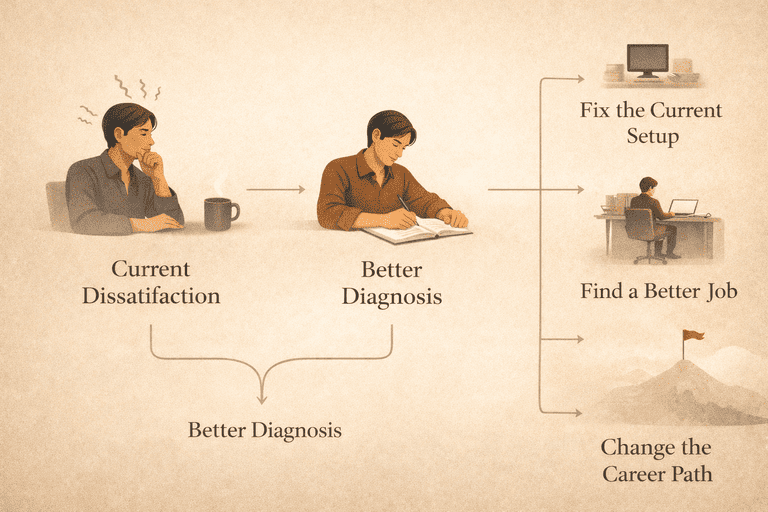
Do not turn the answer into instant action. Turn it into the next right test.
If the evidence points toward a new job, validate the better version of the same field:
- what role variations exist?
- what companies run the work differently?
- what part of the environment needs to change?
If the evidence points toward a new career direction, do not go straight to fantasy titles. Start with:
- what strengths still transfer?
- which adjacent families reduce the mismatch?
- how much distance is there really?
- what evidence can you build before the move?
If the evidence points toward adjacency, that is usually the strongest place to start because it gives you movement and signal without pretending the old work had no value.
What A Good Result Should Leave You With
If you answer this question well, you should not only feel clearer. You should have a more usable decision frame.
A good result should leave you with:
- a clearer diagnosis of whether the pain is local or structural
- a stronger view of what you still want to preserve
- a smaller set of plausible next moves
- a more honest read on the cost of each move
That is much more useful than a dramatic declaration that you are either trapped forever or destined for total reinvention.

Final Answer
You need a new job if the core work still fits and the problem is mostly the conditions, incentives, structure, or employer version of the role.
You need a new career direction if the actual work keeps misfitting you across contexts, the same friction keeps repeating, the future path looks wrong, and small fixes never solve the real problem.
And if the answer is neither pure stay nor pure reinvention, pay attention. The strongest move is often an adjacent one.
References
[1] World Health Organization. Burn-out an occupational phenomenon.
[2] CDC NIOSH. What burnout is and is not.
[3] Sullivan, S. E., & Baruch, Y. (2009). Advances in career theory and research: A critical review and agenda for future exploration. Journal of Management, 35(6), 1542-1571.
[4] OECD. Career Guidance for Adults in a Changing World of Work.
[5] OECD. Career Guidance for Adults in a Changing World of Work.
[6] Verquer, M. L., Beehr, T. A., & Wagner, S. H. (2003). A meta-analysis of relations between person-organization fit and work attitudes. Journal of Vocational Behavior, 63(3), 473-489.
[7] Ok, C., & Lim, S. (2022). Job crafting to innovative and extra-role behaviors: A serial mediation through fit perceptions and work engagement. International Journal of Hospitality Management, 106, 103288.
[8] Abele, A. E., & Spurk, D. (2009). The longitudinal impact of self-efficacy and career goals on objective and subjective career success. Journal of Vocational Behavior, 74(1), 53-62.
Get A Clearer Career Signal
Take the assessment to see what fits, what feels off, and which roles are more likely to suit you.

Builds CareerMeasure hands on and writes about career fit, role transitions, and the gap between generic personality advice and evidence-based career decisions.
Community Discussion
Share your thoughts about this article
Delete Comment?
Are you sure you want to delete this comment? This action cannot be undone.