

How To Explain a Career Change Without Looking Lost

One of the hardest parts of a career change is not always choosing the next move. Sometimes it is explaining the move in a way that sounds coherent.
You may know the change makes sense to you. You may know the old role stopped fitting. You may know the new direction is more credible than it looks from the outside. And still, the moment you try to explain it out loud, the story starts sounding vague, defensive, or overly dramatic.
That is where many otherwise smart transitions lose credibility.
The issue is usually not that the move is irrational. The issue is that the explanation is built in the wrong order.
The Short Answer
The best way to explain a career change without looking lost is to frame it as a progression from what you have already proven toward a better-fit next role, not as a rejection of your entire past.
A strong transition explanation usually does four things:
- shows what your prior work actually proved
- names what kind of work you now want more or less of
- explains why the target direction is a logical extension, not a random escape
- shows that you have validated the move with real evidence
What makes people sound lost is usually not the fact that they are changing careers. It is that they describe the change as emotion first and logic second.
Why So Many Career Change Explanations Sound Weak
People often build the explanation around the most emotionally immediate part of the problem.
They say things like:
- I just need something different
- I want to do more meaningful work
- I am burned out
- I do not feel passionate about this anymore
- I have always wanted to try something else
Those statements may be true. They are usually not enough.
The problem is that they tell the listener more about dissatisfaction than about direction. They explain why you want out, but not why the new move is credible.
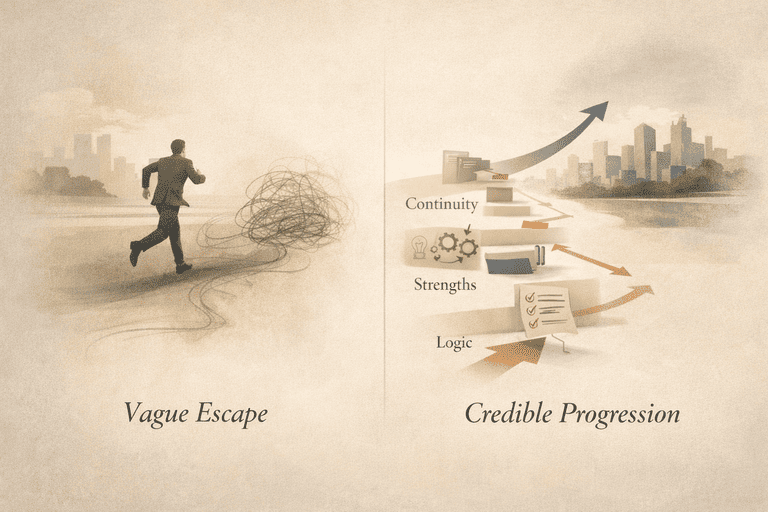
That gap matters because transition research treats career changes as interpretation problems as much as movement problems.[1] Adults are rarely choosing from zero. They are trying to connect prior experience, current constraints, and a more coherent next step.
That is what your explanation has to do too.
What The Other Person Is Actually Listening For
When an employer, interviewer, or networking contact hears that you are changing direction, they are usually trying to answer a narrower set of questions than you think.
They want to know:
- why this move makes sense now
- what from your past experience still transfers
- whether you understand the target work realistically
- whether this is a thoughtful transition or an impulsive reaction
That means your explanation does not need to prove your entire identity. It needs to reduce uncertainty.
Good explanations reduce uncertainty by increasing coherence.
They make it easy for the other person to say:
- yes, I can see the through-line
- yes, this person understands what they are moving toward
- yes, this sounds like a reasoned change, not a vague escape
The Three Things Every Strong Transition Story Needs
If you want the explanation to sound credible, build it around these three elements.
1. Continuity
Your story needs a clear through-line.
That through-line is not usually your exact old job title. It is the underlying value you have been creating.
Examples:
- a teacher may have spent years translating complexity, facilitating learning, and adapting to different audiences
- a salesperson may have spent years diagnosing needs, building trust, and moving people toward decisions
- a project manager may have spent years coordinating moving parts, reducing ambiguity, and driving execution
- a marketer may have spent years interpreting audience behavior, shaping messaging, and turning insight into action
Continuity matters because it keeps the transition from sounding like a total break in identity. Career adaptability research is useful here because successful transitions usually depend on how well people interpret and reframe existing capabilities, not only on whether they start over completely.[2] Cross-country adaptability work reinforces that same framing rather than treating reinvention as the default.[3]
2. A Clear Reason For Change
This is where people often become either too vague or too negative.
The best reason for change is specific enough to sound real but clean enough to stay professional.
For example:
- I want to move closer to the design side of the work, not only the delivery side
- I want to keep the client-diagnosis part of my background, but move away from quota-heavy pressure
- I want to stay close to learning work, but not in a classroom structure
- I want more ownership over systems and outcomes, and less dependency-heavy coordination
Those explanations are stronger than:
- I hate my job
- I am exhausted
- I just need a fresh start
The listener does not need your whole emotional history. They need the decision logic.
3. A Credible Target
The last part is where the story either lands or collapses.
You need to show why the target role is not just attractive in theory, but believable in relation to your background.
That means explaining:
- what transfers
- what you have learned about the target work
- why the match is stronger than your current path
This is where career-change stories become much stronger when they include validation, not only aspiration. Adult career-guidance work keeps emphasizing that transitions are better when people can connect prior skills, labor-market reality, and targeted exploration rather than making purely abstract identity moves.[4] That research tradition is useful precisely because it treats transitions as interpreted and tested moves, not just identity declarations.[5]
The Two Mistakes That Make You Sound Lost Fast
Mistake 1: Explaining The Change As A Rejection Of Your Past
This sounds like:
- everything I did before was wrong
- I never really liked any of it
- I am trying to leave that whole world behind
Sometimes the emotional truth may feel close to that. It is still usually the wrong professional framing.
Why? Because if you erase the value of your own past too aggressively, you also erase the logic of why anyone should trust you in the next step.
A stronger frame is:
- this earlier work taught me something real
- it proved strengths that still matter
- I now want to use those strengths in a more fitting context
That keeps the move from sounding like pure disowning.
Mistake 2: Explaining The Change Only In Value Words
People often reach for big abstract terms because they sound noble:
- meaning
- purpose
- impact
- passion
- alignment
The problem is that these words rarely explain a target role well on their own.
They can make the speaker sound sincere, but they often make the move sound underdiagnosed. The listener still cannot tell what kind of work you actually want.
A better explanation connects values to work design.
Instead of:
- I want more meaningful work
say:
- I want work that uses my strongest skill more directly in learning design rather than in classroom delivery
Instead of:
- I want more impact
say:
- I want to move from individual client closing to longer-horizon account development and adoption work
Now the story is doing real explanatory work.
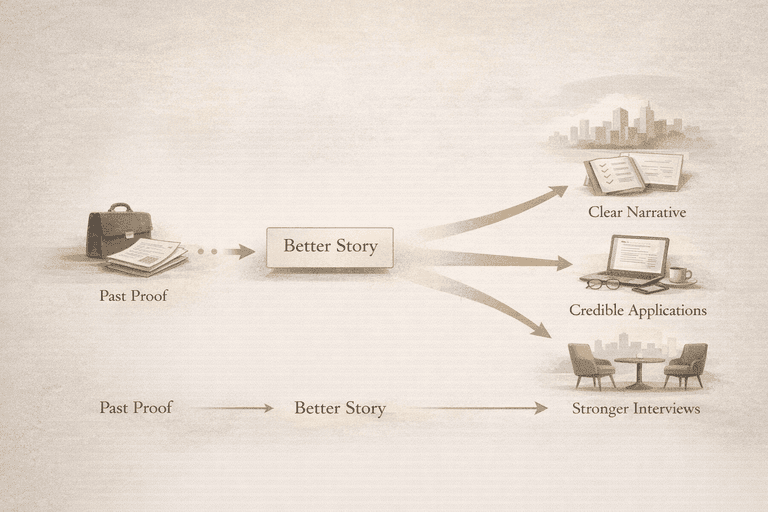
Build The Story In This Order
This is the simplest structure I know that works in interviews, networking conversations, cover letters, and internal transitions.
If your explanation still sounds abstract, the transferable-skills worksheet helps identify a concrete old task, new task, piece of evidence, and remaining gap.
Step 1: Start With What Your Background Proves
Open with evidence, not emotion.
Examples:
- Over the past eight years in recruiting, I have built strong judgment around talent evaluation, stakeholder alignment, and process coordination.
- Over the past decade in teaching, the strongest thread in my work has been designing instruction, adapting content to different audiences, and helping people learn complex material clearly.
- In sales, the part of the work where I consistently added the most value was diagnosing needs, building trust, and helping customers move from uncertainty to a workable decision.
This establishes competence before transition.
Step 2: Name What You Want More Of And Less Of
Now narrow the diagnosis.
Examples:
- I want more of the problem-solving and relationship-building side of the work, and less of the short-cycle quota pressure.
- I want more of the learning-design and content-structuring side of my background, and less of the classroom intensity.
- I want more direct ownership over systems and outcomes, and less coordination-heavy work without authority.
This is where the shift starts sounding deliberate.
Step 3: Explain Why The New Direction Fits Better
This is the bridge sentence many people skip.
You need to connect the target role to the diagnosis, not just mention the role by name.
Examples:
- That is why customer success is a more natural next move for me than another closing role.
- That is why instructional design is a better fit than staying in classroom teaching.
- That is why program operations is more compelling to me than another traditional project-management role.
The point is not to sound clever. The point is to make the logic unavoidable.
Step 4: Show That You Validated The Move
This is what separates a thoughtful change from a fantasy.
Validation can include:
- conversations with people already doing the work
- repeated review of real job postings
- small projects, certifications, or portfolio evidence
- internal exposure to related responsibilities
Identity and transition research matters here too. Narrative explanations become more convincing when they do not only tell a story about the self, but also show engagement with the realities of the new role.[6]
In practice, this sounds like:
- I have spoken with people in the role, studied the day-to-day requirements closely, and done enough validation to be confident that this is the right direction.
That sentence does a lot of work.
What A Good Career Change Explanation Sounds Like
Here is the pattern in plain language:
I have done X. That work proved Y. I now want more of A and less of B. That is why role Z is a logical next move. I have validated it through real evidence.
That structure works because it combines continuity, diagnosis, and next-step logic.
Notice what it does not do:
- it does not apologize for changing
- it does not attack the old field
- it does not pretend the shift came out of nowhere
- it does not rely on vague self-discovery language
Four Strong Examples
Teacher To Instructional Designer
I have spent most of my career translating complex material into structured learning experiences and adapting content for different kinds of learners. Over time I realized the part of teaching I want more of is the design and development side, not the classroom delivery environment. That is why instructional design feels like a more focused next step. I have validated it by reviewing real role requirements, speaking with practitioners, and building a clearer understanding of the output the role actually demands.
Sales To Customer Success
My background in sales gave me strong experience in discovery, trust-building, and helping customers move from uncertainty to commitment. What I want less of now is the short-cycle quota structure, not the customer-facing problem-solving itself. That is why customer success feels like a stronger fit than another closing role. It lets me preserve the relationship and diagnostic side of my experience in a healthier operating model.
Recruiter To People Operations
Recruiting taught me stakeholder management, process discipline, communication under pressure, and strong judgment about people and teams. Over time I found myself more interested in the systems and employee-experience side of the work than in constant pipeline pressure. That is why people operations feels like a logical next move. It is not a rejection of recruiting. It is a more fitting use of the same underlying strengths.
Project Manager To Program Or Operations Work
Project management helped me build execution judgment, cross-functional coordination, and the ability to move complex work forward under ambiguity. What I want less of now is constant dependency management without enough structural ownership. That is why program or operations roles appeal to me more. They preserve the systems and execution side of my background while giving me a stronger fit on the control-to-accountability balance.
How To Sound Honest Without Oversharing
This is the balance many people struggle with.
You do not need to lie about why you are changing. You also do not need to narrate every frustration in full detail.
A good rule is:
- be specific about the work logic
- be restrained about the emotional history
That means you can say:
- I realized I wanted to move away from quota-heavy selling
- I wanted to stay in learning work, but not in classroom delivery
- I wanted more ownership and less pure coordination
You usually do not need to say:
- I was miserable every day
- my boss destroyed my confidence
- I cannot stand this field anymore
Those details may be true. They rarely improve the transition story.
How To Pressure-Test And Use The Story
You do not need to tell the whole story at the same level of detail everywhere.
If you cannot yet explain why this target is preferable to staying or making a smaller move, return to the three-option transition worksheet before polishing the story.
Use the shorter version in:
- resume summary language
- LinkedIn headlines and about sections
- first-touch networking conversations
Use the fuller version in:
- cover letters
- interviews
- deeper informational conversations
The goal is consistency, not identical wording. The through-line should stay the same even when the length changes.
The Best Test For Whether Your Explanation Works
After you say the story out loud, ask:
- does this sound like a progression or a panic response?
- can someone unfamiliar with my situation see the through-line quickly?
- does it explain what I am moving toward, not just what I am leaving?
- does it show that I understand the target role beyond its title?
If the answer is yes, the story is probably strong enough.
If the explanation still sounds like:
- I just need something else
- I want a change
- I am looking for more purpose
then it probably needs one more pass.
Final Answer
You explain a career change without looking lost by making the move sound like a reasoned progression, not an emotional escape.
Start with what your past work proved. Name what you want more of and less of. Explain why the new direction fits that diagnosis. Then show that you have validated the move with real evidence.
That is what turns a career change from a vague story about dissatisfaction into a credible story about fit.

References
[1] De Vos, A., et al. Career transitions and employability. Journal of Vocational Behavior, 2021.
[2] Savickas, M. L., & Porfeli, E. J. (2012). Career Adapt-Abilities Scale: Construction, reliability, and measurement equivalence across 13 countries. Journal of Vocational Behavior, 80(3), 661-673.
[3] Fugate, M., Kinicki, A. J., & Ashforth, B. E. (2004). Employability: A psycho-social construct, its dimensions, and applications. Journal of Vocational Behavior, 65(1), 14-38.
[4] OECD. Career Guidance for Adults in a Changing World of Work.
[5] Jiang, Z., Newman, A., Le, H., Presbitero, A., & Zheng, C. (2019). Career exploration: A review and future research agenda. Journal of Vocational Behavior, 110, 338-356.
[6] Ibarra, H., & Barbulescu, R. (2010). Identity as narrative: Prevalence, effectiveness, and consequences of narrative identity work in macro work role transitions. Academy of Management Review, 35(1), 135-154.
[7] Sullivan, S. E., & Baruch, Y. (2009). Advances in career theory and research: A critical review and agenda for future exploration. Journal of Management, 35(6), 1542-1571.
[8] CareerMeasure. Methodology.
See Your Stronger-Fit Next Moves
Get a clearer picture of which adjacent paths fit you better before making a bigger jump.

Builds CareerMeasure hands on and writes about career fit, role transitions, and the gap between generic personality advice and evidence-based career decisions.
Community Discussion
Share your thoughts about this article
Delete Comment?
Are you sure you want to delete this comment? This action cannot be undone.