

Careers Similar to Sales:
What To Explore If You Want Out of Quota Pressure

Careers similar to sales include account management, partnerships, customer success, enablement, implementation, and revenue operations. None of those titles guarantees freedom from quotas. Compare who owns revenue, how performance is assessed, and what happens when a customer or target is at risk.
The most useful shortlist starts with the part of sales you want to keep: explaining, solving customer problems, building relationships, teaching colleagues, or improving the process. Then investigate whether a particular vacancy changes the pressure you want to leave.
Compare The Pressure Before The Title
Use this table to investigate the six directions in this guide. It describes work to look for and questions to ask, rather than assigning one operating model to every employer. Request examples of actual performance goals and ask who owns the difficult handoffs.
| Direction | Work you may be able to carry over | Customer contact to check | Commercial pressure to investigate |
|---|---|---|---|
| Account management | Relationship continuity and resolving client issues | Ongoing portfolio versus constant new accounts | Does this role own renewals, upsells, and an individual quota? |
| Partnerships | Finding mutual value and coordinating stakeholders | External partners, customers, or both | Is success measured by partner-sourced pipeline or closed revenue? |
| Customer success | Discovery, expectation setting, and adoption support | Assigned accounts, escalation coverage, and meeting load | Who owns retention, expansion, and renewal negotiations? |
| Enablement or training | Coaching and explaining a repeatable process | Internal teams versus customer-facing sessions | Which revenue results affect this role's evaluation or variable pay? |
| Implementation or onboarding | Scoping needs and coordinating a handoff | Pre-sale demonstrations versus post-sale delivery | Is the role accountable for a sales target, launch date, or billable utilization? |
| Revenue operations | Process documentation and pipeline analysis | Mostly internal stakeholders or direct client coverage | What happens during missed forecasts and quarter-end deadlines? |
A title containing "solutions" deserves particular attention: establish whether the vacancy sits before or after the sale. If it is a technical sales role, our guide to careers after tech sales considers the technical evidence you may need as well as the commercial overlap.
Try one interview question across every role: "Walk me through a recent week when the team missed a target. What changed for the person in this job?" The answer can reveal workload and incentives that a title or benefits list cannot.
Why People Misread The Problem
Sales roles compress many things into one title:
- relationship management
- persuasion
- discovery
- coordination
- commercial judgment
- urgency tolerance
- emotional regulation
- rejection handling
When people burn out, they often reject the whole package at once.
That is understandable, but not always accurate. A person may dislike having every month governed by target pressure, while still being very good at relationship management. Another may dislike prospecting but enjoy solution-oriented conversations once the customer is serious. Another may dislike the adversarial feel of hard-closing environments but still fit a more trust-based or continuity-based commercial role.
That is why leaving sales can get fuzzy. The title hides a mix of work that should be separated before any move is made.
First Decide What You Want Less Of
This step matters more than the title search.
Common patterns:
- less quota volatility
- less cold outreach or high-volume prospecting
- less adversarial closing pressure
- less comp uncertainty
- less emotional wear from repeated rejection
- less dependence on end-of-month urgency
Different adjacent paths solve different versions of that problem.
If you skip this step, every non-AE role starts to look promising even though the lived experience can be very different.

Six Better-Fit Paths To Explore
1. Account Management
This is often the strongest adjacent move for people who still like clients but do not want a pure hunter model.
Account management usually preserves:
- relationship continuity
- commercial awareness
- expectation setting
- stakeholder coordination
- problem solving tied to real customer context
What changes:
- more retention and expansion logic
- less cold prospecting
- more ongoing relationship stewardship
- more pressure around service, continuity, or renewals rather than pure new-logo closing
This path fits best when you still like client-facing work but want more continuity and less constant chase.
2. Partnerships
Partnerships can be a strong fit for people who like external relationships and commercial strategy, but want less daily direct-selling pressure.
What transfers well:
- relationship building
- persuasion
- commercial communication
- identifying mutual value
- managing longer-term external stakeholders
What changes:
- usually longer cycles
- more strategic alignment work
- a potentially different mix of commercial targets
- more ambiguity and cross-functional coordination
This path fits best when you still like external influence, but want the work to feel more strategic and less target-chased.
3. Customer Success
This is often attractive to people who like helping customers win, but do not want the emotional rhythm of quota-carrying sales.
If the customer-success version still owns the pressure you want to leave, compare alternatives to customer success before treating it as the default escape route.
Customer success usually rewards:
- discovery conversations
- trust-building
- expectation management
- problem-solving under real customer conditions
- long-term relationship maintenance
What changes:
- the work shifts toward adoption, retention, and value realization
- the pressure becomes more about health, churn, and continuity than direct closing
- commercial incentives may still exist, but they are often structured differently
This path fits best when you liked the consultative, relationship-heavy side of sales more than the pure closing environment.
4. Sales Enablement or Training
Some people in sales realize they do not actually want less of the function. They want to shift from carrying the number to helping others perform.
Enablement and training can fit when you like:
- coaching
- explaining what works
- building systems for better performance
- onboarding or skill transfer
- turning tacit judgment into teachable structure
What changes:
- different revenue accountability to verify with the employer
- more internal-facing work
- more facilitation, content, and process design
- less direct client pressure
This path fits best when your strongest contribution is helping people become more effective rather than staying in the front-line selling seat yourself.
5. Solutions, Implementation, or Onboarding Support
Some salespeople are strongest not at chasing, but at making things make sense.
If you were consistently strongest when:
- explaining the product
- clarifying process
- reducing customer confusion
- shaping a smoother handoff
- helping customers adopt what they bought
then implementation, onboarding, or solutions-adjacent work may fit better than quota-carrying sales.
What transfers well:
- customer communication
- discovery
- translation between needs and product logic
- expectation setting
- issue triage
What changes:
- less pure persuasion
- more post-sale or solution-side credibility
- more coordination with internal teams
- more emphasis on delivery and usability
This path fits best when you liked making the work real more than winning the deal itself.
6. Revenue-Adjacent Operations or Program Work
Some people in sales eventually realize that the part they were really best at was not persuasion. It was keeping a commercial system moving.
This can include:
- forecast discipline
- pipeline hygiene
- process coordination
- handoffs
- internal communication
- seeing where the machine breaks
That can point toward operations, program coordination, or revenue-adjacent internal roles.
What changes:
- a potentially lower share of direct client work
- more internal systems work
- more process and workflow ownership
- pressure that may shift toward forecasts, data quality, and deadlines
This path fits best when you want to stay close to commercial work but not in the same emotional or numerical position inside it.
How To Choose And Validate The Right Path
At this point, the most useful question is not which title sounds safest. It is which part of sales still feels like yours.
Use these filters.
If You Still Like Client Contact, Look Harder At Account Management, Partnerships, or Success
Some people are done with selling, but not with people. They still like high-context conversations, external relationships, and helping someone move through uncertainty.
If that is true, a fully internal role may feel flatter than expected.
If You Like Teaching the Work More Than Doing the Work, Look Harder At Enablement
Some people realize their strongest skill is not closing. It is helping others understand what good looks like and making the commercial system easier to execute well.
That often points more naturally toward enablement or training than toward another direct customer role.
If You Like Process More Than Persuasion, Look Harder At Operations-Adjacent Paths
Some salespeople are tired not only of quota, but of emotional performance. They want more structure, less identity pressure, and less dependence on being "on" all the time.
That usually points more toward operations, implementation, or coordination-heavy roles.
The Feel Of The Work Changes A Lot
This is the part many people underestimate.
All of these roles sit near sales, but the day can feel very different.
Account management usually feels:
- more continuity-based
- more relationship-stable
- less chase-heavy
- still commercially accountable
Partnerships usually feels:
- more strategic
- more ambiguous
- more cross-functional
- less transactional, but not necessarily lighter
Customer success usually feels:
- more problem-solving and continuity-focused
- more service-oriented
- more tied to customer health and retention than direct closing
Enablement usually feels:
- more internal
- more structured
- more facilitation and systems-oriented
- less directly revenue-exposed
Implementation and onboarding usually feel:
- more concrete
- more delivery- and transition-oriented
- less persuasion-heavy
- more operationally grounded
That matters because not every adjacent move solves the same kind of pain.
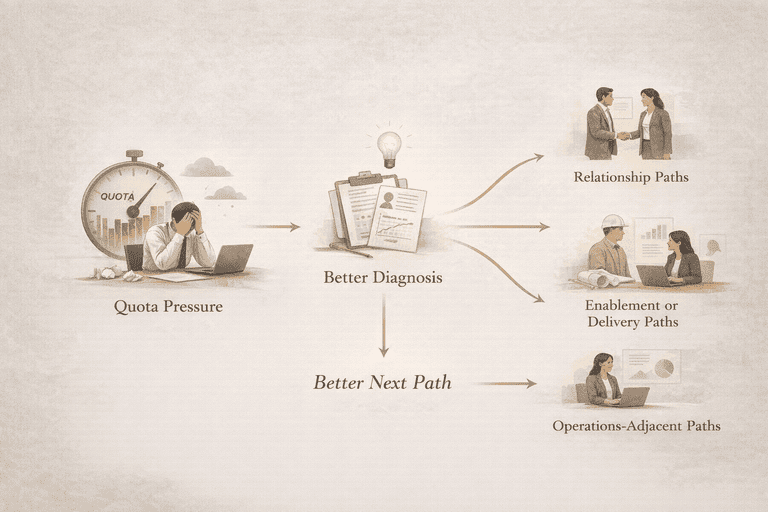
Do You Want Less Selling, Or Less Pressure Structure?
This distinction matters more than people expect.
Some people genuinely want less persuading, less commercial tension, and less identity investment in external outcomes. Others are still comfortable with persuasion and relationship work, but no longer want their weeks ruled by quota cycles, reset pressure, and compensation volatility.
Those are different exits.
If you want less selling itself, you will often fit better in:
- enablement
- implementation
- revenue-adjacent operations
If you still like commercial and client-facing work, but want a better pressure structure, you may fit better in:
- account management
- partnerships
- some customer success roles
This is also why titles can mislead. A role can look adjacent on paper and still recreate the same pressure in another form. Some account roles still carry hard revenue expectations. Some success roles quietly operate like renewal sales. Some partnership roles become target-heavy once the company matures.
So the right question is not only whether the title sounds adjacent. It is:
- how is success actually measured?
- how much of the pressure is numeric, visible, and constant?
- how much of the role still depends on direct persuasion?
- how much control do I have over the outcomes I am being judged on?
That is where the real fit often becomes visible.
The Risk Of Choosing Only By Relief
This is where people make avoidable mistakes.
If you are exhausted enough, any non-quota role can sound like relief. But relief is not the same thing as fit.
A seller may leave for customer success and realize the customer load still drains them. Another may leave for operations and realize they miss external energy more than expected. Another may go into partnerships and discover the ambiguity is more stressful than the directness of sales ever was.
That is why the decision needs two filters:
- what part of sales pressure am I reducing?
- what kind of work do I still want to organize my day around?
How To Read Whether A Role Is Recreating Sales Pressure
This is one of the most useful checks when you start applying.
Some adjacent roles are genuinely different from sales. Others are only cosmetically different. The title changes, but the pressure structure does not.
Warning signs include:
- success language built almost entirely around growth, expansion, renewals, or pipeline
- role descriptions that talk about relationship management but quietly anchor everything to aggressive numeric ownership
- customer success roles that read like renewal sales
- account roles that are still mostly closing roles under a softer title
- partnership roles that are really quota-carrying channel sales
That does not mean those jobs are bad. It means they may not solve the problem you are actually trying to solve.
The more useful reading questions are:
- what metrics dominate the role?
- what part of the work seems to carry the emotional pressure?
- how much of success depends on persuasion versus continuity, support, or execution?
- does the company describe the role as relational, but evaluate it like frontline revenue ownership?
That kind of reading matters because title similarity is not enough. If the pressure structure stays the same, the role may feel better for a month and then recreate the same underlying problem.
What To Build Before You Apply
People coming out of sales usually do better when they translate their work into the real logic of the next role instead of only saying they want out.
Use the transferable-skills worksheet to connect a sales task to the target requirement, including evidence and the domain knowledge you still need.
That often means:
- rewriting the experience at the task level
- showing what part of the commercial work you were actually strongest in
- identifying whether the next role is closer to relationships, process, training, or delivery
- narrowing the target instead of applying to every role that looks less intense
- showing continuity instead of only escape
The stronger story is not "I want out of sales." It is "I have strong relationship, communication, and commercial judgment, and I want to apply those strengths in a role with a better pressure structure."
Final Answer
The best careers similar to sales are usually adjacent roles that preserve the strongest parts of commercial work while changing the quota structure around them.
Account management, partnerships, customer success, enablement, implementation, and operations-adjacent roles often make sense because they reuse real sales-built strengths without requiring the same day-to-day life as quota-carrying sales.
The smartest move is usually not to ask how to escape sales entirely. It is to identify which part of sales still fits you, which part is making the role unsustainable, and which adjacent path changes that tradeoff in a believable way.

References
[1] OECD. Career Guidance for Adults in a Changing World of Work.
[2] O*NET Resource Center. O*NET Content Model.
[3] O*NET OnLine. Help: Advanced Searches.
[4] U.S. Bureau of Labor Statistics. Sales Managers. Occupational Outlook Handbook.
[5] U.S. Bureau of Labor Statistics. Wholesale and Manufacturing Sales Representatives. Occupational Outlook Handbook.
[6] U.S. Bureau of Labor Statistics. Training and Development Specialists. Occupational Outlook Handbook.
[7] Savickas, M. L., & Porfeli, E. J. (2012). Career Adapt-Abilities Scale: Construction, reliability, and measurement equivalence across 13 countries. Journal of Vocational Behavior, 80(3), 661-673.
[8] Brown, A., Bimrose, J., Barnes, S. A., & Hughes, D. (2012). The role of career adaptabilities for mid-career changers. Journal of Vocational Behavior, 80(3), 754-761.
Get A Clearer Career Signal
Take the assessment to see what fits, what feels off, and which roles are more likely to suit you.

Builds CareerMeasure hands on and writes about career fit, role transitions, and the gap between generic personality advice and evidence-based career decisions.
Community Discussion
Share your thoughts about this article
Delete Comment?
Are you sure you want to delete this comment? This action cannot be undone.