

Careers Similar to Project Management:
Adjacent Roles With Better Fit

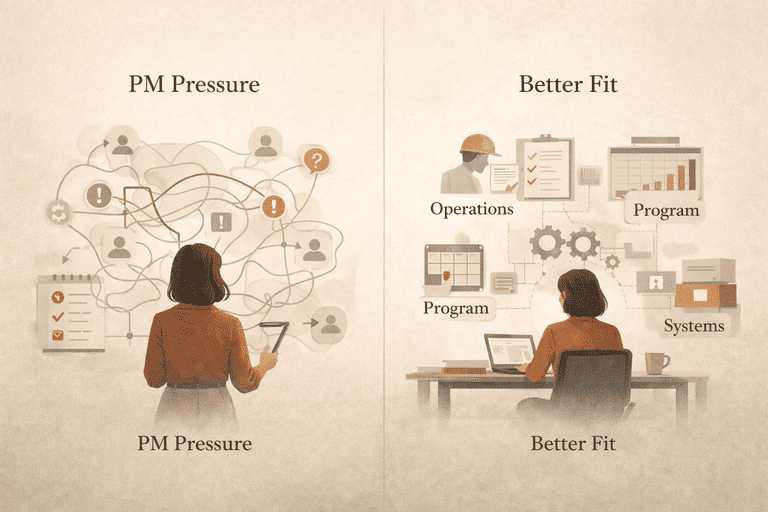
Many project managers do not actually want out of ownership, coordination, or making complicated things move. They want out of the particular pressure structure that project management often turns into.
That pressure structure usually looks like this:
- accountability without enough authority
- constant dependency management
- too much status work
- too many meetings
- endless follow-up across people who do not share the same incentives
- being the person everyone expects to keep the machine moving no matter how little control you actually have
That is why "What careers are similar to project management?" is a better question than "What should I do if I want to leave project management?" The second question is too broad. The first creates room for a more useful diagnosis: what part of project management still fits me, and what part of the role is creating the chronic friction?
The Short Answer
If you want out of classic project-management pressure but still want to use PM-built strengths, the strongest adjacent paths usually preserve some mix of coordination, prioritization, cross-functional communication, execution judgment, and operational clarity while changing how much of the role is pure dependency orchestration.
That often includes roles in:
- program management
- operations
- implementation
- service delivery
- product-adjacent coordination
- internal systems or business process roles
Those roles are not automatically easier, and they are not all the same. But they often change the part of PM work that feels most wearing while preserving the parts that still fit.[1] O*NET's occupational framework reinforces the same idea by connecting adjacent roles through shared work demands rather than title similarity alone.[2] The better question is: am I done with coordination itself, or am I done with being responsible for momentum without enough control over the system?
Why Project Managers Often Misread The Problem
Project management compresses many kinds of work into one title:
- sequencing
- dependency management
- stakeholder communication
- expectation setting
- risk tracking
- follow-through
- status visibility
- escalation
That makes burnout in the role harder to interpret.
A PM may think they are done with coordination when what they are actually done with is being stuck in perpetual follow-up. Another may think they want to leave execution work entirely when what they really want is more ownership over the system they are coordinating. Another may think they hate cross-functional work when what they really hate is being the neutral pressure-absorber between teams with misaligned incentives.
That is why the title is not enough. Before making a move, the actual source of friction has to be named more precisely.
First Decide What You Want Less Of
This matters more than the title search.
Common patterns:
- less meeting density
- less follow-up fatigue
- less indirect authority
- less reactive coordination
- less being trapped between teams
- less timeline pressure without decision power
- less constant translation between stakeholders
Different adjacent roles solve different versions of that problem.
If you skip this step, every operations or program title starts to look attractive even though the lived work can still be very different.
Six Better-Fit Paths To Explore
1. Program Management
The guide for former project managers looks more closely at how coordination and judgment can be presented as evidence in an application.
This is often the strongest adjacent move for PMs who still like orchestration, but want the work to sit at a slightly higher or more integrated level.
Program management usually preserves:
- cross-functional coordination
- sequencing and dependency thinking
- stakeholder alignment
- risk and escalation judgment
- execution visibility
What changes:
- the scope often becomes broader and more strategic
- the time horizon is often longer
- there is usually more need to connect initiatives rather than only run one project
- depending on the org, you may gain more leverage or simply inherit bigger ambiguity
This path fits best when you still like the coordination spine of PM work, but want the work to feel more connected to bigger decisions rather than only short-cycle project upkeep.
2. Operations
Operations is often a strong fit for PMs who are tired of coordinating around a broken system and would rather own part of the system itself.
What transfers well:
- process thinking
- prioritization
- issue triage
- cross-functional communication
- workflow visibility
- turning ambiguity into motion
What changes:
- less pure project framing
- more continuous ownership
- more direct influence over recurring systems
- often less artificial deadline churn and more ongoing process responsibility
This path fits best when you want less temporary orchestration and more durable ownership.
3. Implementation or Delivery Roles
Some PMs do not want less execution. They want execution that is closer to the actual product, service, or customer outcome.
Implementation and delivery roles can fit when you still like momentum, coordination, and execution, but want the work to feel more concrete and less abstractly managerial.
What transfers well:
- sequencing
- stakeholder handling
- issue management
- dependency tracking
- expectation setting
What changes:
- more direct tie to product or service outcomes
- often clearer ownership boundaries
- less generic project language
- more practical delivery logic
This path fits best when you still like making things happen, but want less "project manager as professional nag" energy.
4. Product-Adjacent Roles
Some PMs are strongest not in coordination for its own sake, but in shaping priorities, clarifying tradeoffs, and keeping work aligned to something that matters.
That can point toward product-adjacent roles when the person likes:
- prioritization
- decision framing
- translating between stakeholders
- clarifying requirements
- thinking about why the work matters, not only when it ships
What changes:
- less generic coordination
- more product, customer, or roadmap context
- more tradeoff judgment
- sometimes less meeting churn, but often more ambiguity
This path fits best when you want to stay cross-functional but closer to decision logic than to pure project administration.
5. Internal Systems or Business Process Roles
Some PMs discover the part they really like is not running projects. It is making messy systems cleaner.
That can point toward internal systems, business process, workflow improvement, or tooling-adjacent roles.
What transfers well:
- process mapping
- issue spotting
- documentation
- coordination across functions
- implementation discipline
What changes:
- less visible project theater
- more system ownership
- more process design and refinement
- more focus on repeatability instead of one-off delivery
This path fits best when you want your coordination skill to turn into a better system, not another pile of status updates.
6. Service Delivery or Client-Facing Delivery Management
Some PMs still like external-facing work. They just want a role where the value chain feels clearer.
Service delivery or client-facing delivery roles can fit when you still want:
- external stakeholder contact
- expectation management
- problem solving with real-world urgency
- continuity from handoff to outcome
What changes:
- the work often becomes more delivery- and relationship-grounded
- success may be easier to feel because the output is more visible
- pressure can still be high, but the role may feel less abstract than internal project coordination
This path fits best when you still like people and delivery, but want the role to feel more tangible than generic PM work.
How To Choose And Validate The Right Path
At this point, the best question is not which title looks safest. It is which part of project management still feels like yours.
Use these filters.
If You Still Like Orchestration But Want More Leverage, Look Harder At Program or Ops
Some PMs still enjoy cross-functional movement. What they hate is having too little authority relative to their accountability.
Those people often do better when they move toward roles with more system ownership.
If You Like Execution More Than Status Management, Look Harder At Implementation or Delivery
Some PMs are tired of the meta-work around execution, not execution itself. They want the work to be closer to the actual thing being built, delivered, or improved.
That often points toward implementation, service delivery, or internal execution-heavy roles.
If You Like Prioritization and Tradeoffs More Than Follow-Up, Look Harder At Product-Adjacent Work
Some PMs were always strongest in translating needs, clarifying scope, and helping teams work on the right thing rather than only enforcing timelines.
Those people may fit better closer to product or process direction than inside classic project administration.
The Feel Of The Work Changes A Lot
This is the part many PMs underestimate.
All of these roles sit near project management, but the day can feel very different.
Program management usually feels:
- broader
- more strategic
- more ambiguous
- still cross-functional, but less trapped in one project
Operations usually feels:
- more continuous
- more system-owned
- less theatrical
- more grounded in recurring process
Implementation usually feels:
- more concrete
- more delivery-facing
- less abstractly managerial
- closer to the thing actually being shipped or adopted
Product-adjacent work usually feels:
- more decision-heavy
- more prioritization-oriented
- less pure timeline management
- sometimes more ambiguous, but often more meaningful to the right person
That matters because not every adjacent move solves the same kind of pain.
Do You Want More Control, Or Less Coordination?
This distinction matters.
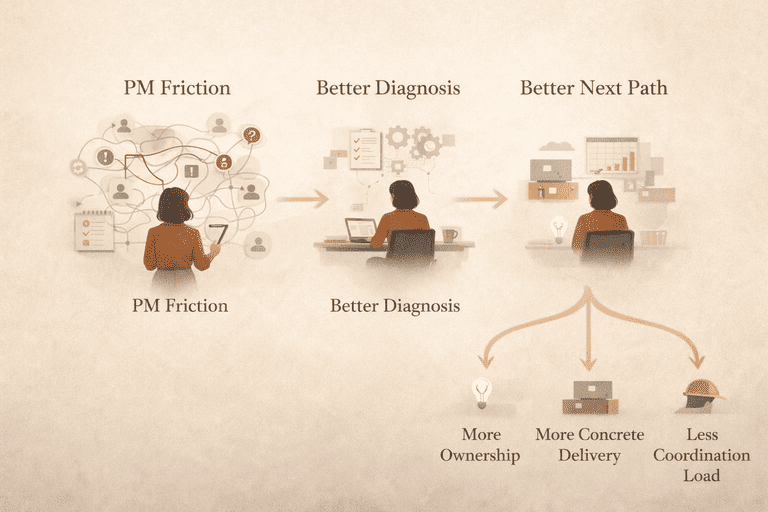
Some PMs still want coordination. They just want more control over the system they are responsible for. Others are genuinely done with being the connective tissue between too many people and want the work itself to contain less coordination.
If you want more control, you may fit better in:
- operations
- program
- internal systems
If you want less coordination intensity overall, you may fit better in:
- product-adjacent roles
- more individual-contributor process roles
- certain implementation or systems positions with clearer scope
That is why adjacent titles are not enough on their own. The real question is whether the new role changes the authority, ownership, and coordination burden in the direction you actually need.
How To Read Whether A Role Will Really Feel Better
This is one of the most useful checks before applying.
Many roles near project management borrow similar language:
- cross-functional
- fast-paced
- stakeholder management
- execution
- prioritization
- alignment
But those words do not tell you enough. The real difference is usually hidden in the control structure around the work.
Questions that matter more:
- do you own part of the system, or are you only coordinating around other owners?
- are you expected to make prioritization decisions, or only facilitate them?
- is the role measured by outcomes you can influence directly, or by timelines that depend on everyone else?
- does the role reduce meeting-driven translation work, or just rename it?
That is why two adjacent roles can look similar and feel completely different in practice. A PM may move into operations and feel immediate relief because ownership becomes more durable and the work less performatively managerial. Another may move into a program role and discover that the scale is bigger, but the dependency pressure is still there. Another may move closer to product and discover that more ambiguity is tolerable because the decision logic feels more meaningful than endless status management.
The title does not answer that. The operating structure does.
How Much Social Load Do You Still Want?
This is easy to miss because PM work normalizes constant people management without naming it that way.
A lot of project managers are not only tired of timelines. They are tired of carrying so much social coordination:
- chasing updates
- calming stakeholders
- translating between teams
- absorbing frustration
- keeping momentum alive when other people are blocked, tired, or misaligned
That means the next role should not only be judged by scope or authority. It should also be judged by how much relational maintenance the day still requires.
Some adjacent roles still carry heavy social load:
- program management
- service delivery
- externally facing implementation
Some often reduce it:
- certain operations roles
- internal systems or business process work
- some product-adjacent paths, depending on the company
Neither is automatically better. The point is that this variable changes how sustainable the role feels. Two jobs can both look "adjacent to PM" and still differ dramatically in how much human energy they consume each week.
That is why the real question is not only "What do I want more control over?" It is also:
- how much coordination energy do I still want to spend every day?
- do I want to stay in high-translation work or move toward deeper ownership?
- am I tired of managing work, or tired of managing people around the work?
The answer often explains the better fit more clearly than the title ever will.
What To Build Before You Apply
PMs usually become more credible faster when they translate their experience into the actual logic of the next role instead of only saying they want "less project work."
Complete the transferable-skills worksheet for a target vacancy before building a work sample, so the artifact answers a real requirement.
That often means:
- rewriting experience at the system, execution, and decision level
- showing where you improved process or not just coordinated people
- naming whether your strength is orchestration, execution, prioritization, or systems improvement
- targeting one adjacent family at a time
- showing continuity instead of escape
The stronger story is not "I want out of project management." It is "I am strong at coordination, execution clarity, and cross-functional movement, and I want to apply those strengths in a role with a better control-to-accountability balance."
Final Answer
The best careers similar to project management are usually adjacent roles that preserve coordination and execution strengths while changing the pressure structure around them.
Program management, operations, implementation, product-adjacent work, internal systems, and service delivery roles often make sense because they reuse real PM-built judgment without requiring the same version of constant follow-up, indirect authority, and meeting-heavy pressure.
The smartest move is usually not to ask how to leave project management entirely. It is to identify which part of PM work still fits you, which part is making the role unsustainable, and which adjacent path changes that tradeoff in a believable way.

References
[1] OECD. Career Guidance for Adults in a Changing World of Work.
[2] O*NET Resource Center. O*NET Content Model.
[3] O*NET OnLine. Help: Advanced Searches.
[4] Project Management Institute. Pulse of the Profession.
[5] U.S. Bureau of Labor Statistics. Project Management Specialists. Occupational Outlook Handbook.
[6] U.S. Bureau of Labor Statistics. Training and Development Managers. Occupational Outlook Handbook.
[7] Savickas, M. L., & Porfeli, E. J. (2012). Career Adapt-Abilities Scale: Construction, reliability, and measurement equivalence across 13 countries. Journal of Vocational Behavior, 80(3), 661-673.
[8] Brown, A., Bimrose, J., Barnes, S. A., & Hughes, D. (2012). The role of career adaptabilities for mid-career changers. Journal of Vocational Behavior, 80(3), 754-761.
See Your Stronger-Fit Next Moves
Get a clearer picture of which adjacent paths fit you better before making a bigger jump.

Builds CareerMeasure hands on and writes about career fit, role transitions, and the gap between generic personality advice and evidence-based career decisions.
Community Discussion
Share your thoughts about this article
Delete Comment?
Are you sure you want to delete this comment? This action cannot be undone.