

Career Test for Adults:
What To Use When You Are Not Starting From Zero

Most adults do not need a career test for the reason career-test marketing assumes.
They are not sitting at the beginning of life asking, "Who am I?" in the abstract. They are usually asking something messier and more expensive: should I stay in this role or leave it, what still transfers, and how big does the next move really need to be?
OECD guidance on adult career support makes the same distinction in more formal language: adults often seek career guidance because they want to progress in work, change jobs, or respond to labor-market shifts, not because they are making a first-ever career choice.[1] That means the best career test for adults is usually not the prettiest result page or the most flattering label. It is the one that matches the kind of decision you are actually trying to make.
The Short Answer
If you want a free, credible starting point, the O*NET Interest Profiler on My Next Move is still one of the best first stops.[2] The surrounding O*NET occupational system makes that starting point more useful than a standalone quiz result.[3]
If you want broad exploration, use a broad exploration platform. If you want personality-and-interest language for self-reflection, inspect which constructs a tool measures. Personality and vocational interests are related but distinct.[6] Personality evidence is useful, but still partial and context-dependent for career decisions.[5] Treat the result as one input alongside your work experience and practical constraints.
If you are already working and want to examine your current role, CareerMeasure includes current-role fit and adjacent-career exploration.[7] This is our product's intended use, not evidence of better career outcomes than another assessment. Inspect its outputs before deciding whether it addresses your question.
What Adults Actually Need From A Career Test
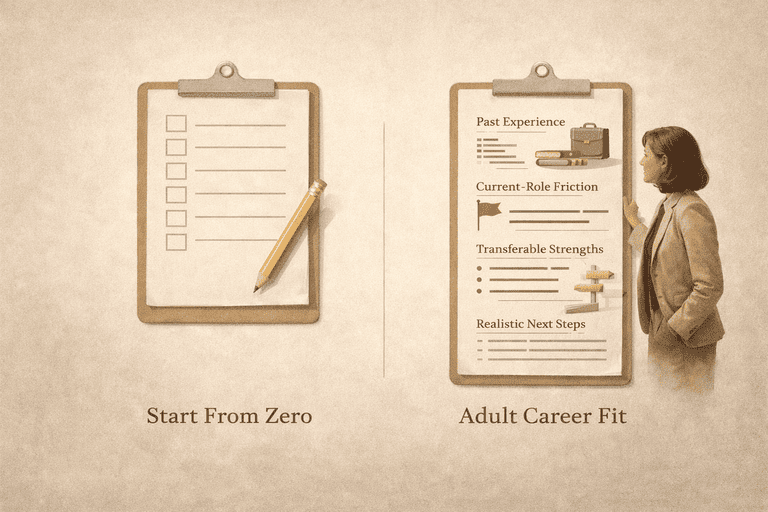
Once you already have work history, the problem changes. You are not choosing from zero anymore. You already have evidence.
You know which parts of work drain you faster than they should. You know whether you can tolerate ambiguity, politics, customer exposure, constant context switching, or quota pressure. You know whether you like creating, persuading, organizing, investigating, teaching, or improving systems. You may not have a clean theory for those patterns yet, but the patterns are there.
That is why adult career decisions are usually less about identity discovery and more about decision support. A useful adult-oriented career test should help you do four things well:
- clarify what part of your current dissatisfaction is real mismatch versus temporary friction
- identify what kinds of work still fit, not only what sounds appealing in theory
- translate your existing experience into realistic next-step options
- narrow the field enough that a decision becomes easier, not noisier
If the tool does not help with those jobs, it can still be interesting. It just may not be enough for an adult decision.
Why Adult Career Decisions Are Harder Than Career-Test Marketing Admits
Adult career problems are usually more expensive than early-career exploration problems.
If preserving experience and working around existing responsibilities are central to your decision, the assessment guide for adults over 40 considers those constraints in more detail.
You are not only choosing among abstract possibilities. You may be carrying income pressure, family responsibilities, professional reputation, accumulated specialization, and years of evidence about what work does and does not do to your energy. That changes what a useful tool needs to do.
A test for adults therefore has a harder job than "tell me what sounds like you." It has to help you sort between:
- temporary stress and deeper mismatch
- a bad role version and a bad role family
- a fixable problem and a structural one
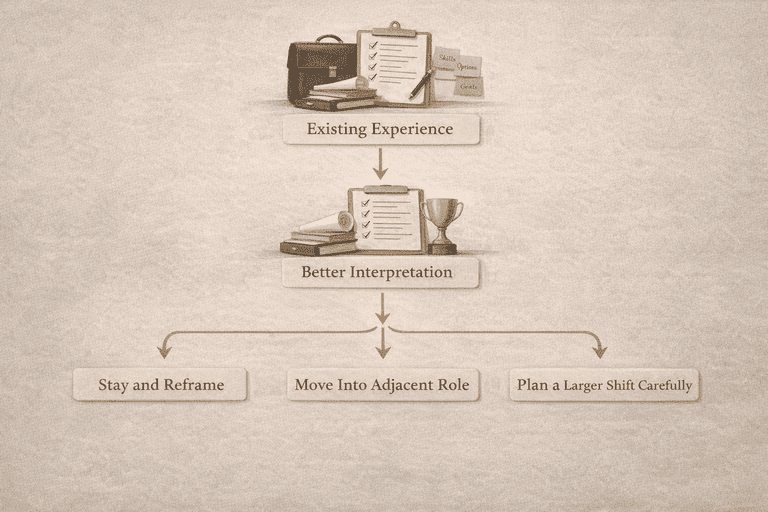
- an adjacent move and a much larger reset
That is why so many adults take career tests and come away vaguely dissatisfied. The tool may be working exactly as designed, but the design is for orientation or identity language, not for the actual decision pressure an adult is carrying.
Why So Many Career Tests Feel Wrong To Adults
Most career tests are built around one of three promises.
The first promise is orientation: "Let me show you the landscape." That can be useful. The second is identity: "Let me describe your personality." That can also be useful. The third is diagnosis: "Let me help you interpret what is happening in your current work and what kind of move makes sense next." That is rarer, but for many adults it is the most valuable promise of the three.
The trouble is that career-test marketing often blurs those promises together. A personality-led tool gets discussed as if it were a diagnosis tool. A broad exploration engine gets discussed as if it were a decision engine. A free interest profiler gets expected to resolve questions about burnout, promotion, or mid-career fit. That is where disappointment starts.
Research on personality and vocational interests points in the same direction. Personality has real signal in work outcomes, but it does not explain enough on its own to stand in for career fit.[5] And personality is not interchangeable with vocational interests, which is one reason adult decisions usually need more than a single personality-style result.[6] Adults feel the limitation faster because they already have lived work evidence that pushes back against oversimplified advice.
Another way to say it is this: many adults buy a tool for the job they wish they had, not the job they actually have. They buy exploration when they need diagnosis. They buy identity language when they need current-role interpretation. Then the tool feels underwhelming, even if it is fine within its own category.
The Four Types Of Career Tests Adults Usually Run Into
1. Free Interest Profilers
These are best when you need a clean starting point without spending money first.
The O*NET Interest Profiler remains the strongest example. It is public, tied to occupational data, and built for exploration rather than hype.[2] The Department of Labor's My Next Move launch material makes the use case clear: search occupations, browse industries, and use the Interest Profiler to orient yourself.[3]
That is valuable because many adults do not need a dramatic answer on day one. They need a credible first map. The limitation is that an interest profiler is strongest at pointing toward kinds of work, not at diagnosing why your current role feels wrong or how far your next move needs to be.
Use this type of tool when your question is: "I need a grounded place to begin."
2. Broad Exploration Engines
These are best when your problem is not a lack of self-awareness, but a lack of visibility into the field.
This category matters because some adults are not blocked by self-knowledge. They are blocked by visibility. They need a wider map of roles, industries, and adjacent options than they currently have. Research on career exploration supports the idea that exploration is an active information-gathering process rather than a one-time identity event.[4] That breadth is a real advantage if you suspect the right answer might be outside the handful of job titles you already know.
The tradeoff is that breadth can easily become noise. A broader map is not automatically a better decision. For adults who are already in a role, the real challenge is often not "show me more options." It is "help me interpret what I should do from where I already am." Exploration engines are usually stronger at the first job than the second.
Use this type of tool when your question is: "I need to see the landscape before I narrow it."
3. Personality-Led Career Tests
These are best when you want a familiar language for self-reflection.
Personality-led tools stay popular because they give people fast language for how they tend to operate. That can be useful. Personality language can help you notice environment preferences, energy patterns, tolerance for structure, or social style. What it usually cannot do by itself is tell you whether your current role is structurally wrong, whether your dissatisfaction is mostly motivational, or whether your next move should be adjacent or much larger. That is too much weight for one layer of self-description.
The research base is much more modest than the internet version of personality advice. Personality has real predictive value in work, but it is partial and context-dependent.[5] Personality and vocational interests are connected, but they are not the same construct, which is one reason career-fit guidance needs more than a single personality result.[6]
Use this type of tool when your question is: "I want useful language for how I work, but I know this is not the whole answer."
4. Diagnostic Career-Fit Systems
These are best when the real problem is interpretation, not only exploration.
That is where CareerMeasure fits. The methodology is built around interests, motivations, and strengths, then anchored back to current-role fit, gap interpretation, adjacent-career logic, and stronger-fit exploration.[7]
That design matters because adults usually do not need a result that says, "You might like marketing, counseling, and UX design." They need help answering questions like:
- Is this role fundamentally wrong for me, or only wrong in this team or environment?
- Which parts of my experience still transfer?
- Is my next move a small adjacent shift or a bigger reset?
- What does "better fit" actually mean in practical terms?
Those questions describe what to inspect in the output. A product's use of the word "diagnostic" does not establish its accuracy, and a career questionnaire does not diagnose a health condition.
Use this type of tool when your question is: "I need help understanding what is happening now and what a realistic next step looks like."
What Adults Usually Buy By Mistake
There are three common buying mistakes here.
1. Buying Breadth When The Real Problem Is Interpretation
This happens when someone already knows a fair amount about the market, but still feels stuck because they do not understand the mismatch in their current role. A broader list of options can feel productive while still avoiding the real question.
2. Buying Personality Language When The Real Problem Is Decision Friction
This happens when someone wants a cleaner story about themselves, but what they actually need is a better judgment call. Personality language can feel clarifying without materially improving the decision.
3. Buying A Verdict Instead Of A Tool
This is the biggest mistake. Adults often hope a test will tell them what to do. Most good tools cannot do that. What they can do is narrow the field, sharpen the diagnosis, and improve the quality of the next decision.
How To Pick The Right Career Test As An Adult
The cleanest way to choose is to stop asking for the single "best" career test and instead match the tool to the decision.
Use the career-change test buyer guide to inspect the output and access boundary before deciding whether another report would address your uncertainty.
If you need a free and credible first map, start with the O*NET Interest Profiler.[2] It is one of the best low-risk ways to get oriented without pretending to answer more than it can.
If you need maximum exploration breadth, use a broad exploration platform. It is strongest when you want to browse a larger field of possibilities and compare many roles before narrowing.[4]
If you want personality-led reflection, use a personality-oriented tool as one layer of understanding rather than as a final verdict on career fit. Personality adds useful signal.[5] It still needs to sit beside work-interest evidence and real-world context.[6]
If you need to understand your current role before deciding whether to change jobs, change careers, or adjust your direction, use a more diagnostic tool like CareerMeasure.[7]
That framing is important because many adults buy the wrong tool for the wrong job. They choose a broad exploration engine when they really need diagnosis. Or they choose a personality-led product when they really need current-role interpretation. Then they blame the category when the problem is partly a mismatch between the tool and the decision.
A Simpler Buying Rule
If you want the shortest possible version, use this:
- choose a free interest profiler if you need a credible place to begin
- choose a broad exploration engine if your main issue is limited visibility
- choose a personality-led tool if you want self-reflection language and know that is only one layer
- choose a diagnostic career-fit tool if your real problem is understanding your current role and deciding what kind of move makes sense next
That is a much better rule than asking for one universally best career test for adults, because adults are usually not buying one generic answer. They are buying help with a specific decision.
The Biggest Mistake Adults Make With Career Tests
The biggest mistake is treating the test like a verdict instead of a decision aid.
Adults especially should resist that temptation. Once you have real work history, your lived pattern matters at least as much as your abstract traits do. A good tool should help you notice those patterns more clearly, pressure-test them, and translate them into better options. It should not replace judgment.
That is also why the best outcome from a career test is usually not a label. It is a better decision frame. You should come away with clearer tradeoffs, sharper language for what is and is not working, and a narrower, more realistic set of next moves.
If the result is only "here are twenty jobs you might like," that may still be interesting. But for many adults, it is not enough.
That is especially true once you already have meaningful work history. At that point, your lived evidence matters too much to be replaced by a neat label or a broad recommendation list. The test should help you interpret that evidence, not ignore it.
Final Answer
The best career test for adults depends less on age itself than on the kind of problem you are trying to solve.
If you need a free starting point, use the O*NET Interest Profiler. If you need broad exploration, inspect a platform's occupation coverage. If you want personality-led reflection, use the result as one input alongside work experience. CareerMeasure offers current-role interpretation and adjacent-career exploration; compare the demo with the question you need to answer before purchasing.
Adults are rarely choosing from zero. The career test should respect that.

References
[1] OECD. Career Guidance for Adults in a Changing World of Work.
[2] O*NET Resource Center. O*NET Interest Profiler Services.
[3] U.S. Department of Labor. US Department of Labor launches My Next Move for jobseekers.
[4] Jiang, Z., Newman, A., Le, H., Presbitero, A., & Zheng, C. (2019). Career exploration: A review and future research agenda. Journal of Vocational Behavior, 110, 338-356.
[5] Judge, T. A., & Zapata, C. P. (2015). The person-situation debate revisited: Effect of situation strength and trait activation on the validity of the Big Five personality traits in predicting job performance. Academy of Management Journal, 58(4), 1149-1179.
[6] Wille, B., Dupré, S., & De Fruyt, F. (2025). Personality and vocational interests: Connections between two fundamental individual-differences construct domains. Current Opinion in Psychology, 66, 102103.
[7] CareerMeasure. Methodology.
Get A Clearer Career Signal
Take the assessment to see what fits, what feels off, and which roles are more likely to suit you.

Builds CareerMeasure hands on and writes about career fit, role transitions, and the gap between generic personality advice and evidence-based career decisions.
Community Discussion
Share your thoughts about this article
Delete Comment?
Are you sure you want to delete this comment? This action cannot be undone.