

Career Test for Adults Over 40:
What To Use When Starting Over Is Not an Option

By the time most people are over 40, the career problem has changed.
You are usually not asking the soft early-career question of who you might become in the abstract. You are asking a more practical and more expensive question: what can still change without blowing up income, credibility, family stability, or the value of everything you have already built?
That is why many career tests feel off at this stage. They are often designed for orientation, identity language, or broad exploration. Adults over 40 usually need something tougher than that. They need a tool that helps them interpret real work history, separate fixable friction from structural mismatch, and identify a next move that is believable from where they are now.
The Short Answer
If you are over 40, the best career test is usually not the one that gives the most flattering label. It is the one that helps you make a realistic decision.
For a free first pass, the O*NET Interest Profiler is still one of the best places to start because it gives a credible interest-based map without charging you for false certainty.[1] Its documentation is also unusually clear about what it measures and what it does not.[2] Personality-led tools can still be useful for self-reflection, but they are too thin to carry a serious midlife decision by themselves.[3] Personality signal is real, but the research base is still too partial to treat it as the whole decision engine.[4] If the real question is what your current role is getting wrong, what still transfers, and how large the next move really needs to be, a more diagnostic system like CareerMeasure is usually stronger for that job.[5]
So the right rule is simple: use free interest tools for orientation, use personality tools for partial reflection, and use diagnostic fit tools when the real problem is deciding what to do from where you already are.
Why Over 40 Changes The Question
Age itself is not the important variable. Constraint density is.
By this stage, most people have accumulated some mix of:
- income dependence
- professional reputation
- domain-specific experience
- family responsibilities
- fatigue from repeating work that no longer fits
- anxiety about wasting the capital they have already built
That changes what a useful career test needs to do.
A younger user can often tolerate broader exploration and noisier experimentation. Adults over 40 can still change direction, but the cost of a wrong move is often higher. OECD guidance on adult career support makes the same point in institutional language: adults seek guidance to progress in work, change jobs, choose training, and respond to labor-market shifts, not simply to make a first career choice.[6]
That means the test has to respect evidence you already have:
- what work drains you
- what work still energizes you
- which strengths are real
- which constraints are fixed
- how much transition distance you can realistically carry
If a tool ignores those realities and only gives a personality story or an attractive list of occupations, it may still be interesting. It is just not solving the adult over-40 problem very well.
What Adults Over 40 Usually Need From A Career Test
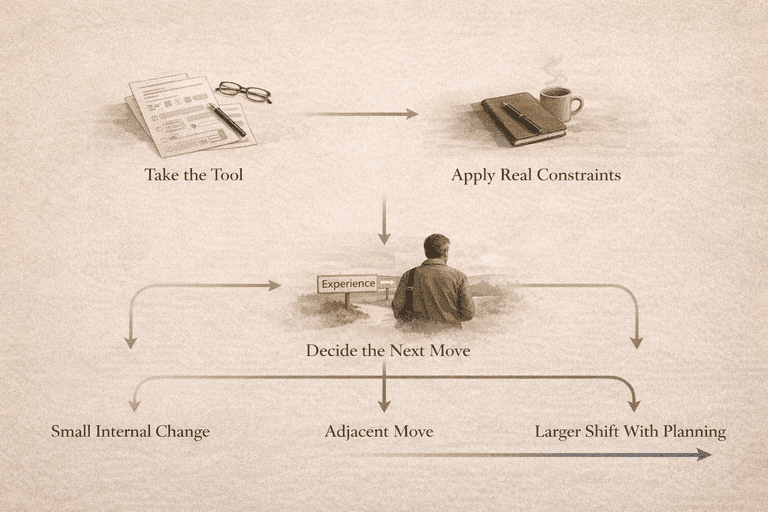
The three-option career-change worksheet compares a current-role change, an adjacent move, and larger retraining against your actual constraints before you choose a test.
At this stage, the test is not mainly there to discover a whole new identity. It is there to reduce decision error.
In practice, a useful tool should help with five harder jobs:
- separate temporary role friction from deeper mismatch
- identify what should stay in the next move, not only what should change
- clarify which strengths still transfer credibly
- reduce fantasy options and increase adjacent realism
- turn vague dissatisfaction into a smaller set of workable next steps
That is why the best outcome is usually not a label. It is a sharper frame.
The user should come away with a better answer to questions like:
- is the problem the job, the environment, or the broader career?
- how much of my current experience still has value?
- do I need a different version of the work or a different type of work?
- how big does this move really need to be?
That is a different standard from "did the result feel accurate?"
Why So Many Career Tests Underperform For This Age Group
Most career tests miss because they are built around a thinner problem than the one adults over 40 are carrying.
They often assume the user mostly needs one of three things:
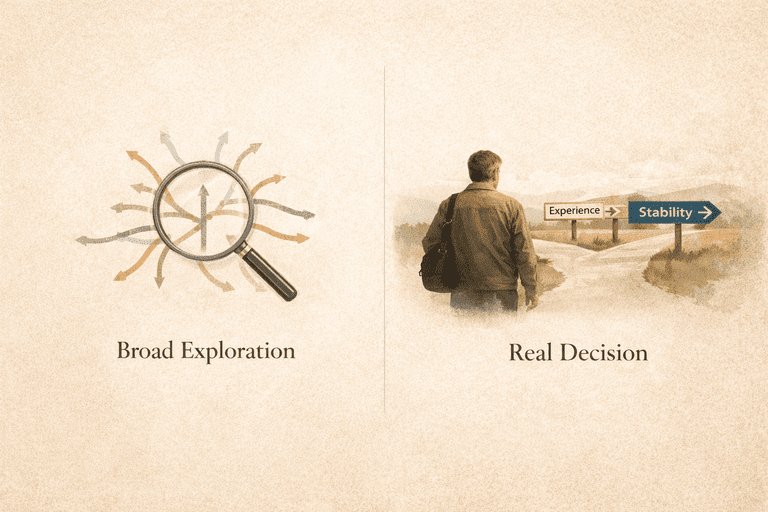
- broad exploration
- personality language
- aspirational inspiration
Those can all be useful. But none of them is the same as mid-career decision support.
This is where many adults buy the wrong tool for the wrong job. They buy a broad exploration platform when the real issue is not visibility. They buy a personality test when the real issue is current-role interpretation. Or they buy a verdict when what they actually need is a disciplined way to narrow the next move.
Career adaptability research is useful here because it frames adult career movement as a process of concern, control, curiosity, and confidence rather than a one-time revelation.[7] That is much closer to reality. A good over-40 career test should improve that process. It should not pretend to replace it.
What Different Types Of Career Tests Are Actually Good For
This is the simplest way to stop expecting the wrong thing from the tool.
1. Free Interest Profilers
These are strongest when you need a clean, credible place to begin without spending money first.
The O*NET Interest Profiler is still the best example. It is public, explicit about what it measures, and designed to help users identify work-interest patterns and explore occupations from there.[1] The O*NET manual makes that boundary unusually legible for a free tool.[2]
That matters because interest is one of the more useful first-pass signals when someone feels directionally lost. Vocational interests predict meaningful educational and work outcomes, and they add signal that personality alone does not fully capture.[8]
But the limitation matters too. A free interest profiler is a map, not a diagnosis. It can help you see directions. It cannot tell you whether your current role is fixable, whether your dissatisfaction is burnout or mismatch, or how much transition distance is realistic at your stage of life.
Use this when your question is:
I need a grounded first map.
2. Personality-Led Tools
These are strongest when you want language for broad work style patterns.
That can still be useful over 40. A personality result can help explain why you keep reacting badly to certain environments, management styles, or work rhythms. It can help you describe your need for autonomy, structure, people contact, novelty, or predictability.[3]
The problem is that personality is only one layer of career fit. The research base is consistent on that point. Personality has real work-related signal, but it is partial and context-dependent.[4] It does not stand in for interests, strengths, motivation style, transition feasibility, or current-role diagnosis.
That is why personality tools often feel emotionally useful and operationally incomplete. They can help you say, "this kind of environment tends to drain me." They usually cannot tell you what realistic next move makes sense from the life you already have.
Use this when your question is:
I want better self-reflection language, but I know this is not the whole answer.
3. Broad Exploration Platforms
These are strongest when the real problem is limited visibility.
Sometimes adults over 40 are not blocked by self-knowledge. They are blocked by narrow exposure. They only know the titles in their own lane. They have no map of adjacent roles, nearby industries, or alternate ways their skills could be used.
Breadth helps there. Career exploration research supports the idea that exploration is an active information-gathering process, not just a one-time identity exercise.[9]
But exploration platforms have a predictable weakness for adults under pressure: they can produce a wider list without producing a better decision. At this stage, more options are not automatically better. In fact, more options can become another way to avoid the harder interpretive question.
Use this when your question is:
I know too little about the landscape, and I need to widen the field before I narrow it.
4. Diagnostic Career-Fit Systems
These are strongest when the real problem is interpretation.
That is where CareerMeasure is more useful. The methodology is built around interests, motivations, and strengths, then anchored back to current-role fit, gap interpretation, and adjacent-career reasoning.[5]
That matters more after 40 because the user is rarely choosing from zero. They are usually deciding how to preserve some parts of their working life while changing others.
A more diagnostic system is better for questions like:
- what exactly is wrong with my current role?
- what parts of my experience still have value?
- is this a bad version of the work or the wrong kind of work?
- do I need a smaller adjacent move or a larger change?
Use this when your question is:
I need help understanding what is happening now and what kind of move is realistic next.
The Biggest Buying Mistakes Adults Over 40 Make
There are a few failure patterns that show up repeatedly.
Mistake 1: Buying A Fantasy Generator Instead Of A Decision Aid
This happens when someone wants relief more than clarity.
The result often looks like a list of attractive roles that feel emotionally clean because they are far away from the current pain. But if the transition distance is too large, the result is not actually useful. It is just temporarily comforting.
Mistake 2: Treating Self-Recognition As Proof
This is the trap many personality-heavy tools create.
The result feels accurate, so the user assumes the recommendation must also be strong. Those are not the same thing. A tool can describe your tendencies well and still offer weak career guidance.
Mistake 3: Asking For A Final Answer Too Early
Adults over 40 are often under real time and energy pressure, so the temptation is understandable. But most useful tools do not work by handing down a verdict. They work by narrowing the field, improving interpretation, and helping you make a better next judgment.
Mistake 4: Ignoring Transition Distance
This is the most expensive one.
A role can sound better, align with your personality, and even match your interests while still being unrealistic right now because:
- the training burden is too high
- the compensation drop is too steep
- the market is weak
- the next step is too far from your current evidence
At this stage, realism is not negativity. It is part of fit.
A Better Way To Choose The Tool
The career-change test buyer guide shows the free interest route, the actual CareerMeasure assessment, and the questions each result still leaves for you to investigate.
The cleanest way to choose is to stop asking for the single best career test for adults over 40 and instead ask what problem you actually need the tool to solve.
If you need a free and credible first map, start with the O*NET Interest Profiler.[1] It gives useful directional signal without pretending to do more than it does.
If you need broader exposure to adjacent possibilities, use a broad exploration platform, but treat it as a visibility tool rather than a verdict engine.[9]
If you want personality language, use a personality-oriented tool for reflection and environment-fit clues.[3] But do not let it carry the whole decision, because personality evidence is still only one layer of fit.[4]
If your actual problem is interpreting current-role pain, protecting transferable strengths, and deciding how large your next move should be, use a more diagnostic tool like CareerMeasure.[5]
That framing matters because over 40, the real issue is usually not whether you can imagine a new life. It is whether the next move is coherent, defensible, and strong enough to improve the life you already have.
A Short Rule That Works Better
If you want the shortest possible version, use this:
- choose a free interest profiler if you need orientation
- choose a personality-led tool if you need language for work style, not a verdict
- choose a broad exploration platform if you lack visibility into adjacent roles
- choose a diagnostic fit tool if the real decision is how to move from your current career capital into a better-fit next chapter
That is a much better buying rule than asking for the universally best test, because adults over 40 are not buying one generic answer. They are buying help with a specific decision under constraint.
What A Good Result Should Leave You With
At this stage, the output should not mainly give you excitement. It should give you traction.
A useful result should leave you with:
- a clearer read on what problem you are actually solving
- a smaller and more believable set of next-step options
- a stronger sense of what existing strengths still matter
- a more realistic view of whether the move should be small, adjacent, or much larger
If the result mainly leaves you with novelty, identity language, or a long list of distant possibilities, it may still be interesting. It is just probably not strong enough for the decision most adults over 40 are actually making.
Final Answer
The best career test for adults over 40 is the one that respects the fact that starting over is rarely the real goal.
If you need a free first map, use the O*NET Interest Profiler. If you need personality language, use a personality-led tool as one layer of reflection, not as the whole answer. If you need broader visibility, use an exploration platform. If you need help interpreting current-role pain, preserving what still works, and choosing a realistic next move, a more diagnostic tool like CareerMeasure is stronger for that job.
At this stage, the right tool should not only help you imagine. It should help you decide.

References
[1] O*NET Resource Center. Interest Profiler (IP) at O*NET Resource Center.
[2] O*NET Resource Center. O*NET Career Exploration Tools.
[3] 16Personalities. Our Framework.
[4] Judge, Timothy A., and Charles P. Zapata. The Person-Situation Debate Revisited: Effect of Situation Strength and Trait Activation on the Validity of the Big Five Personality Traits in Predicting Job Performance. Academy of Management Journal, 2015.
[5] CareerMeasure. Methodology.
[6] OECD. Career Guidance for Adults in a Changing World of Work.
[7] Savickas, M. L., & Porfeli, E. J. (2012). Career Adapt-Abilities Scale: Construction, reliability, and measurement equivalence across 13 countries. Journal of Vocational Behavior, 80(3), 661-673.
[8] Stoll, Gundula, et al. Vocational Interests Assessed at the End of High School Predict Life Outcomes Assessed 10 Years Later Over and Above IQ and Big Five Personality Traits. Journal of Personality and Social Psychology, 2017.
[9] Jiang, Z., Newman, A., Le, H., Presbitero, A., & Zheng, C. (2019). Career exploration: A review and future research agenda. Journal of Vocational Behavior, 110, 338-356.
Get A Clearer Career Signal
Take the assessment to see what fits, what feels off, and which roles are more likely to suit you.

Builds CareerMeasure hands on and writes about career fit, role transitions, and the gap between generic personality advice and evidence-based career decisions.
Community Discussion
Share your thoughts about this article
Delete Comment?
Are you sure you want to delete this comment? This action cannot be undone.