

Career Change for Marketers:
Better-Fit Roles Beyond Campaign Execution

Many marketers who want a career change are not trying to leave audience thinking, positioning, or communication behind.
They are trying to leave a narrower pattern inside marketing work.
Often that means some combination of:
- campaign churn
- shallow metric pressure
- too many channels at once
- stakeholder chaos
- work that feels more reactive than thoughtful
- a career path where the title sounds strategic but the day-to-day feels increasingly fragmented
That distinction matters because "leave marketing" is usually too broad. A lot of marketers are not rejecting the underlying strengths they built. They are rejecting the exact operating rhythm around those strengths.
That is where a better move usually starts.
The Short Answer
The best career changes for marketers usually preserve something real from marketing while changing the work pattern around it.
That often includes adjacent paths like:
- product marketing
- content strategy or content design
- UX research or audience insights
- lifecycle, CRM, or customer journey work
- brand strategy or messaging-heavy roles
- operations or systems-adjacent roles that still use marketing judgment
The key question is not only "What can a marketer switch into?" It is: which parts of marketing still fit me, and which parts of the current marketing environment are the actual source of friction?
Why Marketers Often Misread The Problem
Marketing compresses many kinds of work into one word:
- audience research
- message strategy
- content creation
- campaign operations
- channel management
- experimentation
- reporting
- stakeholder translation
That makes dissatisfaction harder to interpret.
A marketer may think they are done with marketing when what they are actually done with is campaign volume. Another may think they want a more "strategic" role when what they really want is fewer channels and more depth. Another may think they hate persuasion work when what they really hate is being trapped between short-term metrics and stakeholder requests.
That is why the title is not enough. Before making a move, the actual source of friction has to be named more precisely.
What Marketing Usually Trains Better Than Marketers Realize
People outside marketing often flatten the work into copy, channels, or promotion. Marketers inside the field often understate the deeper strengths they built because the work is so often measured through visible outputs.
Good marketers usually develop strength in:
- audience interpretation
- message framing
- translating vague business goals into communication strategy
- pattern recognition across behavior signals
- structured experimentation
- synthesizing scattered inputs into a coherent story
- coordinating across teams with different incentives
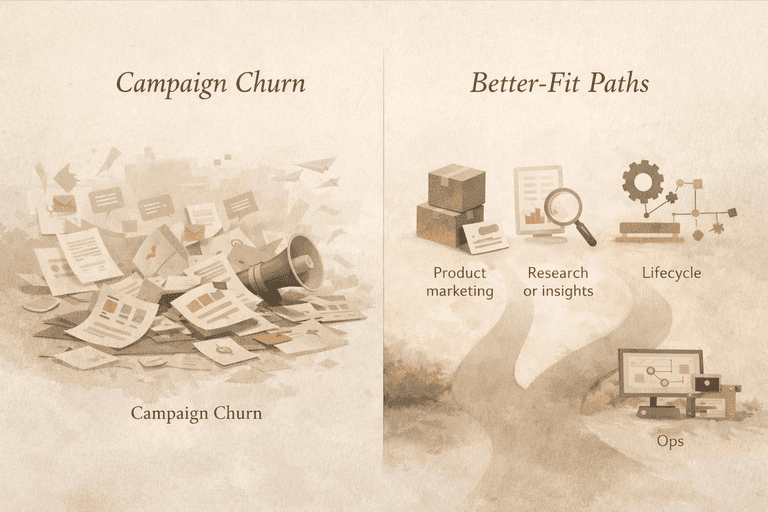
Those are durable strengths.
That is one reason adjacent moves often work better than people first assume. The strongest transitions usually happen through underlying work-pattern overlap, not through title similarity alone. Career-transition and employability research reflects the same basic idea: successful moves come from reinterpreting real existing capability and connecting it to adjacent work rather than acting like prior experience no longer counts.[1]
First Decide What You Want Less Of
This matters more than the title search.
Common patterns include wanting less:
- campaign churn
- channel fragmentation
- reactive request intake
- weak strategic ownership
- reporting rituals that feel disconnected from real learning
- constant content demand without enough depth
- persuasion work in low-clarity environments
Different adjacent roles solve different versions of that problem.
If you skip this step, every product, strategy, or insights title starts looking attractive even though the lived work can still feel very different.
Six Better-Fit Paths Beyond Traditional Marketing Execution
These are not the only options. They are the paths that most often make practical sense because they preserve real marketing strengths while changing the work structure.
If coordination is the work you want to preserve, compare roles similar to project management and check whether they retain the deadline pressure you want to reduce.
1. Product Marketing
This is often the strongest adjacent move for marketers who still like message strategy, positioning, and audience understanding, but want the work to sit closer to product and decision-making.
What transfers well:
- audience understanding
- messaging
- competitive framing
- go-to-market thinking
- translating complexity into usable language
What changes:
- more product context
- more cross-functional work with product and sales
- less pure campaign management
- more emphasis on positioning and launch logic
This path fits best when you still like strategic communication, but want less fragmented execution work.
2. Content Strategy Or Content Design
Some marketers realize the part they actually care about is structure, clarity, and message architecture, not campaign throughput.
What transfers well:
- editorial judgment
- message hierarchy
- audience empathy
- information structure
- aligning content to user intent
What changes:
- less channel juggling
- more depth per output
- more systems thinking about content
- often more collaboration with product, UX, or design
This path fits best when you liked the logic and structure of messaging more than the promotion machine around it.
3. UX Research Or Audience Insights
This is often a stronger path than marketers first assume, especially for people whose strongest fit was always in understanding behavior rather than running campaigns.
What transfers well:
- audience curiosity
- research framing
- interpreting behavior patterns
- turning signal into recommendations
- presenting insight clearly
What changes:
- more formal research methods
- less persuasion-heavy execution
- more evidence gathering
- more emphasis on what users actually do and need
This path fits best when you want to stay close to customer understanding, but with more depth and less channel pressure.
4. Lifecycle, CRM, Or Customer Journey Work
Some marketers do not want less marketing. They want a more structured and continuity-based version of it.
What transfers well:
- segmentation thinking
- message sequencing
- experimentation
- customer behavior interpretation
- clarity around stages and conversion logic
What changes:
- more systems and automation work
- more continuity across the journey
- less one-off campaign energy
- more emphasis on retention, adoption, or lifecycle design
This path fits best when you still like communication and experimentation, but want it organized around a clearer system.
5. Brand Strategy Or Messaging-Heavy Roles
Some marketers are strongest not in execution, but in framing.
They are the people who keep noticing:
- what the company actually sounds like
- where positioning gets fuzzy
- when the story is not landing
- how different messages conflict
That can point toward brand strategy, narrative work, or messaging-heavy roles.
What changes:
- less dashboard-heavy performance pressure
- more emphasis on positioning and coherence
- more interpretive work
- often fewer channels but higher-stakes communication decisions
This path fits best when your strongest contribution was always strategic clarity rather than throughput.
6. Marketing Operations, Systems, Or Process Roles
Some marketers are strongest when the work becomes more structured.
They like:
- process design
- workflow clarity
- measurement logic
- tooling
- reducing operational friction
That can point toward marketing operations or other systems-heavy roles adjacent to marketing.
What transfers well:
- understanding how campaigns actually run
- knowing where handoffs break
- seeing how measurement and execution interact
- keeping complex workflows functional
What changes:
- less creative ambiguity
- more process ownership
- more tooling and system logic
- less dependence on constant campaign ideation
This path fits best when you want to stay near marketing but not in the same kind of execution seat.
Common Traps In The Exit Search
This is where marketers lose time.
“Anything More Strategic”
"Strategic" is one of the most misleading words in career-change language.
Some roles sound more strategic and still involve:
- endless stakeholder alignment
- shallow decks
- weak ownership
- performance pressure with cleaner wording
Do not use status language as a proxy for better fit.
Another Channel Role With The Same Churn
Sometimes the move only changes the channel:
- social to email
- paid to lifecycle
- content to product launches
That can still be a good move. But if the real issue is fragmentation, reactivity, or constant volume pressure, switching channels alone may not solve much.
Roles Chosen Only Because They Sound Less “Marketing”
This is another trap.
People sometimes choose a title because it sounds more serious, more analytical, or less associated with promotion. But if the daily work still depends on the same speed, persuasion demands, and stakeholder noise, the fit problem can survive the rebrand.
What Marketers Often Misdiagnose About Themselves
This is where the search usually gets distorted.
#### “I Only Know Campaigns”
This is rarely the whole truth.
What is usually true is that the marketer has spent years using deeper strengths inside a campaign-shaped environment. Once the environment stops fitting, they start confusing the environment with the skill set.
They say:
- I only know email
- I only know paid acquisition
- I only know content marketing
But what they often actually know is:
- how to understand an audience
- how to frame a message
- how to connect signals to behavior
- how to structure communication so people move
That is a much stronger basis for an adjacent move than they usually think.
#### “If I Leave Marketing, I Need To Leave Persuasion Entirely”
Not necessarily.
Some marketers really are done with persuasion-heavy work. Others mainly want less shallow or less reactive persuasion. That is a big difference.
A move into product marketing, insights, or lifecycle may still use influence and message judgment, but in a much better-fit structure.
#### “Research Means Starting Over Completely”
Sometimes the move into research or insights does require real upskilling. But it is often not a total reset. Marketers already understand audience behavior, framing, hypothesis-testing, and the difference between what people say and what they actually do. Those are not trivial foundations.
Why Marketers Often Stay Too Long
Marketers often stay in weak-fit roles longer than they should because the field is unusually good at generating plausible explanations for why the next quarter might finally feel better.
There is always:
- the next campaign
- the next repositioning
- the next channel shift
- the next leader
- the next reorg
That can keep people treating structural fit problems like temporary execution problems. The work keeps changing just enough on the surface that it can take a long time to notice the deeper pattern underneath.
If the same friction keeps returning across campaigns, companies, or role variations, that matters. It usually means the problem is not only this launch or this boss. It is the relationship between you and the work pattern itself. That is exactly the kind of pattern a better-fit adjacent move is meant to solve.
How To Choose And Validate The Right Path
Once you have two or three likely path families, stop relying on abstract titles and start reading real postings carefully.
Look for repeated signals in:
- how much of the work is still campaign throughput versus deeper strategic ownership
- whether the role is closer to audience understanding, messaging, systems, or pure delivery
- how much stakeholder management is required
- whether success is measured through output volume, business insight, adoption, or long-horizon positioning
- how much of the work is research, writing, coordination, or operations
This matters because titles like:
- product marketing manager
- growth strategist
- content strategist
- lifecycle manager
- audience insights lead
can describe very different daily lives across different companies.
The title is not enough. The task mix tells the truth.
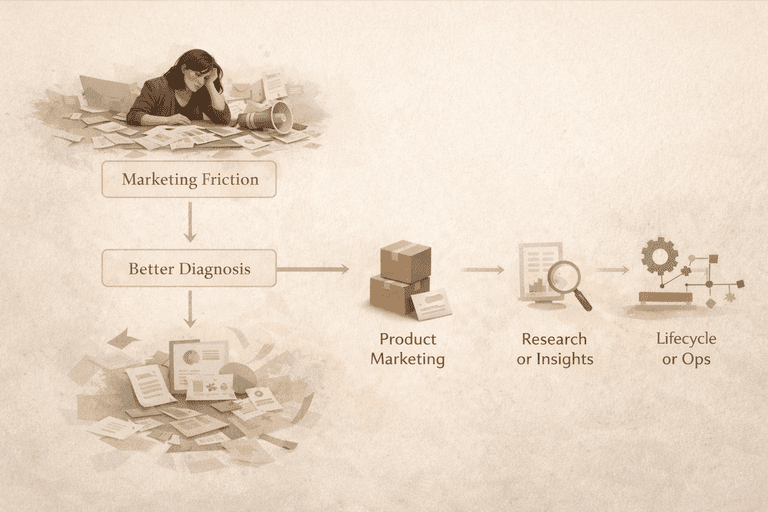
Use These Fit Filters
At this point, the best question is not which title sounds smartest. It is which part of marketing still feels like yours.
Use these filters.
#### If You Still Like Messaging But Want More Depth, Look Harder At Product Marketing or Content Strategy
This usually fits when you still want:
- communication strategy
- positioning
- audience understanding
but want less:
- scattered channel execution
- endless asset churn
#### If You Like Customer Understanding More Than Promotion, Look Harder At Research or Insights
This usually fits when your strongest instinct is:
- why did people behave this way?
- what are they actually responding to?
- what is the signal underneath the metric?
#### If You Like Systems More Than Campaign Drama, Look Harder At Lifecycle or Ops
This usually fits when you still like structure, experimentation, and optimization, but want it inside a more coherent operating model.
What A Strong Marketer Exit Usually Preserves
The best adjacent move usually preserves at least one of these:
- audience judgment
- message framing
- behavioral interpretation
- structured experimentation
- the ability to translate business goals into communication choices
If the next role uses almost none of that, the move may still be right, but it is no longer a simple adjacent transition. It becomes a larger reset with a different risk profile.
How To Pressure-Test The Next Role Before You Move
Do not stop at title appeal.
Pressure-test the role against the real problem.
Ask:
- does the role still revolve around constant output churn?
- does it preserve the audience and message work I still value?
- does it deepen my strongest strengths, or only give them a cleaner label?
- does it move me toward depth, systems, or insight, or only away from the current pain?
This matters because adjacent roles can still hide the same pattern under more impressive language.
How To Explain The Move So It Sounds Coherent
Marketers often undersell themselves here by making the move sound too vague.
Use the transferable-skills worksheet to distinguish campaign experience that answers a target requirement from tools or domain knowledge that still need work.
Weak version:
- I want to do something more strategic
- I want to get out of marketing
- I am looking for a broader role
Stronger version:
- Marketing gave me strong audience judgment, message framing, and the ability to connect behavior patterns to action. Over time I realized I want more depth in customer understanding and less campaign churn, which is why research and insights feel like a more fitting next step.
Or:
- My background in marketing built strong positioning and communication strategy skills. I found that the part of the work I wanted more of was shaping the message and less of was managing fragmented campaign execution, which is why product marketing is a stronger next fit.
That kind of explanation preserves continuity while making the move sound deliberate.

Final Answer
The best career change for a marketer is usually not a random escape from communication work. It is a better-fit path that preserves real marketing strengths while changing the operating rhythm that stopped fitting.
Once you separate what marketing trained you to do from the specific churn of campaign execution, the options get much clearer. You are no longer asking what unrelated role you could maybe tolerate. You are asking where audience insight, message judgment, and structured experimentation can be used in a way that fits you better now.
References
[1] De Vos, A., et al. Career transitions and employability. Journal of Vocational Behavior, 2021.
[2] O*NET OnLine. Advanced Search.
[3] O*NET OnLine. Summary Report and Occupation Structure Resources.
[4] Fugate, M., Kinicki, A. J., & Ashforth, B. E. (2004). Employability: A psycho-social construct, its dimensions, and applications. Journal of Vocational Behavior, 65(1), 14-38.
[5] OECD. Career Guidance for Adults in a Changing World of Work.
[6] Savickas, M. L., & Porfeli, E. J. (2012). Career Adapt-Abilities Scale: Construction, reliability, and measurement equivalence across 13 countries. Journal of Vocational Behavior, 80(3), 661-673.
[7] U.S. Bureau of Labor Statistics. Advertising, Promotions, and Marketing Managers.
[8] CareerMeasure. Methodology.
See Your Stronger-Fit Next Moves
Get a clearer picture of which adjacent paths fit you better before making a bigger jump.

Builds CareerMeasure hands on and writes about career fit, role transitions, and the gap between generic personality advice and evidence-based career decisions.
Community Discussion
Share your thoughts about this article
Delete Comment?
Are you sure you want to delete this comment? This action cannot be undone.