

CareerMeasure vs CareerExplorer vs Truity:
Which Career Test Actually Helps You Make a Decision?

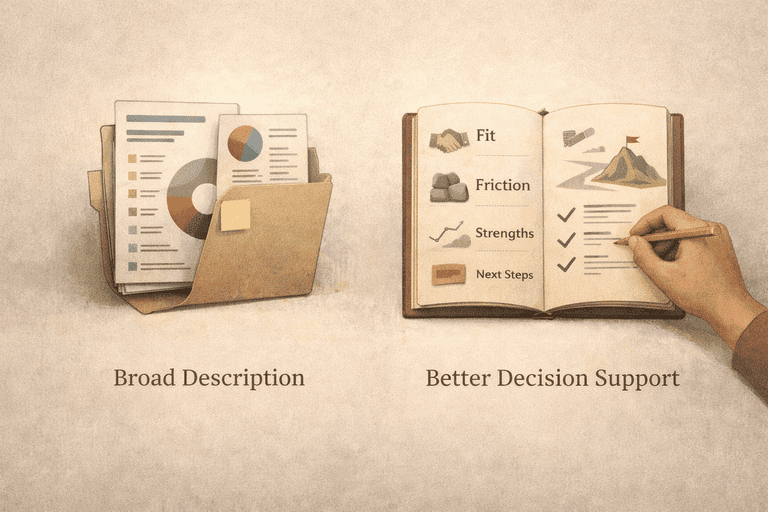
CareerExplorer, Truity, and CareerMeasure offer different ways to explore career fit. CareerExplorer describes a broad matching and exploration platform. Truity's Career Personality Profiler combines Holland interests and Big Five traits. CareerMeasure brings interests, motivations, and strengths together with current-role interpretation. The useful choice is the output that addresses your next decision, not the provider with the strongest marketing claim.
Disclosure and review scope: I am CareerMeasure's founder. Public product pages and available sample material were checked on September 5, 2026. This is a documented feature comparison, not a controlled accuracy test or a newly completed paid assessment on every platform. We have not established that CareerMeasure produces better career outcomes than either competitor.
Compare The Actual Assessments
Truity offers several products. This table focuses on the Career Personality Profiler, rather than treating it as interchangeable with the separate TypeFinder for Career Planning.[2][3]
| Detail to compare | CareerExplorer | Truity Career Personality Profiler | CareerMeasure |
|---|---|---|---|
| Publicly described inputs | Interests, goals, history, workplace preferences, and personality[1] | Holland interests and Big Five personality traits[2] | Interests, motivations, and strengths[5] |
| Expected effort | Provider estimate: about 30 minutes[1] | Provider FAQ: 94 questions, about 10-15 minutes[2] | 90 questions, estimated about 15 minutes[4] |
| Access boundary we could verify | Career-test FAQ says matches, insights, and reports are free; conflicting membership wording remains elsewhere | Free basic summary; comprehensive report offered separately | Free account for baseline results; deeper reports and exploration are paid |
| What to inspect before choosing | Explanations of matches and the career/degree profiles | The official sample report and the actual free summary | The product demo, free baseline, and methodology |
| What none of these facts establishes | Personal eligibility or a better career outcome | Personal eligibility or a better career outcome | Personal eligibility or a better career outcome |
The time estimates are provider descriptions, not timings from a new end-to-end test. None of the rows measures how well a particular result predicts your satisfaction or hiring prospects.
CareerExplorer: Inspect The Matches And Access Terms
CareerExplorer's test page currently advertises more than 1,500 career and degree profiles. That is a combined count, not 1,500 distinct occupations. It describes recommendations using several inputs, including work and education history.[1] It would be inaccurate to describe it as a personality-only quiz.
There is an access inconsistency worth knowing about. The career-test FAQ says the experience, including reports, is free. The homepage still describes a membership program, and the old membership URL redirects there.[6] We therefore do not publish an old subscription price as if it were a verified current offer.
If broad exploration is your need, inspect whether the recommendations introduce useful roles and explain them clearly. If you already have targets, check whether the available output helps you compare those targets. Library size alone does not tell you how much the report will reduce your uncertainty.
Truity: Distinguish The Free Summary From The Full Report
The Career Personality Profiler's official page identifies Holland Code and Big Five foundations and distinguishes a free basic result from an optional comprehensive report.[2] The separately linked sample shows what a full report can contain, including interest and personality interpretation and career-oriented material.[8]
Read the sample as a sample. Its depth should not be presented as content every free user receives. We have not made a new paid purchase to verify the entire current checkout and delivery experience for this comparison, so a fresh paid-report price is not asserted here.
Our Truity Career Personality Profiler review documents the earlier hands-on inspection and its limitations. Check that review's observation date separately from this public-page refresh.
TypeFinder is another product with different framing.[3] If you arrive through a TypeFinder link, confirm its questionnaire and report rather than assuming the Career Personality Profiler table applies to it.
CareerMeasure: Inspect Current-Role Interpretation Before Buying Depth
CareerMeasure's assessment uses 90 questions across interests, motivations, and strengths. Its free route requires an account to unlock baseline results, including a Blueprint preview and current-career check. Paid access adds deeper reporting and exploration.[4]
The methodology explains the model, while the demo lets you inspect how the product presents information.[5] A demo uses an example profile; it is not evidence that your own interpretation will be useful. Taking the free baseline is a way to assess that usefulness against your actual work experience.
The model's breadth is a design choice, not proof of superior prediction. Self-reported strengths are not an observed skills test, an occupational match is not an eligibility check, and a fit interpretation cannot diagnose a health condition. Qualifications, local opportunities, employer conditions, and personal constraints still require separate judgment.
Before paying, find one interpretation you can use. For example, does a current-role result help you identify a task you want to examine or a condition to discuss with your manager? If the output does not answer a live question for you, more pages alone are a weak reason to upgrade.
Compare The Evidence Behind A Claim
Research supporting a framework and research validating a finished product are different things. Judge and Zapata's work examines how situational factors affect relationships between personality and job performance.[7] It does not compare these three services or establish that one provider's recommendations are better.
For any provider, ask what was validated: questionnaire structure, repeatability, similarity to another measure, satisfaction with the report, or a later career outcome. These are not interchangeable endpoints. A large user count or a detailed report is not a substitute for evidence about the claim being made.
Our assessment credibility checklist gives a practical way to inspect those distinctions. Apply it to our claims as well as competitors' claims.
Use One Decision To Compare The Outputs
Here is an illustrative exercise for someone considering a move from teaching. It is not a result produced by any of the three tools.
| Question to bring to a report | Evidence to look for | Follow-up outside the assessment |
|---|---|---|
| Do I still want to explain and teach? | A clear interpretation of interests, with room for disagreement | Compare a live training task with a self-guided learning-design task |
| What do I want to change about current work? | Specific prompts about duties and conditions | Check whether the target role recreates those conditions |
| Which suggested role is worth researching? | An understandable reason for the suggestion | Read actual vacancies and identify missing requirements |
| Would paying resolve my uncertainty? | A visible section that addresses the question I still have | Use a sample before choosing a paid report |
You can use the same questions with a free interest tool. Our O*NET Interest Profiler review shows a three-direction example using the official public resource.
Choose The Next Useful Step
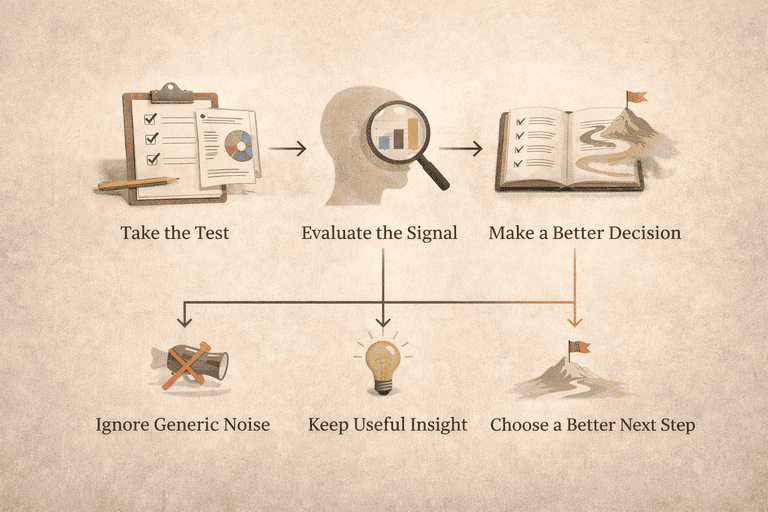
Start with public samples and the available free result. If your uncertainty is about a credential, hiring requirement, or schedule, investigate that directly. Adult career guidance covers training and progression as well as exploring new roles, so another test is only one possible next step.[9]
CareerExplorer is worth inspecting for its matching and exploration experience. Truity is worth inspecting if you want its specific interest-and-personality report. CareerMeasure is worth inspecting if you want to examine our current-role and broader fit interpretations. Choose paid depth only after you can identify what it adds to a decision you are actually making.

References
[1] CareerExplorer. Career Test | The World's Most Powerful Career Test.
[2] Truity. Career Personality Profiler: questionnaire and FAQ.
[3] Truity. TypeFinder for Careers.
[4] CareerMeasure. Homepage.
[5] CareerMeasure. Methodology.
[6] CareerExplorer. Homepage and membership wording. The previous membership URL redirects here.
[7] Judge, T. A., & Zapata, C. P. (2015). The person-situation debate revisited: Effect of situation strength and trait activation on the validity of the Big Five personality traits in predicting job performance. Academy of Management Journal, 58(4), 1149-1179.
[8] Truity. Career Personality Profiler sample report.
[9] OECD (2021). Career Guidance for Adults in a Changing World of Work.
Try The Assessment Yourself
See how CareerMeasure handles your current role, your fit gaps, and your next-step options directly.

Builds CareerMeasure hands on and writes about career fit, role transitions, and the gap between generic personality advice and evidence-based career decisions.
Community Discussion
Share your thoughts about this article
Delete Comment?
Are you sure you want to delete this comment? This action cannot be undone.