

Burned Out and Bored at Work? How To Tell What Problem You Actually Have

Burnout and boredom can look more similar than people expect.
In both cases, work can start feeling flat, heavy, and strangely hard to care about. You may feel detached. Your patience may drop. The week may begin to feel longer than it should. You may stop recognizing yourself in the way you relate to work.
That overlap is exactly why people misdiagnose the problem. They assume low energy means burnout. Or they assume boredom means the work is easy and therefore not serious. Both mistakes can lead to the wrong move.
The better question is not "why am I disengaged?" The better question is: am I exhausted because work is taking too much from me, or deadened because work is asking too little of the parts of me that actually need to be used?
The Short Answer
Burnout is usually an overload problem. Boredom is usually an under-stimulation problem.
Burnout is tied to chronic workplace stress that has not been successfully managed and typically shows up through exhaustion, greater mental distance or cynicism, and reduced professional efficacy.[1] CDC guidance similarly treats burnout as a work-related syndrome rather than a catch-all label for every form of disengagement.[2] Boredom at work is more often linked to underload, low meaning, weak challenge, repetitive or fragmented task structures, and a drop in intrinsically supported motivation.[3] Motivation research points in the same direction when challenge and need satisfaction collapse.[4]
The tricky part is that both can produce low engagement, low energy, and a feeling that something about work has gone dead. That is why the safest approach is to look at the pattern:
- burnout usually says: this is too much
- boredom usually says: this is not enough in the right way
Why People Confuse Them
From the inside, both states can create some version of:
- low energy
- emotional distance
- procrastination
- lower care
- a sense of dragging yourself through the day
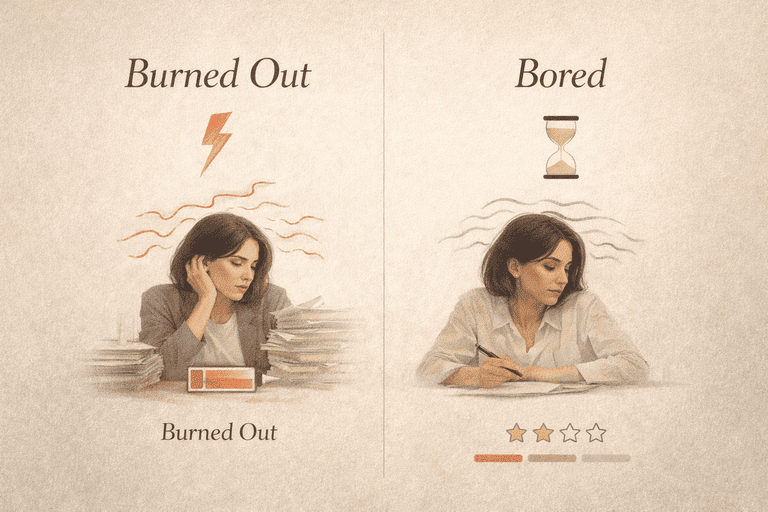
That makes the quick diagnosis tempting.
But the mechanism underneath is different.
Burnout is usually associated with chronic overload, sustained demands, inadequate recovery, and work conditions that keep asking more than the person can keep giving without a cost.[1] CDC guidance is useful here because it keeps the concept tied to work stress rather than vague unhappiness.[2] Boredom is more often associated with insufficient challenge, low autonomy, repetitive or fragmented tasks, and low task meaning.[3] Work-design research reinforces that pattern.[4] Motivation research points in the same direction through unmet needs for challenge, autonomy, and interest.[5]
In plain language:
- burnout often feels like depletion
- boredom often feels like deadness
Those states can overlap, and they can even feed each other, but they are not the same thing.
What Each One Usually Feels Like
Burnout
Burnout is not just ordinary tiredness.
The WHO framing is useful because it keeps the concept narrow: chronic workplace stress, exhaustion, mental distance or cynicism, and reduced professional efficacy.[1] CDC guidance reinforces that burnout is not a catch-all label for every form of distress or disengagement at work.[2]
In lived terms, burnout often feels like:
- everything takes more effort than it should
- you are carrying too much for too long
- recovery no longer catches up
- the work keeps demanding output after your inner system is already depleted
- even things you normally care about feel harder to access
Burnout often carries a sense of strain. There is pressure in it. The work may still matter to you, but you no longer have enough left to meet it cleanly.
That is why people in burnout can still care a lot and perform badly, or care a lot and keep performing only by spending themselves down.
Boredom
Boredom at work is more serious than many people think.
It is not simply "I wish this were more fun." Work-related boredom is associated with low challenge, low meaning, low variety, low autonomy, and weaker quality of work motivation.[3] Work-design research points in the same direction rather than treating boredom as a trivial complaint.[4] The result is not only irritation. It can become emotional flatness, passivity, distraction, and a slow erosion of care.
In lived terms, boredom often feels like:
- your attention has nowhere useful to go
- the work does not ask enough of the parts of you that want to be used
- the day feels longer than it should
- you are present physically but mentally not really there
- you are underused in ways that become strangely exhausting
That last point matters. Boredom can be tiring too. Under-stimulation does not create rest. It often creates its own kind of depletion because you keep having to force life into work that gives you too little back.
This is why boredom gets underestimated. People hear "bored" and imagine low stakes, indulgence, or a minor complaint. But work boredom is often useful evidence that the role is not making enough real use of your attention, strengths, or need for meaningful challenge.
The Fastest Working Distinction
If you want the fastest working distinction, use this:
The keep-and-change exercise for work you do well but dislike helps record a specific task and its conditions before drawing a conclusion from your overall mood.
Burnout
The work is too much.
Too much:
- pressure
- demand
- pace
- exposure
- responsibility
- emotional load
- recovery debt
Boredom
The work is too little in the wrong places.
Too little:
- challenge
- variety
- meaning
- ownership
- stimulation
- skill use
- visible consequence
This is not a perfect rule, but it is a strong first cut.
What Each One Gets Mistaken For
This is where people usually go wrong first.
Burnout often gets mistaken for:
- weakness
- loss of discipline
- proof that the whole career is wrong
- a purely personal problem
Boredom often gets mistaken for:
- laziness
- immaturity
- lack of gratitude
- a trivial issue because the work is "easy"
Those are all weak readings. Burnout is usually a work-stress and capacity problem. Boredom is usually a task-design, underuse, or fit problem. Both deserve a more serious diagnosis than the moralized versions people often default to.
The Five Tests To Run
These are the tests I would actually use before calling the problem one thing or the other.
Test 1: The Weekend Test
What happens when you get a little distance from work?
If you start recovering energy but still feel dead at the thought of returning to the same repetitive, under-stimulating work, boredom may be the bigger issue.
If you remain deeply exhausted, emotionally thin, and unable to recover even with time away, burnout becomes more likely.
This is not perfect, but it helps separate depletion from flatness.
Test 2: The Challenge Test
Ask whether more meaningful challenge would help or hurt.
If the idea of a more engaging project, cleaner ownership, or more interesting work sounds relieving, boredom may be central.
If the idea of one more thing to own sounds intolerable, burnout may be central.
That distinction matters because bored people often want better work. Burned-out people often want less demand.
Test 3: The Pressure Test
What is making the problem worse?
If the main accelerator is:
- constant urgency
- impossible load
- endless interruptions
- emotional exhaustion
- too much responsibility with too little recovery
that points toward burnout.
If the main accelerator is:
- monotony
- low challenge
- low ownership
- repetitive tasks
- meaningless busyness
that points toward boredom.
Test 4: The Care Test
Do you still care under the exhaustion?
Burnout often contains blocked care. The person may still care about the work or outcomes, but the system is too drained to keep showing up cleanly.
Boredom often contains thinned care. The work itself no longer has enough vitality, novelty, meaning, or challenge to hold attention.
That is not absolute, but it is often a revealing difference.
Test 5: The Better-Version Test
What version of change feels relieving?
If relief sounds like:
- fewer demands
- more rest
- lower pressure
- more support
- clearer boundaries
that suggests burnout.
If relief sounds like:
- better problems
- more challenge
- more meaningful work
- more room to use your strengths
- less trivial repetition
that suggests boredom.
There is another useful cue here:
- burned-out people often fantasize about escape from demand
- bored people often fantasize about better work
That difference is not perfect, but it is often revealing.
When Burnout And Boredom Mix Together
This is where many adults actually are.
You can be:
- overloaded by some parts of the work
- under-stimulated by other parts
- emotionally tired and intellectually dead at the same time
For example, someone can be overwhelmed by meetings, reactive communication, and political cleanup while also feeling underused by the actual content of the work. Or they can be drained by people-management load while also bored by the repetitive structure of the role itself.
This mixed state often produces the most confusion because neither label feels complete.
When that happens, the right move is not to force a single word too early. The right move is to ask:
- what is exhausting me?
- what is deadening me?
- what part of the work is too much?
- what part of the work is too little?
That gives you a cleaner diagnosis than calling the whole thing burnout or the whole thing boredom.
It also helps explain sentences like:
- "I want rest, but I also want work that actually wakes me up again."
- "I am exhausted by the structure, but underused by the content."
- "I need less of some things and more of others."
Those are mixed-state sentences. They usually mean the work is both overloading and undernourishing different parts of you at the same time.
What Each Pattern Usually Points To
Burnout Usually Points To
- workload problems
- boundary problems
- management problems
- chronic stress exposure
- unsustainable expectations
- insufficient recovery
That often means the first intervention should be:
- load reduction
- boundaries
- support
- recovery
- environment change
not instant career reinvention.
Boredom Usually Points To
- underuse of strengths
- low challenge
- weak task meaning
- repetitive work design
- low ownership
- poor fit between the role and how you want to work
That often means the first intervention should be:
- role redesign
- more meaningful challenge
- adjacent moves
- better-fit task mix
- stronger autonomy or scope
not only more rest.
The Fastest Practical Question
If you only remember one diagnostic question, use this:
Do I mostly need less demand, or do I mostly need better demand?
If the answer is less demand, burnout is probably central.
If the answer is better demand, boredom is probably central.
If the honest answer is both, you are probably in the mixed case and need to separate the parts of the role that overload you from the parts that underuse you.
How Each One Usually Changes Your Behavior
This is another useful diagnostic layer.
Burnout often changes behavior through collapse:
- more avoidance
- shorter patience
- less emotional range
- slower recovery
- more dread around ordinary demands
Boredom often changes behavior through drift:
- more distraction
- more checking out
- more shallow procrastination
- more craving for novelty outside the work
- less natural investment in the outcome
Those are not perfect categories, but they often help because they show the direction of the problem. Burnout behavior usually looks like a system under too much load. Boredom behavior usually looks like a system no longer getting enough meaningful signal.
Why Boredom Can Feel So Tiring Anyway
People often expect boredom to feel light. At work, it often does not. Having to stay present inside under-stimulating, low-meaning work can create its own kind of fatigue because attention keeps searching for something more alive than the role is giving it.
What People Get Wrong Next
The most common mistake with burnout is treating it like proof that the whole career is wrong.
The most common mistake with boredom is treating it like a minor attitude problem.
Both errors are expensive.
Burnout can make a basically good role feel impossible. Boredom can make a tolerable role slowly empty out your motivation until you no longer recognize why you are still there. Neither should be trivialized.
Another mistake is trying to solve boredom only with recovery. Recovery matters, but if the work keeps underusing you, rest alone will not restore engagement. The reverse is also true: more challenge will not fix burnout if your system is already overloaded.
Another mistake is treating either state as proof that you should immediately blow up the whole career. Sometimes the right answer is a role redesign, a workload change, an adjacent move, or a better environment rather than a full identity reset.
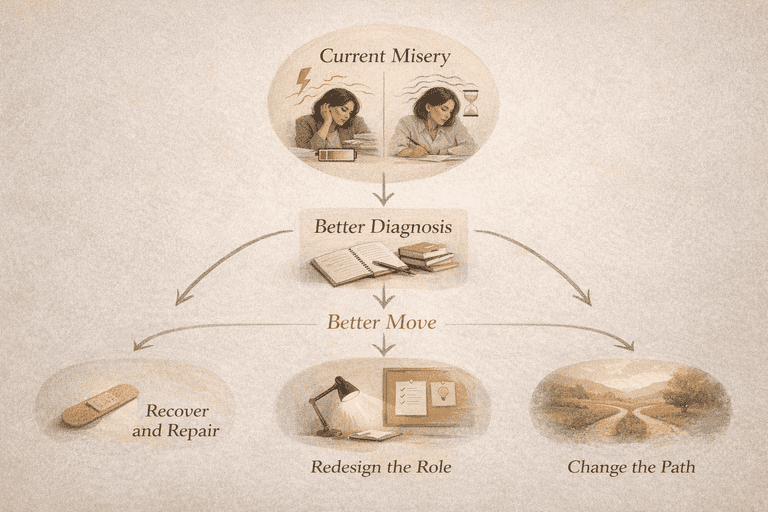
What To Do Before Making A Bigger Move
If you think it is burnout:
When you are ready to examine the scale of a work change, the job-versus-career decision guide separates employer conditions from recurring occupational demands.
- reduce load where you can
- test recovery honestly
- examine whether the work becomes meaningful again when pressure lifts
If you think it is boredom:
- identify which parts of your ability are underused
- test whether better challenge restores energy
- examine adjacent paths or redesigned versions of the role
If you think it is mixed:
- separate the exhausting parts from the deadening parts
- ask which problem is primary
- solve the dominant one first rather than trying to label the whole experience with one word
If you are still unsure, do one more practical test:
- if rest helps a lot but better work still sounds unappealing, burnout may still be primary
- if better work sounds relieving even while you are tired, boredom or underuse may be carrying more of the problem
That is often enough to make the next move clearer.
Final Answer
Burnout and boredom can both create low energy and low engagement, but they usually come from different failures in the work.
Burnout is usually a problem of overload, chronic stress, and depleted capacity. Boredom is usually a problem of under-stimulation, low meaning, and underused capability. The safest distinction is to ask whether the work feels like too much or not enough in the right way.
If you get that diagnosis right, the next move gets much clearer.

References
[1] World Health Organization. Burn-out an occupational phenomenon.
[2] CDC NIOSH. What burnout is and is not.
[3] van Hooff, M. L. M., & van Hooft, E. A. J. (2017). Boredom at work: Towards a dynamic spillover model of need satisfaction, work motivation, and work-related boredom. European Journal of Work and Organizational Psychology, 26(1), 133-148.
[4] Martin, D. R., Winchatz, M. R., Knight, K., & Burrows, L. (2023). Managing workplace boredom: Employee coping strategies, supervisor communication, and job satisfaction. Journal of Leadership & Organizational Studies, 30(3), 314-326.
[5] Hackman, J. R., & Oldham, G. R. (1975). Development of the Job Diagnostic Survey. Journal of Applied Psychology, 60(2), 159-170.
[6] Deci, E. L., Olafsen, A. H., & Ryan, R. M. (2017). Self-determination theory in work organizations: The state of a science. Annual Review of Organizational Psychology and Organizational Behavior, 4, 19-43.
[7] CareerMeasure. Methodology.
[8] Jiang, Z., Newman, A., Le, H., Presbitero, A., & Zheng, C. (2019). Career exploration: A review and future research agenda. Journal of Vocational Behavior, 110, 338-356.
Get A Clearer Career Signal
Take the assessment to see what fits, what feels off, and which roles are more likely to suit you.

Builds CareerMeasure hands on and writes about career fit, role transitions, and the gap between generic personality advice and evidence-based career decisions.
Community Discussion
Share your thoughts about this article
Delete Comment?
Are you sure you want to delete this comment? This action cannot be undone.