

Best Jobs for Former Recruiters:
Adjacent Paths That Reuse What You Already Do Well

Many recruiters who want out of recruiting make the same mistake at the start of the search: they assume the job title explains their whole skill set.
That is usually the wrong frame.
Recruiting compresses a lot of work into one label. It is part relationship-building, part evaluation, part process management, part expectation-setting, part stakeholder diplomacy, and part emotional regulation under pressure. When people burn out on the role, they often reject the whole package at once. But the part they want to leave is usually narrower than that.
Often, the real desire is not "I need a completely different identity." It is: I want to keep the strongest parts of what I built, but stop living inside req pressure, pipeline volatility, and constant outbound demand.
That is a much more practical career problem.
The Short Answer
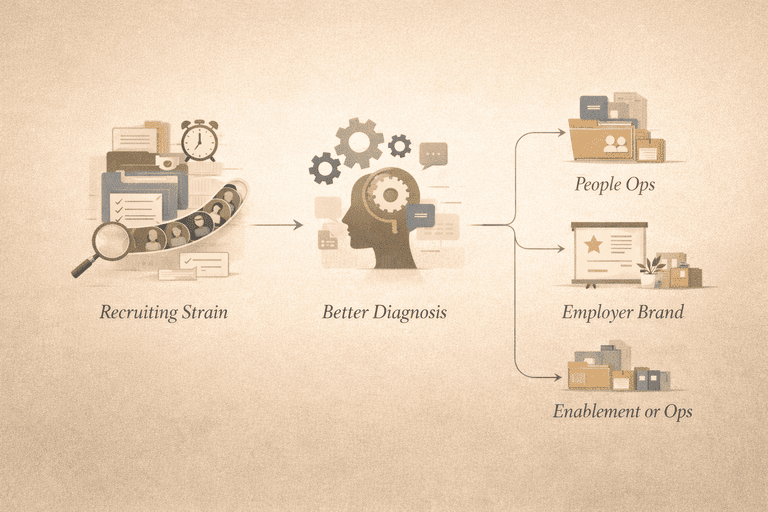
The best jobs for former recruiters are usually not random people-facing jobs. They are adjacent roles that preserve real recruiting strengths while changing the pressure structure around them.
That often includes paths like:
- people operations or talent operations
- employer brand or recruitment marketing
- onboarding, learning, or enablement work
- customer success or account-facing support roles
- program coordination and internal operations
- candidate experience, workforce programs, or employee-support roles
The better question is not only "What can recruiters do next?" It is: which parts of recruiting still fit me, and which parts of the recruiting environment do I most want to stop carrying?
Why Recruiters Often Misread Their Own Value
Recruiters are used to describing themselves through the visible workflow:
- sourcing
- screening
- managing candidates
- coordinating interviews
- closing offers
Those are real parts of the work. They are not the whole value.
Recruiting also builds a less obvious set of strengths:
- evaluating signal under incomplete information
- building trust quickly
- managing emotionally loaded conversations
- aligning competing stakeholders
- keeping a process moving under pressure
- spotting friction in systems and handoffs
- calibrating expectations before things break

That is why adjacent transitions can make much more sense than people first assume. The move often works not because another job is vaguely "about people," but because the underlying work patterns are closer than the titles suggest. Employability and transition research keeps returning to this same point: successful moves depend partly on how well people reinterpret existing capabilities and apply them in adjacent contexts, not only on whether they start over entirely.[1]
First Separate What You Want To Keep From What You Want To Leave
This is the most important step in the whole article.
Many recruiters are not trying to leave all of the following:
- fast judgment
- communication
- relationship management
- process orchestration
- talent or people insight
They are trying to leave more specific things:
- constant req volume
- high-pressure hiring targets
- outbound sourcing load
- unstable hiring swings
- emotionally repetitive rejection cycles
- the feeling of being accountable without enough control
Different adjacent paths solve different versions of that problem.
If you skip this step, every role with "people" in the description can start looking attractive even though the day-to-day fit may still be wrong.
What Recruiting Usually Trains Better Than People Notice
Recruiting is one of those jobs where outsiders often flatten the work and insiders often normalize its complexity.
Good recruiters are usually not only persuasive. They are usually good at:
- hearing what a manager is actually asking for, not only what they say
- spotting pattern mismatch early
- running structured processes with many moving parts
- staying calm around uncertainty and emotion
- keeping communication clear while multiple parties want different outcomes
- building enough trust that people tell the truth faster
Those are durable strengths.
That is one reason adjacent paths usually emerge from work-pattern overlap rather than title similarity. O*NET's occupational framework reflects the same basic logic: related roles often connect through shared work activities, skills, and demands rather than through public labels alone.[2]
Once you think at that level, the next-move map gets cleaner.
What Recruiters Often Misdiagnose About Themselves
This is where the search usually goes off track.
#### “I Only Know How To Recruit”
This is rarely true.
What is usually true is that the recruiter has spent years using their strengths inside one commercial and organizational format. Once that format gets old, the person starts mistaking familiarity for identity.
They say:
- I only know hiring
- I only know candidate conversations
- I only know agency or in-house recruiting
But what they often actually know is:
- how to assess signal quickly
- how to move people through uncertainty
- how to keep stakeholders aligned
- how to run a process under pressure
- how to translate messy needs into workable decisions
That distinction matters because the first framing collapses the search. The second opens it up.
#### “If I Leave Recruiting, I Have To Leave People Work”
Some recruiters absolutely do want much less people intensity. Others only want less of one kind of people intensity.
That is a critical difference.
A recruiter may be tired of:
- repetitive screening conversations
- managing candidate disappointment
- hiring-manager volatility
- pressure to create urgency on demand
without being tired of:
- trust-building
- expectation-setting
- guided decision-making
- structured support conversations
If you confuse those two, you can overcorrect into a role that removes the wrong thing.
#### “Any Internal Role Will Feel Better”
Not necessarily.
Some internal roles simply redistribute the same pressure pattern:
- high responsiveness demands
- low control with high accountability
- emotionally repetitive conversations
- constant handoff friction
That is why the target role has to be judged by daily work structure, not only by whether it sounds less exposed than recruiting.
Six Adjacent Paths That Often Make Sense
These are not the only options. They are the paths that most often make practical sense because they preserve something real.
For client-facing options, the customer-success alternatives guide helps you inspect relationship work alongside caseloads, escalation, and commercial responsibilities.
1. People Operations Or Talent Operations
This is often the strongest adjacent move for recruiters who still like the people-and-process side of work but want less pipeline pressure.
What transfers well:
- stakeholder communication
- documentation discipline
- workflow coordination
- issue triage
- policy/process interpretation
- keeping multi-step systems moving
What changes:
- less direct candidate selling
- less sourcing pressure
- more internal systems ownership
- more operational and employee-lifecycle work
This path fits best when you liked the organizational and process side of recruiting more than the chase itself.
2. Employer Brand Or Recruitment Marketing
Some recruiters are strongest not in full-cycle execution, but in messaging, positioning, and shaping how an organization is understood externally.
What transfers well:
- audience insight
- messaging clarity
- talent-market pattern recognition
- candidate communication
- knowing what actually resonates
What changes:
- less interview coordination
- less requisition management
- more content, campaign, and positioning work
- often more cross-functional collaboration with marketing or people teams
This path fits best when you cared a lot about how roles, teams, and companies were presented and understood.
3. Candidate Experience, Workforce Programs, Or Employee Support Work
Some recruiters discover that the strongest part of their fit was never the hiring target. It was helping people move through uncertainty with more clarity and less friction.
That can translate into paths like:
- candidate experience
- workforce development programs
- internal mobility support
- early-career or university program coordination
- employee-support functions adjacent to HR
What transfers well:
- relationship management
- expectation-setting
- communication under uncertainty
- progress updates and follow-through
- helping people navigate complex processes
This path fits best when you still want human-facing work, but want it organized around support rather than constant requisition pressure.
4. Onboarding, Training, Or Enablement
Some recruiters are especially strong at helping people ramp, understand expectations, and become effective faster.
That can make onboarding, enablement, or training-adjacent roles more natural than they first appear.
What transfers well:
- clarifying process
- guiding people through ambiguity
- communication structure
- facilitation
- helping people move from uncertainty to confidence
What changes:
- less candidate pipeline volatility
- more learning and process-design work
- more internal-facing rhythm
- less reliance on constant external outreach
This path fits best when you liked the educational and expectation-setting side of recruiting more than the sourcing and closing side.
5. Customer Success Or Account-Facing Support
This is not the right move for every recruiter, but it can work surprisingly well for some.
It usually fits when the recruiter's strongest strengths were:
- discovery conversations
- relationship-building
- expectation-setting
- following through across multiple stakeholders
- reading unspoken friction early
What changes:
- the context becomes customer-facing instead of candidate-facing
- the work often shifts toward adoption, continuity, or retention rather than placement
- success is measured differently, even if relationship intensity remains
This path is strongest when you still like people-facing problem-solving, but do not want the same recruiting structure around it.
6. Program Coordination, Operations, Or Implementation Work
Some recruiters eventually realize the part they were actually best at was not talent evaluation alone. It was making a messy multi-party process move cleanly.
That can point toward:
- program coordination
- people-program operations
- implementation support
- internal project or workflow roles
- operations-heavy work with many handoffs
What transfers well:
- process ownership
- deadline management
- communication across functions
- issue spotting
- keeping work moving without ideal conditions
This path fits best when you want less interpersonal persuasion load and more structured execution.
Common Traps In The Exit Search
This is where people make avoidable mistakes.
“Anything In HR”
HR is not one thing.
Some recruiters imagine they can simply move into "HR" as a clean umbrella answer. In practice, HR can mean employee relations, compensation, benefits, generalist work, operations, compliance, people programs, or organizational development.
Some of those paths fit recruiting backgrounds well. Others require a different appetite for policy, conflict, or administrative depth than recruiters expect.
Another High-Pressure People Role With A Different Label
Sometimes the new role sounds different but reproduces the same structure:
- relentless outreach
- high emotional management
- target pressure
- low control with high accountability
If the pressure pattern is what broke fit in recruiting, changing the title alone will not help much.
Roles Chosen Only Because They Seem Easy To Explain
This is another trap.
People often default to the move that sounds easiest on paper instead of the move that most directly solves the fit problem. That can keep the transition socially legible while preserving the wrong work pattern underneath it.
How To Choose And Validate The Right Path
If you are a recruiter leaving recruiting, do not stop at title-level appeal.
Pressure-test the next role against the real problem.
Look At Where The Pressure Lives
Ask:
- is the work still target-heavy?
- is the pressure still built around constant responsiveness?
- is success still highly dependent on other people doing what they said they would do?
- is the role still emotionally repetitive in the same way?
The title matters less than the pressure pattern.
Look At What Kind Of Judgment The Role Actually Rewards
Some adjacent roles reward:
- people judgment
- process judgment
- communication judgment
- systems judgment
That is usually a good sign for former recruiters.
Other roles mainly reward technical depth or domain expertise you may not actually want to build. Those can still be possible moves, but they are less naturally adjacent.
Look At Whether The Role Preserves Continuity You Can Explain
The best adjacent move is usually one where you can tell a clean story:
- what recruiting proved
- what part of the work you want more or less of
- why the new path is a more fitting use of the same strengths
If that through-line is hard to articulate, the move may still be right, but it deserves more validation first.
Use These Fit Filters
At this point, the best question is not which title sounds safest. It is which part of recruiting still feels like yours.
Use these filters.
#### If You Still Like People Conversations, Look Harder At Support-Oriented Or Account-Facing Paths
That can include:
- candidate experience
- employee support
- onboarding
- customer success
These paths preserve more of the relational work while changing the environment.
#### If You Like Process More Than Outreach, Look Harder At Operations Paths
That can include:
- talent operations
- people operations
- program coordination
- implementation support
These paths fit better when the strongest part of your work was getting systems to function cleanly.
#### If You Like Messaging And Positioning More Than Pipeline Management, Look Harder At Employer Brand
This fits best when you were always especially tuned to:
- how roles were framed
- what attracted the right candidates
- how to tell a clearer market story
#### If You Like Helping People Ramp More Than Convincing Them To Enter, Look Harder At Enablement
This is often the right move when you enjoyed clarification, readiness, and confidence-building more than the chase itself.
What A Strong Exit Usually Looks Like
A strong recruiter-to-adjacent move usually has three characteristics.
#### It Preserves A Real Strength
The move should preserve something more specific than "I am good with people."
It should preserve something like:
- fast judgment
- process orchestration
- stakeholder management
- expectation-setting
- communication under uncertainty
#### It Removes The Part That Was Making Recruiting Hard To Sustain
That might mean:
- less sourcing load
- less req volatility
- less pipeline pressure
- less emotional repetition
- less constant external chasing
#### It Is Easy Enough To Explain
The best adjacent moves have a visible through-line.
For example:
- I want to keep the process and people-judgment side of recruiting, but move away from requisition pressure into talent operations.
- I want to preserve the communication and audience insight side of the work, but move toward employer brand and messaging rather than full-cycle recruiting.
- I want to keep helping people move through complex transitions, but in onboarding or employee-support work rather than candidate pipelines.
That kind of explanation makes the move much more believable.
How To Explain The Move So It Sounds Coherent
Recruiters often undersell themselves here by making the story too emotional or too generic.
Use the guide to explaining a career change to connect the recruiting evidence you want to keep with the problem the new employer needs solved.
Weak version:
- I just wanted something different
- I was burned out on recruiting
- I wanted to get out of talent
Stronger version:
- Recruiting taught me fast judgment, stakeholder management, and the ability to move complex people processes forward under pressure. Over time I realized the part of the work I want more of is the systems and coordination side, not the constant requisition cycle. That is why talent operations is a stronger next fit for me.
Or:
- My background in recruiting built strong communication, messaging, and market-read skills. I found myself increasingly drawn to how roles and teams were positioned rather than only running full-cycle searches, which is why employer brand is a more natural next step.
That is the level of story you want. It shows continuity, diagnosis, and direction instead of vague escape.
Final Answer
The best jobs for former recruiters are usually adjacent paths that preserve real recruiting strengths while changing the pressure structure around them.
The strongest move is not the one with the fanciest new title. It is the one that keeps the right parts of your background, removes the parts that were breaking fit, and gives you a transition story that still makes sense.
Once you frame the problem that way, the search gets much clearer. You are no longer asking what random job a recruiter could theoretically do. You are asking which next role makes the smartest use of the judgment, communication, and systems ability you already built.

References
[1] De Vos, A., et al. Career transitions and employability. Journal of Vocational Behavior, 2021.
[2] O*NET OnLine. Advanced Search.
[3] O*NET OnLine. Summary Report and Occupation Structure Resources.
[4] Fugate, M., Kinicki, A. J., & Ashforth, B. E. (2004). Employability: A psycho-social construct, its dimensions, and applications. Journal of Vocational Behavior, 65(1), 14-38.
[5] OECD. Career Guidance for Adults in a Changing World of Work.
[6] Savickas, M. L., & Porfeli, E. J. (2012). Career Adapt-Abilities Scale: Construction, reliability, and measurement equivalence across 13 countries. Journal of Vocational Behavior, 80(3), 661-673.
[7] Society for Human Resource Management. Talent Acquisition Specialist Job Description.
[8] CareerMeasure. Methodology.
See Your Stronger-Fit Next Moves
Get a clearer picture of which adjacent paths fit you better before making a bigger jump.

Builds CareerMeasure hands on and writes about career fit, role transitions, and the gap between generic personality advice and evidence-based career decisions.
Community Discussion
Share your thoughts about this article
Delete Comment?
Are you sure you want to delete this comment? This action cannot be undone.