

Alternatives to Customer Success:
Adjacent Roles With Similar Strengths

Many people in customer success do not actually want out of helping customers, solving problems, or building trust.
They want out of the part of customer success that keeps swallowing the rest of the job.
Usually that means some combination of:
- renewal pressure
- escalations
- constant relationship maintenance
- low-control accountability
- being the absorber of cross-functional friction
- carrying emotional continuity for customers and internal teams at the same time
That is why "What are good alternatives to customer success?" is a better question than "What should I do if I want to leave customer success?" The second question is too blunt. The first creates room for a more useful diagnosis: what part of customer success still fits me, and what part of the role do I most want to stop living inside?
The Short Answer
If you want out of classic customer-success pressure but still want to use customer-success-built strengths, the strongest adjacent paths usually preserve some mix of relationship judgment, expectation-setting, problem-solving, onboarding logic, communication, and cross-functional coordination while changing how the work is measured.
That often includes roles in:
- account management
- onboarding or implementation
- customer education or enablement
- partnerships
- support-adjacent operations or program work
- product, service, or operations roles that still use customer insight
Those roles are not all easier, and they are not all the same. But they often change the part of the work that feels most wearing while preserving the parts of customer success that still fit.
Why People In Customer Success Often Misread The Problem
Customer success compresses many things into one title:
- relationship management
- expectation-setting
- problem triage
- renewal or expansion influence
- onboarding continuity
- internal escalation handling
- adoption coaching
- translation between customer reality and internal teams
When people burn out, they often reject the whole package at once.
That is understandable, but not always accurate. A person may dislike being held emotionally responsible for every customer issue, while still liking consultative conversations. Another may dislike renewal pressure, while still liking long-term problem-solving. Another may dislike the endless smoothing and follow-up but still fit onboarding, implementation, enablement, or account work much better than a total reset.
That is why leaving customer success gets fuzzy. The title hides a mix of work that has to be separated before the next move becomes clear.
First Decide What You Want Less Of
This matters more than the title search.
If renewals or expansion targets are the main problem, the sales alternatives comparison gives questions to ask about who owns revenue in each target role.
Common patterns include wanting less:
- renewal pressure
- constant escalation handling
- emotionally repetitive customer management
- dependency on other teams without enough control
- reactive firefighting
- being measured through churn risk or account health you can only partly influence
Different adjacent roles solve different versions of that problem.
If you skip this step, every customer-adjacent role starts to look promising even though the lived experience can still be very different.
What Customer Success Usually Trains Better Than People Notice
People outside the field often flatten customer success into "account management with a friendlier name." People inside it often understate how much structured judgment the work actually requires.
Good CS professionals usually build strength in:
- discovery through ongoing relationship context
- expectation-setting under uncertainty
- identifying friction before it becomes a crisis
- translating between customer language and internal systems
- protecting trust while moving difficult conversations forward
- coordinating across product, support, sales, and operations
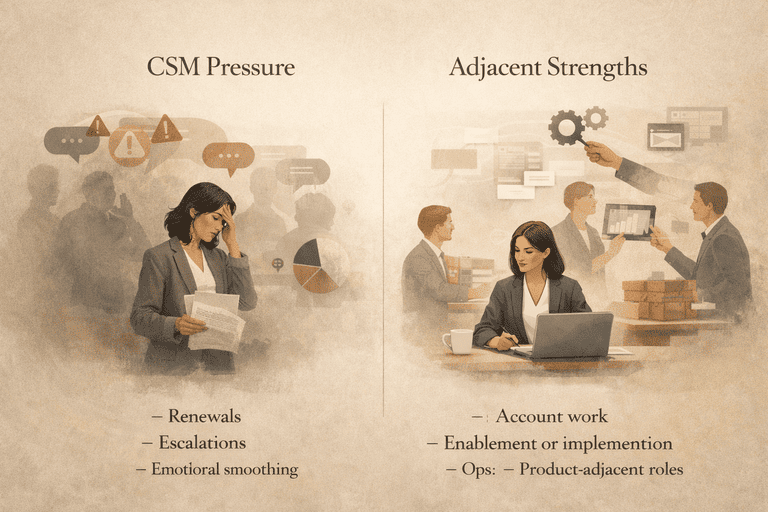
Those are durable strengths.
That is one reason adjacent paths often make more sense than people first assume. The move usually works not because another role is vaguely "customer-facing," but because the underlying work pattern is close enough to carry real continuity. Career-transition and employability research reflects the same principle: people move better when they reinterpret existing capability into adjacent use rather than pretending they have to start over from zero.[1]
Six Adjacent Paths That Often Make Sense
These are not the only options. They are the paths that most often make practical sense because they preserve something real from customer success.
1. Account Management
This is often the strongest adjacent move for people who still like customer relationships but want the role to sit in a clearer commercial structure.
What transfers well:
- relationship continuity
- expectation-setting
- stakeholder communication
- customer context
- problem-solving tied to a live account
What changes:
- the role often becomes more explicitly commercial
- ownership may feel clearer
- success may be tied more directly to account growth or retention rather than diffuse customer health
- some roles reduce emotional maintenance, while others do not
This path fits best when you still like client continuity but want the work to feel more defined and less like open-ended emotional ownership.
2. Onboarding Or Implementation
Some people in customer success are strongest at the early-stage transition from decision to usable reality.
What transfers well:
- clarifying next steps
- guiding customers through uncertainty
- translating requirements
- coordinating handoffs
- helping people move toward confidence and adoption
What changes:
- less long-tail relationship maintenance
- more project-like momentum
- more concrete deliverables
- less ongoing renewal shadow, depending on the company
This path fits best when you liked helping customers get started and become functional more than carrying the account indefinitely.
3. Customer Education Or Enablement
Some people in CS realize they do not want less of the customer problem. They want a different way of helping solve it.
What transfers well:
- teaching through explanation
- reducing confusion
- structuring learning
- helping users gain confidence
- seeing repeated friction patterns
What changes:
- less direct account ownership
- more one-to-many or structured learning work
- more content, training, or enablement design
- less dependence on being the single emotional contact point
This path fits best when your strongest contribution was helping customers understand and succeed, not only managing the relationship container around that work.
4. Partnerships
Partnerships can be a strong fit for people who still like external relationships, but want the work to feel more strategic and less support-driven.
What transfers well:
- trust-building
- expectation-setting
- long-horizon relationship management
- navigating ambiguity across organizations
What changes:
- more strategic alignment work
- less daily support rhythm
- more ambiguity, but often less repetitive escalations
- different success measures than account health or adoption
This path fits best when you still like external-facing work, but want less of the maintenance-heavy feel of classic CS.
5. Support-Adjacent Operations Or Program Work
Some CS professionals discover the part they were really best at was not only the relationship itself. It was keeping a complex service system moving.
That can point toward:
- customer operations
- support operations
- implementation operations
- internal program coordination
- service-delivery operations
What transfers well:
- issue triage
- handoff management
- pattern recognition across repeated friction
- communication across functions
- keeping workflows moving under pressure
What changes:
- less direct customer emotional load
- more systems and process work
- more internal ownership
- less dependence on being "the face" of continuity
This path fits best when you want less customer-facing maintenance and more structured execution.
6. Product, Service, Or Operations Roles That Use Customer Insight
Some people in customer success are strongest not in maintaining accounts but in seeing where the experience breaks.
That can point toward product-adjacent, service-design-adjacent, or operations roles when the person consistently notices:
- repeated friction patterns
- confusing workflows
- gaps between customer expectation and product reality
- where adoption fails because the system is poorly designed
What transfers well:
- close contact with customer reality
- interpreting practical friction
- translating user pain into clearer internal action
- spotting recurring breakdowns
What changes:
- less pure relationship stewardship
- more systems or product context
- more emphasis on improving the machine rather than carrying the account
This path fits best when you still care deeply about the customer problem, but no longer want to be the person holding the whole relationship together by hand.
Common Traps In The Exit Search
This is where people lose time.
Another Customer-Facing Role With The Same Maintenance Load
Sometimes the next title sounds different but reproduces the same structure:
- constant responsiveness
- low control with high accountability
- emotionally repetitive conversations
- dependency on other teams
If that pressure pattern is what broke fit in CS, changing the title alone will not help much.
Roles Chosen Only Because They Sound Less “Support-Like”
This is another trap.
People sometimes choose a title because it sounds more strategic, more commercial, or more respected. But if the daily work still requires them to absorb escalation, smooth relationships, and manage problems they do not control, the fit problem can survive the rebrand.
“Anything Customer-Adjacent”
Not all customer-adjacent roles feel similar.
Implementation can be much more project-like than CSM work. Enablement can be much more structured. Partnerships can be more ambiguous but less repetitive. Account management can be either a cleaner commercial fit or a near-cousin of the same problem, depending on the company.
The title alone does not tell you enough.
What People In Customer Success Often Misdiagnose About Themselves
This is where the search usually goes off track.
#### “I Only Know How To Manage Accounts”
This is rarely the whole truth.
What is usually true is that the person has spent years using deeper strengths inside one service-and-retention structure. Once that structure stops fitting, they start mistaking familiarity for identity.
They say:
- I only know renewals
- I only know adoption work
- I only know customer calls
But what they often actually know is:
- how to build trust under uncertainty
- how to spot risk early
- how to keep multiple stakeholders aligned
- how to turn confusion into forward motion
- how to identify where systems and expectations are breaking
That is a much stronger basis for an adjacent move than they usually think.
#### “If I Leave Customer Success, I Need To Leave Customer Work Entirely”
Not necessarily.
Some people in CS do want much less customer contact. Others only want less of one type of customer contact. That is a critical distinction.
A person may be tired of:
- escalation handling
- emotional maintenance
- being on the hook for everything
without being tired of:
- consultative problem-solving
- onboarding
- teaching
- trust-building
If you confuse those two, you can overcorrect into a role that removes the wrong thing.
Why People In Customer Success Often Stay Too Long
Customer success can keep people longer than they should because the work always offers a plausible story about why the next quarter might finally feel more stable:
- a healthier book of business
- a better customer segment
- a stronger product release
- a cleaner handoff from sales
- a better manager
Sometimes that story is right. Sometimes it only delays the diagnosis.
If the same friction keeps repeating across books of business, managers, or companies, the problem is less likely to be one temporary setup and more likely to be the work pattern itself.
How To Choose And Validate The Right Path
Once you have two or three likely path families, stop relying on title appeal and start reading real postings closely.
Look for repeated signals in:
- whether the role still carries renewal or expansion pressure
- how much direct customer responsiveness is required
- whether the work is more relationship maintenance, project movement, teaching, or systems ownership
- how much cross-functional dependency the role carries
- whether the role is judged by account health, delivery milestones, adoption, process integrity, or operational efficiency
This matters because titles like:
- account manager
- implementation manager
- customer operations lead
- enablement manager
- partnerships manager
can describe very different daily lives across different companies.
The title is not enough. The task mix tells the truth.
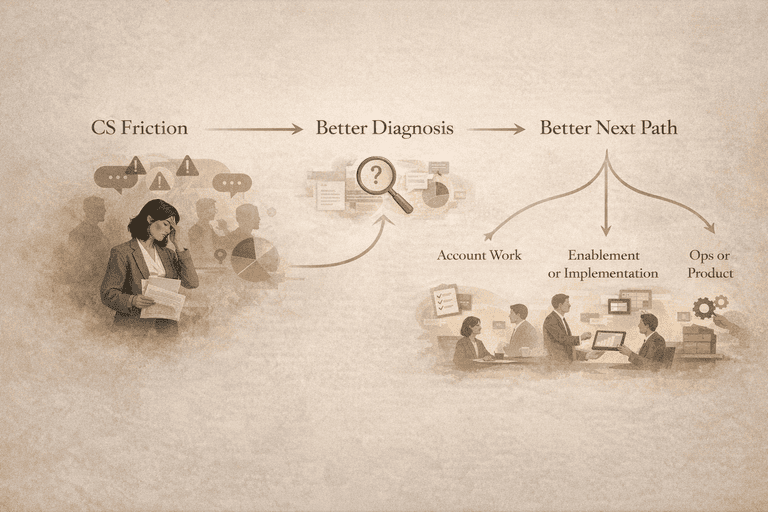
Use These Fit Filters
At this point, the best question is not which title sounds safest. It is which part of customer success still feels like yours.
Use these filters.
#### If You Still Like Customer Conversations, Look Harder At Account Management, Partnerships, or Onboarding
These paths preserve more external-facing work while changing the structure around it.
#### If You Like Helping People Understand More Than Maintaining Accounts, Look Harder At Enablement
This usually fits when your strongest contribution was teaching, clarifying, and building confidence rather than ongoing relationship maintenance.
#### If You Like Fixing The Machine More Than Carrying The Relationship, Look Harder At Ops or Product-Adjacent Roles
This usually fits when you were constantly noticing process failures, handoff breakdowns, or design problems and wanted more leverage over them.
What A Strong Customer Success Exit Usually Preserves
The best adjacent move usually preserves at least one of these:
- trust-building
- expectation-setting
- practical problem-solving
- cross-functional coordination
- customer insight grounded in real friction
If the next role uses almost none of that, the move may still be right, but it is no longer a simple adjacent transition. It becomes a larger reset with a different risk profile.
How To Pressure-Test The Next Role Before You Move
Do not stop at title appeal.
Pressure-test the role against the actual problem.
Ask:
- does the role still depend on constant responsiveness?
- does it preserve the customer-facing strengths I still value?
- does it remove the part of the work that was emotionally or operationally corrosive?
- does it give me more control, more structure, or more clarity than classic CS did?
This matters because adjacent roles can still hide the same pattern under more attractive language.
How To Explain The Move So It Sounds Coherent
People in customer success often undersell themselves here by making the move sound too emotional or too generic.
Build your explanation from the transferable-skills worksheet: connect a customer task to the target task, then state the remaining gap honestly.
Weak version:
- I am burned out on customer success
- I want something less reactive
- I need to get out of CS
Stronger version:
- Customer success taught me strong skills in trust-building, expectation-setting, and translating customer friction into action. Over time I realized the part of the work I want more of is helping customers get to clarity and momentum, not carrying long-tail account maintenance and renewal pressure. That is why onboarding and implementation feel like a stronger next fit.
Or:
- My background in customer success built a lot of practical judgment around where the customer experience breaks and how cross-functional friction affects outcomes. I found I wanted more leverage over those systems and less open-ended relationship ownership, which is why customer operations is a stronger next move.
That kind of explanation preserves continuity while making the move sound deliberate.
Final Answer
The best alternatives to customer success are usually adjacent roles that preserve real customer-success strengths while changing the pressure structure around them.
Once you separate what customer success trained you to do from the exact shape of CSM-style account ownership, the options get much clearer. You are no longer asking what random role might accept a former CSM. You are asking where trust-building, expectation-setting, customer insight, and cross-functional judgment can be used in a way that fits you better now.

References
[1] De Vos, A., et al. Career transitions and employability. Journal of Vocational Behavior, 2021.
[2] O*NET OnLine. Advanced Search.
[3] O*NET OnLine. Summary Report and Occupation Structure Resources.
[4] Fugate, M., Kinicki, A. J., & Ashforth, B. E. (2004). Employability: A psycho-social construct, its dimensions, and applications. Journal of Vocational Behavior, 65(1), 14-38.
[5] OECD. Career Guidance for Adults in a Changing World of Work.
[6] Savickas, M. L., & Porfeli, E. J. (2012). Career Adapt-Abilities Scale: Construction, reliability, and measurement equivalence across 13 countries. Journal of Vocational Behavior, 80(3), 661-673.
[7] U.S. Bureau of Labor Statistics. Customer Service Representatives.
[8] CareerMeasure. Methodology.
See Your Stronger-Fit Next Moves
Get a clearer picture of which adjacent paths fit you better before making a bigger jump.

Builds CareerMeasure hands on and writes about career fit, role transitions, and the gap between generic personality advice and evidence-based career decisions.
Community Discussion
Share your thoughts about this article
Delete Comment?
Are you sure you want to delete this comment? This action cannot be undone.