

16Personalities Career Matches:
What They Get Right and Wrong
16Personalities is one of the most recognizable personality tools on the internet. That visibility gives its career advice more influence than it deserves if people do not read it carefully.
The problem is not that the site is useless. The problem is that many users take a vivid personality framework, a familiar four-letter code, and a polished set of career suggestions, then quietly upgrade all of that into something like a career-fit diagnosis.
That is too much weight for the tool.
So the useful review question is not whether 16Personalities is insightful. It often is. The better question is: what kind of career help does it actually provide, and where does personality-based career matching stop being enough?
The Short Answer
16Personalities career matches are often helpful for broad self-reflection, but they are much weaker for real career decisions.
The company is clear that its framework is not simply Myers-Briggs copied verbatim. In its own explanation, 16Personalities says it uses a five-factor, trait-based model it calls NERIS while keeping the familiar type-code format because people find it easier to understand and use.[1] That is a real improvement over older type systems that lean harder on Jungian language without much measurement clarity.
But the career advice still works mainly at the level of personality-informed plausibility, not full career-fit analysis. The site’s career pages and premium career materials can help users reflect on broad work style preferences, motivating environments, and role families that may feel attractive.[2] The premium materials extend that reflective pattern rather than turning it into a real transition-planning system.[3] What they do not do well is diagnose current-role friction, measure interests and transition distance directly, or tell an adult which next move is realistic from where they already are.
So the right verdict is: good reflection tool, limited decision tool.
What 16Personalities Is Actually Doing
One reason people misread 16Personalities is that they assume it is either just MBTI or fully modern personality science. The reality is more mixed.
16Personalities explicitly says its model combines the convenience of type labels with a trait-based structure influenced by the Big Five.[1] That matters because it means the site is not claiming that cognitive functions are directly measured in the traditional Jungian sense. It is trying to translate trait patterns into a type format people can remember and use.
That is a smart product decision. It makes the framework more legible for ordinary users.
It also creates the central limitation of the system.
Type language is vivid, memorable, and emotionally sticky. It is excellent for helping people say things like:
- "that sounds like me"
- "this explains why certain environments drain me"
- "I can see why I keep preferring this kind of work"
But vivid language is not the same thing as decision precision.
Once a system turns continuous trait patterns into a type identity, it becomes easier for users to overread the result as a durable career conclusion rather than a simplified interpretive lens. Even 16Personalities itself notes that its profiles describe tendencies, not definitive rules or complete answers.[1]
That distinction is easy to agree with intellectually and easy to ignore emotionally.
What It Gets Right
This is the part critics often flatten too much.
1. It Gives People A More Legible Starting Point Than Generic Career Confusion
For many users, 16Personalities is the first tool that gives them language for broad work style patterns.
Its career pages often frame work in terms people actually recognize:
- independence versus collaboration
- structure versus flexibility
- people intensity versus solitude
- ideals versus practicality
- routine versus novelty
That has value. Many adults are not starting with a clean vocabulary for how they relate to work. A system that helps someone articulate, "I like autonomy but not isolation," or "I want meaningful work but not constant emotional labor," can be useful even if it is not a full assessment.
2. The Site Is Clearer Than Many Personality Products About Its Own Framework
This is another real strength.
The 16Personalities framework page is more transparent than the average personality site. It explains the broad model, acknowledges the influence of prior typology traditions, and explicitly argues that it uses trait dimensions rather than Jungian cognitive functions as direct measurement targets.[1]
That does not make the career output fully rigorous. It does make the product more inspectable than many sites that simply inherit MBTI-style language and wrap it in vague science branding.
3. Its Career Advice Often Gets The Mood Of A Type Right
This is one reason the product feels compelling.
If you read 16Personalities career pages for different types, the advice often captures something real about the emotional texture of work preferences. For example, the site’s type-specific career pages often emphasize that some types are energized by guiding people, some by structure, some by independence, and some by novelty or improvisation.[2]
That can feel accurate because personality does relate to broad behavioral tendencies and environments people prefer. The overlap between personality traits and vocational interests is real, even if it is far from perfect.[4]
4. It Is Better For Reflection Than Old Rigid Type Advice
There is a meaningful difference between:
- "your four-letter code determines your perfect career"
and:
- "your personality pattern may help explain which kinds of environments and roles feel more natural to you"
16Personalities usually lands closer to the second. That matters. It makes the best use of the tool more reflective and exploratory than prescriptive.
Why The Career Matches Feel So Convincing
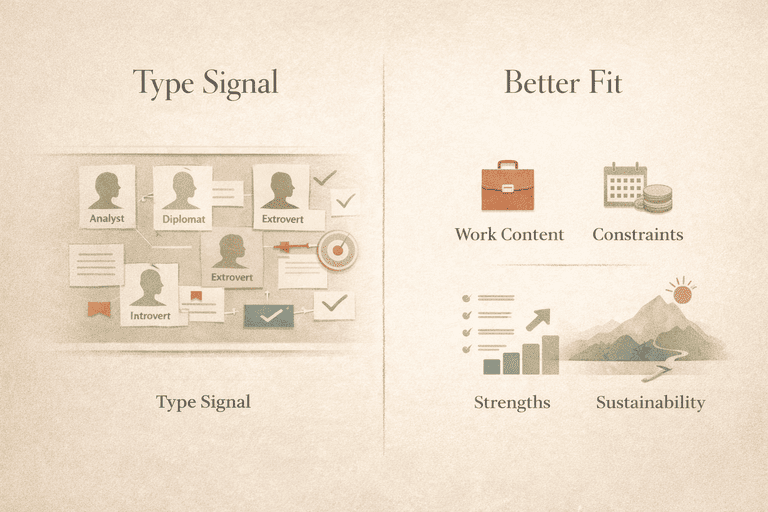
The product works partly because it combines three things that humans find persuasive:
- a memorable identity label
- emotionally recognizable description
- concrete occupational suggestions
That combination creates a strong feeling of closure.
Once a user sees a type description that feels personal and then sees matching careers underneath it, the result can feel more precise than it really is. It feels less like "a broad pattern of tendencies" and more like "the system understands what work I should do."
This is where type-based products gain force and where they become risky.
People are not only reacting to evidence. They are reacting to coherence. A model that tells a neat story about who you are and what careers fit that story is naturally attractive, especially when you already feel uncertain.
That is why accuracy has to be judged more carefully than emotional resonance.
It also helps explain why type-based career content spreads so well online. It is easy to share, easy to remember, and easy to discuss socially. "I am this type, so these careers fit me" is much more portable than a messier statement like "my interests, constraints, experience, and environment needs point toward these adjacent options if I weight them correctly."
The cleaner sentence wins socially. That does not make it the stronger career method.
Where It Gets Career Advice Wrong
This is the part most adults actually need.
The personality-versus-career-fit guide explains why a recognizable description still leaves questions about tasks, conditions, and qualifications unanswered.
1. Personality Is Not The Same Thing As Career Fit
Personality matters. It is not irrelevant. But career fit is larger than personality.
Adult career decisions also depend on:
- interests
- skills
- motivation patterns
- work constraints
- life stage
- current-role friction
- transition distance
- labor-market realism
That is one reason vocational interests remain so important in career research. Interests predict meaningful educational, work, and life outcomes over and above cognitive ability and Big Five personality traits in some settings.[5] So a personality-based career page can be directionally useful while still missing a major part of the actual decision.
2. Type Buckets Are Too Coarse For Harder Career Choices
This is one of the oldest problems with type-based advice.
Continuous traits get converted into categories, and categories are easier to talk about but worse at preserving nuance. Two people with the same type code can still differ meaningfully in the strength of their traits, their interests, their tolerance for different environments, and the practical options available to them.
This is one reason critics have long been skeptical of treating type systems like high-confidence decision tools. Research-based concerns around MBTI-style type interpretation have repeatedly focused on dichotomization, instability around cut scores, and overstating what the categories can support in practice.[6] The same critique keeps resurfacing because the practical career claims often exceed what those categories can really support.[7]
16Personalities is not identical to the MBTI. But once it converts trait patterns into type identities and then into career suggestions, some of the same interpretive risks return.
3. It Does Not Diagnose Your Current Problem
This matters more for adults than for students.
If your real question is:
- am I in the wrong career?
- is my job bad, or is the career wrong?
- am I burned out, bored, underused, or misaligned?
- how big does my next move actually need to be?
16Personalities career matches do not really answer that.
They can sometimes illuminate why certain environments feel draining. That is useful. But they do not separate personality discomfort from manager problems, role design problems, identity drift, overuse of strengths, or life-stage exhaustion.
4. It Can Make Unrealistic Paths Sound More Coherent Than They Are
Because the advice is organized around type themes, it can make certain occupations feel naturally "yours" without doing enough to test whether they are realistic.
A role can fit your broad temperament and still be a terrible next move because:
- the transition distance is too large
- the training cost is too high
- the day-to-day work differs from the fantasy
- the market is weak
- the role preserves the same friction you are trying to escape
This is the part personality-based career matching almost always underweights.
5. It Often Blurs Role Style With Role Content
This is a subtler problem, but it matters a lot.
16Personalities is often strongest at describing how someone may prefer to work:
- independently or collaboratively
- predictably or flexibly
- analytically or interpersonally
- idealistically or pragmatically
That is useful information. But career decisions also depend on what the work actually is.
Someone may prefer calm, thoughtful, autonomous work and still dislike the actual content of a role that appears to match that style. Another person may enjoy fast-moving, social, persuasive environments in principle and still hate the specific incentives or ethical tensions in a sales-heavy job.
This is one reason personality-only matching can feel persuasive and still mislead. It captures part of the work experience while missing the task substance, the incentives, and the actual problems solved all day.
One Practical Difference Between Reflection and Recommendation
This is the line many users need to draw more clearly.
As a reflection tool, 16Personalities can help with questions like:
- what kinds of environments usually drain me?
- why do I keep preferring certain team structures?
- why do some roles feel emotionally wrong even when I can do them?
As a recommendation tool, the standard is much higher. Then the question becomes:
- which realistic next role makes sense from where I am now?
- how far is the transition?
- which parts of my current work should I preserve?
- what problem am I actually trying to solve?
That second set of questions needs more than personality.
This is why many adults feel both helped and unsatisfied by type-based career content. The content gives language, but not enough decision architecture.
Who It Helps, And Where It Stops
Who It Helps Most
16Personalities tends to be strongest for:
- younger users doing early self-reflection
- adults who need broad language for work-style preferences
- people who want a low-friction starting point for exploring fit themes
- users who benefit from narrative clarity before they can think analytically
It is especially useful when the question is:
What kinds of environments and role styles tend to feel more natural or more draining to me?
That is a good use case.
It can also be useful for people who have never had a structured way to think about work style at all. In that situation, even a partial model can be a meaningful upgrade over pure guesswork.
Who It Helps Less
It is weaker for:
- adults making a real career change under constraint
- users trying to choose among adjacent options
- people diagnosing current-role pain
- anyone looking for a tool that measures more than personality pattern
For those users, 16Personalities can still be one input. It just should not be the main engine.
It is especially weak when the user already knows their general personality story and is now trying to make a sharper operational choice. At that point, repeating the type narrative usually adds less value than clarifying interests, work constraints, task preferences, and realistic adjacency.
How To Use It Without Letting It Lead Too Much
For a separate look at work interests, use the official free tool linked in our O*NET Interest Profiler review; its example shows how to investigate the result.
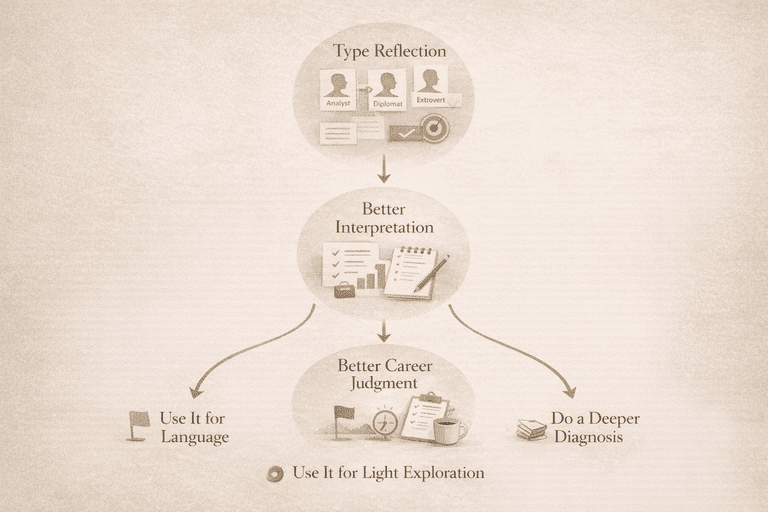
The best way to use 16Personalities career advice is to treat it as a structured reflection prompt, not a recommendation engine you should obey.
A better sequence looks like this:
- use the type description to identify broad work-style themes that feel genuinely true
- separate those themes from the aesthetic appeal of the type label
- compare those themes against your interests, current-role pain, and real constraints
- pressure-test any suggested careers for distance, feasibility, and adjacent overlap
- only then use the result as one input into a larger decision
The wrong sequence is:
- take the test
- identify with the type
- assume the matching careers are the answer
That is how a reflective tool turns into an overconfident one.
Final Answer
16Personalities career matches get something important right: personality can help explain why certain environments, demands, and role styles feel more natural than others. The site is clearer than many type-based products about its framework, and its career pages are often genuinely useful for broad reflection.
Where it goes wrong is in the leap from personality pattern to career decision. Personality is only one part of career fit, type buckets are too coarse for harder decisions, and the system does not really diagnose current-role problems or transition realism.
So the right review is: use it for reflection, not for verdicts.

References
[1] 16Personalities. Our Framework.
[2] 16Personalities. Career Paths | ENFJ Personality (Protagonist).
[3] 16Personalities. Premium Career Suite.
[4] Larson, L. M., Rottinghaus, P. J., & Borgen, F. H. (2002). Meta-analyses of Big Six interests and Big Five personality factors. Journal of Vocational Behavior, 61(2), 217-239.
[5] Stoll, Gundula, et al. Vocational Interests Assessed at the End of High School Predict Life Outcomes Assessed 10 Years Later Over and Above IQ and Big Five Personality Traits. Journal of Personality and Social Psychology, 2017.
[6] Pittenger, D. J. (2005). Cautionary comments regarding the Myers-Briggs Type Indicator. Consulting Psychology Journal: Practice and Research, 57(3), 210-221.
[7] Morgeson, Frederick P., et al. Reconsidering the Use of Personality Tests in Personnel Selection Contexts. Personnel Psychology, 2007.
[8] 16Personalities. Strength of Individual Traits.
Get A Clearer Career Signal
Take the assessment to see what fits, what feels off, and which roles are more likely to suit you.

Builds CareerMeasure hands on and writes about career fit, role transitions, and the gap between generic personality advice and evidence-based career decisions.
Community Discussion
Share your thoughts about this article
Delete Comment?
Are you sure you want to delete this comment? This action cannot be undone.